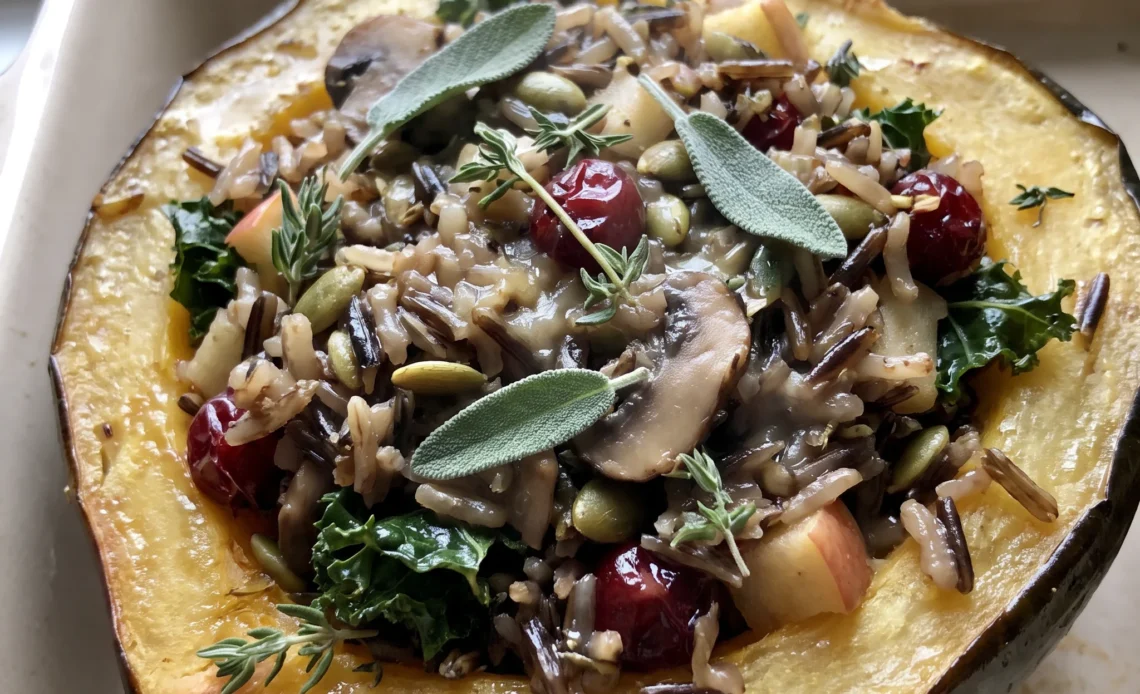
Getting the squash to hold its shape matters more than any single ingredient here, and that’s decided before the filling ever goes in. Roast it cut-side down and it firms into a vessel; roast it past tender and the walls slump the moment you spoon in the rice.
The wild rice is the other quiet test. It stays springy even after it soaks up broth, so the stuffing keeps distinct grains instead of collapsing into a paste, which is what makes this vegan stuffed acorn squash feel like a full meal rather than a side. The margin is real but forgiving.
Mushrooms that brown before the kale and apple go in taste deeper, and a stuffing seasoned slightly bold tastes right against the mild flesh. Overfill the cavity and you’ll fight it at the table.
Wild Rice Brings the Chew
Wild rice doesn’t soften into a porridge the way white rice or quinoa can. Even after it drinks up all that broth, each grain keeps a firm, springy bite. That chew is what gives the stuffing its backbone.
When you pack it into a roasted squash half, the grains stay separate and distinct, not a pasty lump. The contrast matters: the squash flesh is silky and yielding, the sautéed mushrooms and kale are tender, but the rice pushes back.
Without that resistance, the whole filling would collapse into a uniform texture, and you’d lose the pleasure of eating through different consistencies in one forkful. So when you mix the cooked rice with the vegetables, you’re not just adding bulk. You’re adding structure.
Spoon it into the cavity and the rice holds its shape, letting the squash cradle a filling that feels substantial, not sodden. That’s why wild rice is the right grain here, and why a softer one would let the dish down.
Build Flavor in Stages
Start with shallots and garlic in hot oil. They hit the pan first because they need time to brown and sweeten, and that browning is where the base flavor comes from. Once they’re caramelized, push them aside and add the mushrooms.
They’ll release their liquid, then start to brown and crisp at the edges. That’s the umami moment.
If you added everything at once, the mushrooms would steam instead of sear, and the shallots would turn soft without color. After the mushrooms darken, in go the kale and apples.
They only need a few minutes, just until the kale wilts and the apples soften slightly. Any longer and the apples lose their bite, the kale goes limp. So the order isn’t arbitrary.
It’s about giving each vegetable the heat it needs to become its best self. The result is a skillet full of distinct textures and deep, layered flavor that will season the rice without any additional sauce.
Apple and Cranberries Balance the Bowl
Wild rice and mushrooms taste earthy, almost woodsy. That’s good, but on its own it can feel heavy and one-note.
The chopped apple fixes that. As it cooks, it releases juice that moistens the stuffing, and its gentle sweetness cuts through the oil and the rice’s nuttiness. Dried cranberries do something similar but with a tart chew that pops against the soft vegetables.
Together they keep each bite lively. Without them, the filling would taste flat, like a bowl of grains and greens that needs a lift.
You don’t need much: a single apple and a small handful of cranberries are enough to shift the balance. When you taste the finished stuffing, you’ll notice how the sweet-tart notes push back against the savory depth.
That interplay is what makes the dish feel complete, not just healthy. So don’t skip them, and don’t substitute something else that lacks that bright edge.
Why Cut-Side Down Works
Place the squash halves cut-side down on the baking sheet. This orientation does two things. First, the exposed flesh sits against the hot pan, so it caramelizes and browns while the rest of the squash steams in its own moisture.
That gives you tender flesh with a bit of roasted flavor. Second, the cavity faces the pan, so any liquid that releases drains away instead of pooling inside.
If you roasted them cut-side up, the hollow would fill with juices and the flesh would turn soggy, too soft to hold a stuffing. Cut-side down, the squash keeps its shape and firms up just enough to act as a bowl.
When you flip them over after roasting, you’ll see a dry, golden interior ready to be filled. The natural curve of the squash half becomes a sturdy vessel, and the flesh stays intact when you spoon in the wild rice mixture.
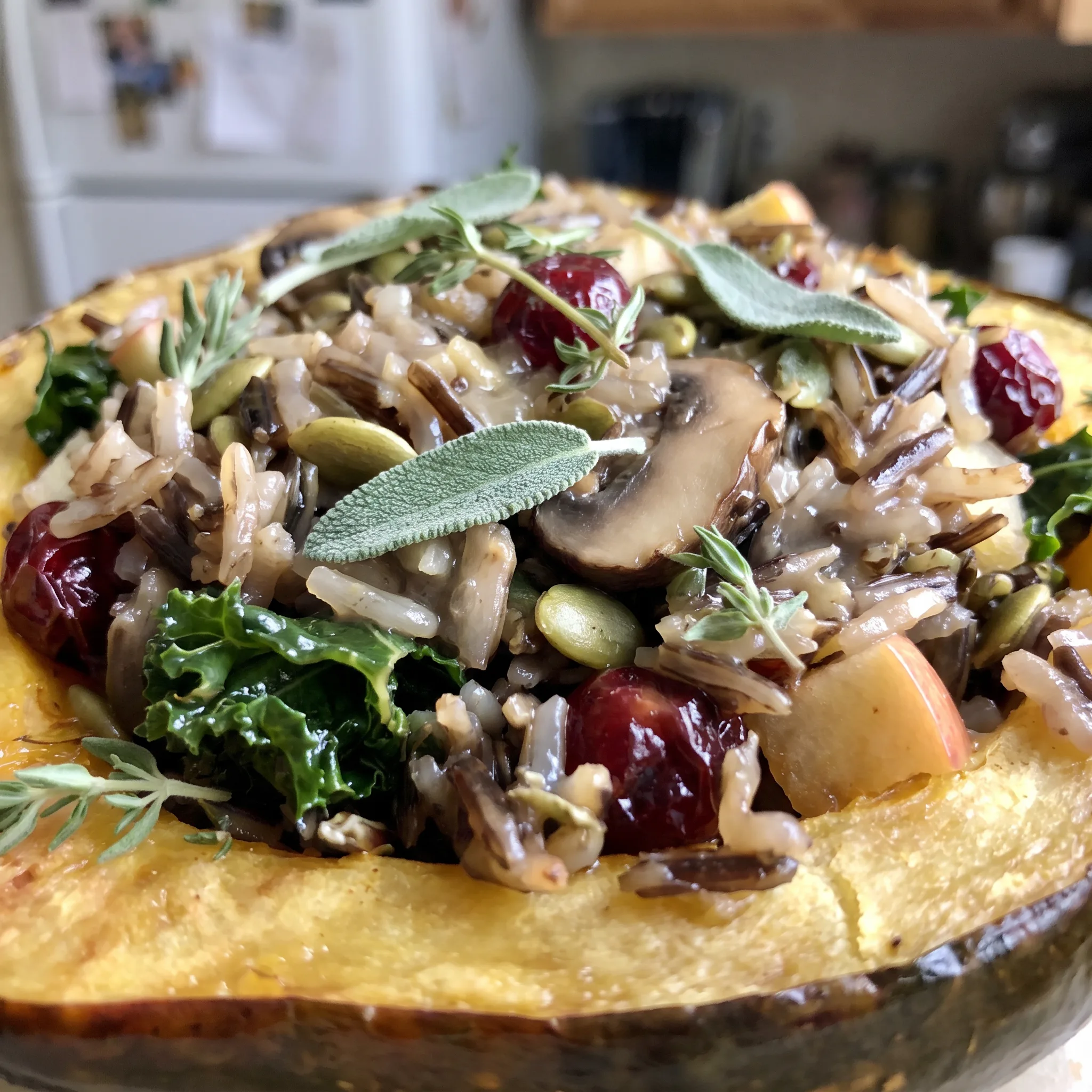
Pick Ingredients That Hold Up in a Stuffed Squash
Acorn squash: Choose ones with a firm, unblemished rind and no soft spots, since each half has to stay intact as a bowl.
Wild rice: Buy true wild rice, the long dark grains, not a quick-cooking blend that softens and loses its chew.
Vegetable broth: Use one you’d drink on its own, because the rice absorbs it straight and a weak broth leaves the grains tasting thin.
Mushrooms: Cremini or button work well, and they should be dry to the touch so they brown instead of steaming in the pan.
Sweet red apple: A crisp, tart-sweet variety holds its shape and keeps some bite once it hits the skillet with the kale.
Pepitas: Raw green pumpkin seeds, not the roasted salted snack kind, so they add crunch without throwing off the seasoning.
When mushrooms, kale, and apples are sautéed past the point of browning and wilting, they release their cellular water into the pan. If that moisture is not cooked off, the stuffing will weep inside the roasted squash, turning the cavity soggy and the rice mushy. The visual cue is a wet, glossy pan bottom instead of a dry, browned surface; once the vegetables are swimming, it is too late to recover without draining and re-browning.
Judging the Squash, the Rice, and the Stuffing as You Go
Knowing when the squash is truly tender
At 40 minutes, check doneness by pressing the outside of a squash half with your thumb. The skin should give slightly, and a knife should slide through the flesh with almost no resistance.
If it’s still firm, give it another 5 minutes. Over-roasting makes the flesh collapse when you stuff it, so pull it as soon as it’s tender. The squash needs to hold its shape to act as a bowl.
Reading the wild rice: chewy, not crunchy
Wild rice is done when the grains have split open and the inside is tender but still chewy. Bite one: if it’s chalky or hard in the center, it needs more time.
If it’s soft and mushy, you’ve overcooked it. Start checking at 40 minutes.
The rice should retain a slight resistance, like al dente pasta. Drain any excess liquid if it hasn’t absorbed after 45 minutes.
The moment mushrooms stop steaming and start browning
Mushrooms release a lot of water when they hit the pan. At first, they’ll look wet and shrink.
Let that liquid cook off. The moment they start to squeak against the pan and their edges turn dark brown, they’re ready. If you add the kale and apples before that, the mushrooms steam instead of sear, and you lose the deep flavor that makes the stuffing taste rich.
Tasting the stuffing before it goes into the squash
Once the rice, pepitas, and cranberries are mixed in, taste a spoonful. The seasoning should be a little stronger than you think, because the mild squash will dilute it.
If it tastes flat, add another pinch of salt. If the apple and cranberries don’t come through, a squeeze of lemon or a splash of vinegar can wake it up.
Adjust now, not after stuffing.
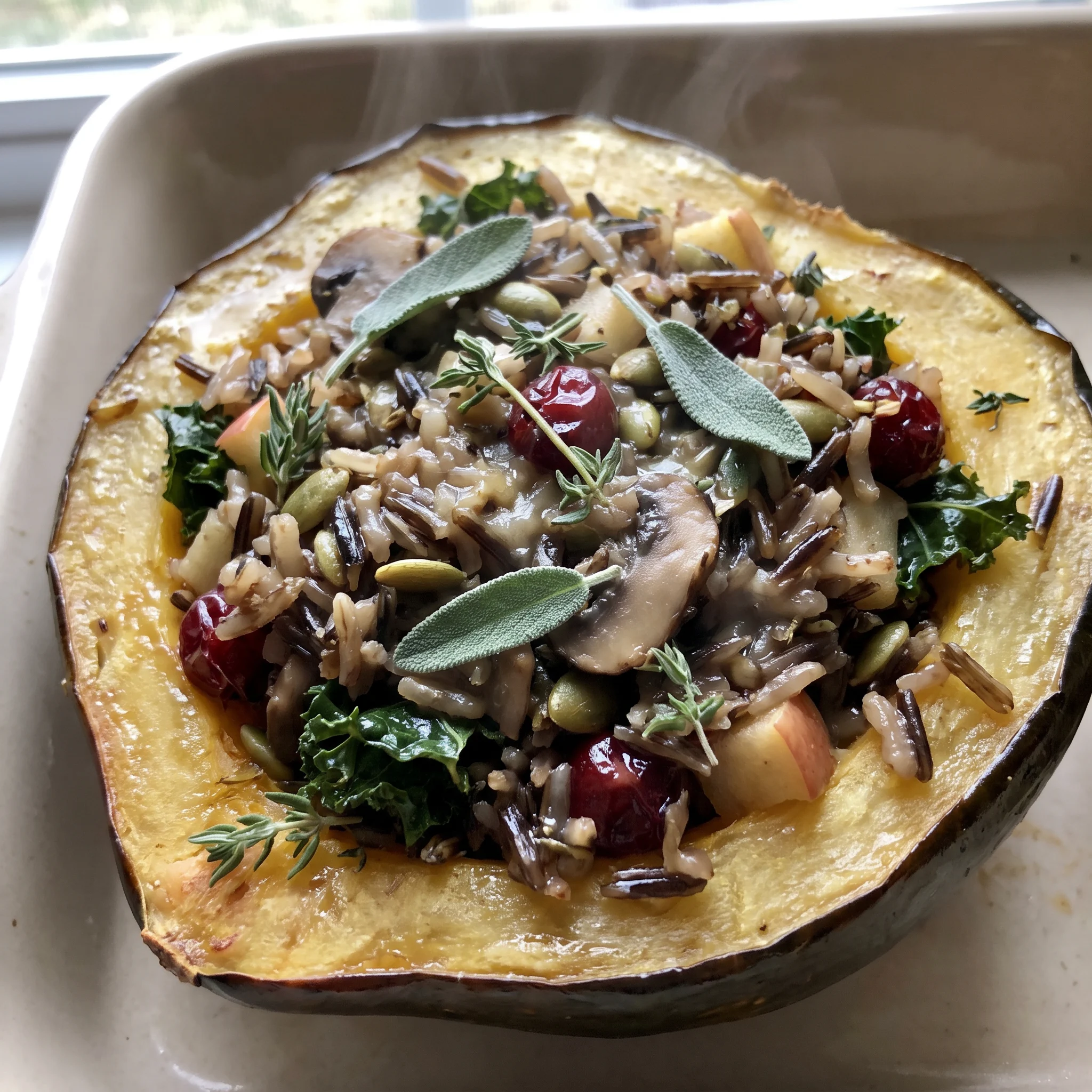
Vegan Wild Rice Stuffed Acorn Squash
Ingredients
Method
- Set oven to 400F. Rinse the acorn squash, cut each one in half lengthwise from stem to tip, and scoop out the seeds and fibrous interior. Place the squash halves on a parchment-lined baking sheet, then rub them with olive oil, salt, and pepper to season. Turn them cut-side down so the flesh faces the pan, and transfer to the oven to roast for 40-45 minutes until fully tender. When done, turn them over and set aside for stuffing.
- While the squash roasts, combine the wild rice and vegetable broth in a small pot and stir. Put on the lid, set over heat, and bring to a boil. After boiling, lower the heat to a gentle simmer and cook for 40-45 minutes until done. Properly cooked wild rice will be chewy yet tender.
- As the squash and rice cook, prepare the filling. First chop the shallots, garlic, mushrooms, apples, and kale. Then pour 2 Tbsp olive oil into a large skillet and warm over medium heat.
- When the oil is hot, add the shallots and garlic and sauté for 3 minutes until they start to brown and caramelize. Then add the chopped mushrooms, stir, and cook for another 5 minutes until the mushrooms begin to brown and crisp.
- After that, add the chopped kale, chopped apples, salt, and pepper. Stir and sauté with the other ingredients over low heat for another 2-3 minutes until the kale wilts and the apples soften slightly.
- Then turn off the heat and stir in the pepitas, dried cranberries, cooked wild rice, fresh thyme, and fresh sage. Mix well and adjust salt and pepper to taste.
- Stuff each roasted acorn squash half with the wild rice mixture. Garnish with more fresh sage and thyme and serve hot. Enjoy!
Swap the Broth and Nuts, but Leave the Wild Rice and Squash Alone
Vegetable broth: Mushroom broth or mushroom stock. The rice absorbs the broth straight, so the swap changes the foundation of the stuffing. Mushroom broth deepens the earthy note that the sautéed mushrooms already bring, making the whole dish taste more woodsy.
Start with the same 1 1/2 cups the recipe uses and adjust to taste after the rice cooks; if the broth is salty, hold back on added salt until you taste the finished stuffing.
Dried cranberries: Pepitas, using the same 1/4 cup measure. You lose the tart chew that cuts through the earthy rice and mushrooms. Pepitas add crunch and a mild nuttiness, so the stuffing becomes less sweet and more savory.
The texture shift is noticeable: each bite is crisper, and the apple now carries all the sweetness. If you want a hint of tartness without dried fruit, a squeeze of lemon at the end can bring back some brightness.
Wild rice: No swap recommended. The long dark grains keep a firm, springy bite even after they soak up broth, and that chew is what holds the stuffing together inside the squash.
A softer grain like white rice or quinoa turns pasty and collapses under the weight of the filling. If you must use a different grain, expect a softer, denser result and adjust the liquid and cooking time by checking doneness early, but the dish won’t have the same backbone.
Acorn squash: No swap recommended. The squash half is the bowl itself. Its flesh roasts to a silky tenderness that contrasts with the chewy rice, and its natural curve cradles the stuffing without falling apart.
A different squash, like butternut, has a different shape and moisture level, so it won’t hold the filling the same way and may turn soggy or collapse. Keep acorn squash for this recipe.
Storing and Reheating Stuffed Squash
These squash halves are at their best within 20 minutes of stuffing, while the top of the rice is still crisp and the squash flesh is warm and yielding. Leave them out longer and the filling starts pulling moisture from the squash, which softens the pepitas and dulls the contrast you built in the skillet.
For leftovers, refrigerate the stuffed halves in a sealed container for up to 3 days. The wild rice absorbs liquid as it sits, so by day two the stuffing tastes softer and less distinct, and the squash releases water into the cavity.
That’s expected. Reheat uncovered at 400F for 10 to 12 minutes, until the top of the rice recrisps and the squash is hot through. A microwave will warm it but leave the filling dense and wet, so skip it.
Freeze only the stuffing, not the assembled squash. The squash’s high water content breaks down in the freezer and turns spongy on thawing. Pack the rice mixture flat in a bag for up to 2 months, thaw overnight in the fridge, then reheat in a skillet before spooning into freshly roasted squash halves.
Add the fresh thyme and sage garnish after reheating, never before. Heat wilts the herbs and turns them dark.
Tips
- Pick squash that feel heavy for their size with a matte, unshiny rind. A glossy skin usually means the squash was picked early, before the starches converted to sugar, and those halves roast up stringy instead of tender. Since each half has to hold the wild rice stuffing without collapsing, a dense, heavy squash also gives you thicker walls that keep their shape.
- If your squash halves wobble on the baking sheet because the rounded sides won’t sit flat, slice a thin sliver off the bottom of each half before roasting. This gives the roasted half a stable base, so when you spoon in the wild rice mixture it stays upright on the plate instead of tipping and spilling the filling.
Frequently Asked Questions
Can I make this vegan wild rice stuffed acorn squash ahead of time?
Yes, but split the work. Cook the wild rice and make the stuffing up to 3 days ahead, then refrigerate it in a sealed container.
Roast the squash and stuff it the day you serve, so the halves stay firm and the pepitas keep their crunch. If you assemble the whole thing ahead, the squash will release water into the cavity and the rice will absorb it, leaving the stuffing dense and soft.
Reheat the stuffing in a skillet before spooning it in, and add the fresh herbs after, not before.
Why is my stuffed acorn squash watery?
The squash most likely released its own liquid into the cavity after roasting. If you piled the stuffing in while the halves were still hot, or if you let them sit stuffed for more than 20 minutes, that moisture has nowhere to go but into the rice.
Roast the squash cut-side down so the juices drain away, and flip them over only once they’re tender. Another cause is undercooked mushrooms. If they didn’t get dark and crisp in the skillet, they’ll keep sweating inside the squash and make the filling wet.
Sauté until their edges brown and they squeak against the pan before you mix in the rice.
How is this different from traditional sausage-stuffed acorn squash?
The biggest difference is the texture. Traditional versions often use bread cubes or a soft grain, which turn pasty and collapse under the squash.
Here, wild rice stays chewy and separate, so each forkful has a springy bite against the silky squash. The flavor base is also different: shallots, garlic, and mushrooms build a savory, woodsy depth instead of the fennel and pork fat of sausage.
Apple and dried cranberries add sweet-tart notes that cut through the oil and earthiness, keeping the stuffing lively rather than heavy.
