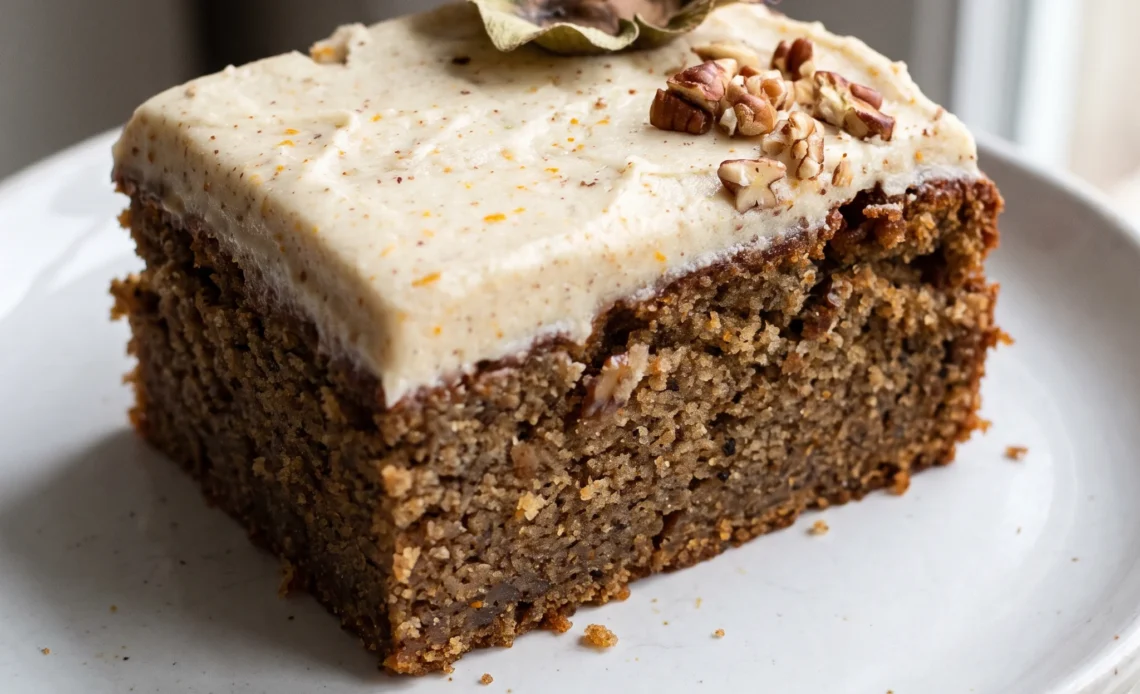
A ripe hachiya smells faintly of apricot and honey before you even cut it, and the puree that goes into this persimmon cake carries that same soft, floral sweetness straight into the crumb. What you get back is a bar that stays tender for days, moister than most spice cakes, with a faint orange perfume riding on top. The catch is ripeness.
An underripe persimmon leaves a drying, puckery coating on your tongue and gums, and baking does nothing to tame it, so the fruit has to be slack and heavy before it ever hits the bowl. Browned butter frosting gives the whole thing a nutty bass note underneath all that fruit, though getting that butter to the right texture takes some patience. Make it when persimmons are at their peak, not after.
Browning butter drives off water and browns milk solids, creating nutty flavor compounds, but the melted fat must be recrystallized to a softened state so it can trap air and form a smooth emulsion with powdered sugar and orange juice. If the butter is too warm, the frosting stays liquid and greasy; if too cold, it seizes into hard lumps that never blend smoothly.
Pick Persimmons That Are Soft Ripe
Persimmon puree carries this cake. Use hachiya persimmons so soft they feel like water balloons, or another astringent variety at that same stage. An underripe one tastes puckery and leaves a dry, furry coating on your tongue and gums that no amount of sugar hides.
That mouthfeel comes from tannins, and it survives baking. Ripe fruit goes the other way: sweet, mild, almost floral, with enough moisture that the crumb stays tender for days.
When you puree the flesh, push it through a sieve if you feel any strings or fiber, because those bits stay distinct in the baked cake. A smooth puree also blends evenly into the wet ingredients, so the orange zest distributes instead of clumping. You can taste a spoonful raw to check.
If it makes your mouth feel tight or dry, don’t bake with it. Wait a day or two on the counter, until the skin slips and the fruit feels heavy and slack.
Browned Butter Needs to Cool Just Right
Browning butter for the frosting isn’t optional garnish. The heat drives off water and toasts the milk solids, and what’s left tastes deep and nutty, almost like toasted hazelnut. That flavor sits well against sweet persimmon and sharp orange, giving the frosting a bass note instead of straight powdered-sugar sweetness.
But timing matters as much as color. The butter has to come back to the texture of softened butter before you beat it with the sugar and liquids. Too warm and the frosting turns soupy and never firms up, no matter how long you whip.
Too cold and it stays in hard flecks that won’t blend, leaving a greasy, separated mess. I’ve learned to start the butter as soon as the cake goes in the oven, then let it sit while the cake bakes and cools.
By the time the bars are ready, it’s usually right. If it’s still liquid, give it a few minutes in the fridge, checking often.
It should yield to a spoon with slight resistance, like room-temperature butter.
How Wet Ingredients Shape the Crumb
Persimmon puree brings a lot of water to this batter, and that’s mostly why the cake stays tender for days. Oil keeps it that way too, since it coats the flour proteins and slows their linking.
Milk adds more liquid and some richness. Together they make a loose, pourable batter, not a stiff one. The danger starts when you add the dry ingredients.
Stir just until you see no dry streaks, then stop. Every extra stroke develops gluten, and gluten makes the cake tough and rubbery, especially once the puree has already weakened the structure. You want a batter that falls off the spatula in a slow ribbon, not one you have to coax.
A few small lumps are fine. Pour it into the pan and smooth the top quickly; the longer it sits, the more the leaveners start working before the oven. The baked cake should feel soft and springy under a light press, with a crumb that holds together but never feels heavy.
Orange Is a Bright Note, Not the Lead
Zest in the batter gives a faint citrus perfume that lifts the persimmon without shouting. You notice it more on the finish than the first bite.
In the frosting, both zest and juice add tang and cut through the powdered sugar and brown butter, so each swipe tastes a little fresher. But orange can easily take over. Too much zest and the cake reads as orange cake with persimmon somewhere in the background, which isn’t what you want.
The juice also brings acid, and acid affects how the frosting sets. A full tablespoon is about right for this amount of sugar and dairy; more and the frosting turns loose and weepy, no matter how long you beat it.
If you taste the finished frosting and the orange feels sharp, a pinch more sugar balances it. The goal is a frosting that tastes rich and nutty first, then orange, then sweet. Persimmon should still come through in the cake itself, so keep the citrus restrained.
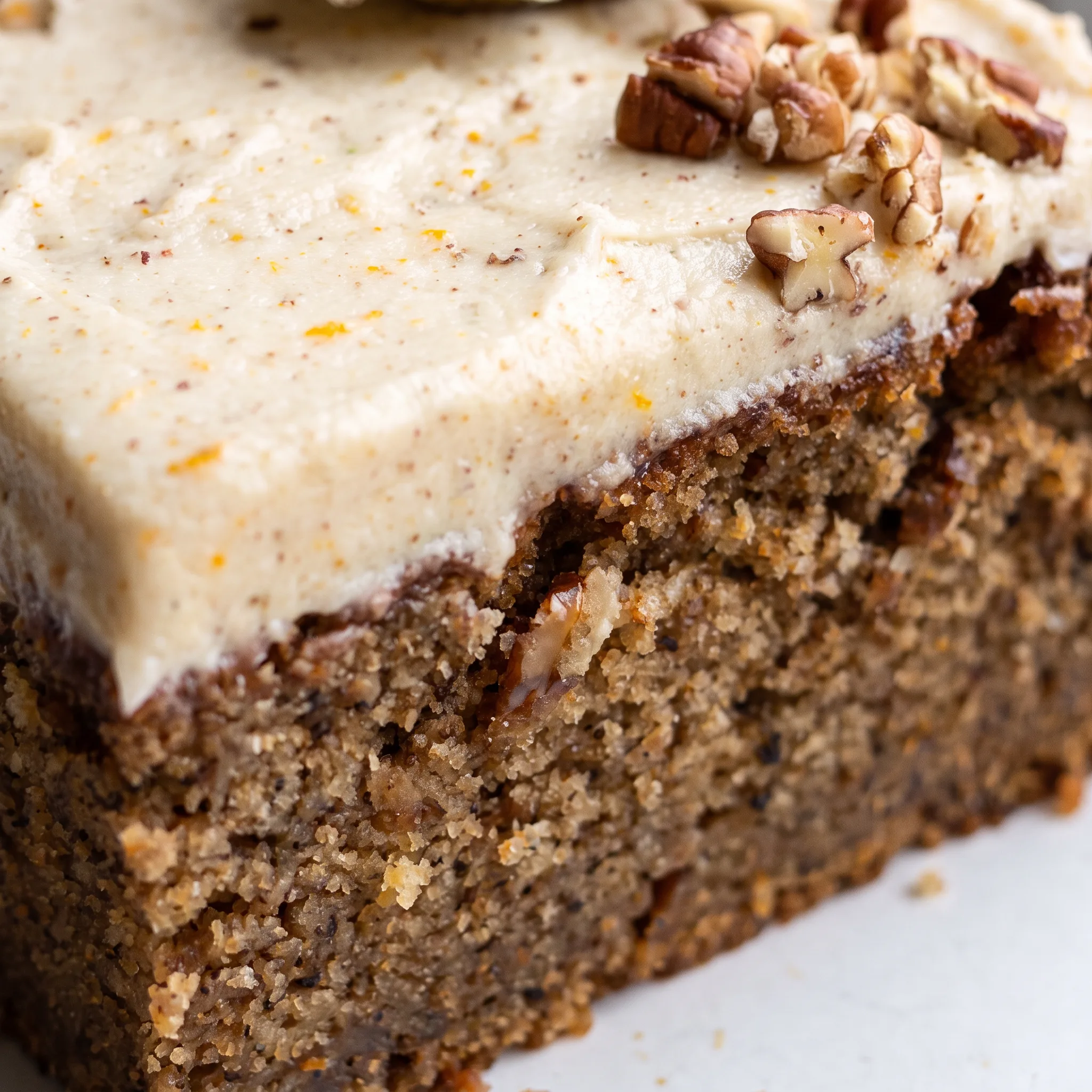
The Ingredients That Make or Break This Cake
Hachiya persimmons: Use very soft, ripe ones for the 1 cup puree; an underripe fruit leaves a drying, puckery coating that baking won’t erase.
Olive oil: The 1/2 cup keeps the crumb tender for days, so use one you like the taste of since it carries the persimmon.
Orange zest: The 1 tablespoon in the batter and 1 teaspoon in the frosting adds a faint perfume, but too much turns this into orange cake.
Unsalted butter: Brown the full stick for the frosting until it smells nutty and turns deep amber, then let it cool to soft-butter texture.
Powdered sugar: Sift the 1 1/2 cups before beating so the frosting turns smooth instead of lumpy against the brown butter.
Judging the Batter, the Crumb, and the Frosting
The batter should fall in a slow ribbon
After folding the dry ingredients in, lift the spatula. The batter should drop off in a thick, slow ribbon that piles on itself for a second before sinking. If it pours fast and thin, you’ve stirred too long and the gluten has developed.
Stop immediately. A few lumps are fine.
Pour it into the pan right away; the leaveners start working as soon as they’re wet, and a batter that sits loses lift.
The center should spring back and smell like spice
At 30 minutes, open the oven and press the center lightly. It should feel firm and springy, not leave an indentation. A toothpick should come out with a few moist crumbs, not wet batter.
If the top is browning too fast, tent it with foil. Overbaking dries the crumb and mutes the persimmon. Underbaking leaves a gummy center that no frosting hides.
Browned butter must cool to the feel of soft butter
When you finish browning the butter, it’s dark amber and smells nutty. It must cool until it’s the texture of softened butter, not warm liquid.
Touch it: it should yield to a spoon with slight resistance, like room-temperature butter. If it’s still liquid, the frosting will be soupy. If it’s hard, it won’t blend.
Chill it briefly if needed, checking every minute.
The frosting should hold a soft peak
After beating the frosting, lift the beaters. The frosting should hold a soft peak that droops slightly, not run off in a stream.
If it’s too loose, the butter was too warm or you added too much juice. Chill the bowl for a few minutes and beat again. If it’s too stiff, a teaspoon of milk loosens it.
Taste it: rich and nutty first, then orange, then sweet.
Spread the frosting when the cake is completely cool
The cake must be completely cool before you frost it. Touch the bottom of the pan; it should feel neither warm nor cool, just room temperature.
If you frost a warm cake, the frosting melts and slides off. Once cooled, spread it evenly.
The frosting should be thick enough to hold a swirl but soft enough to spread without tearing the cake.
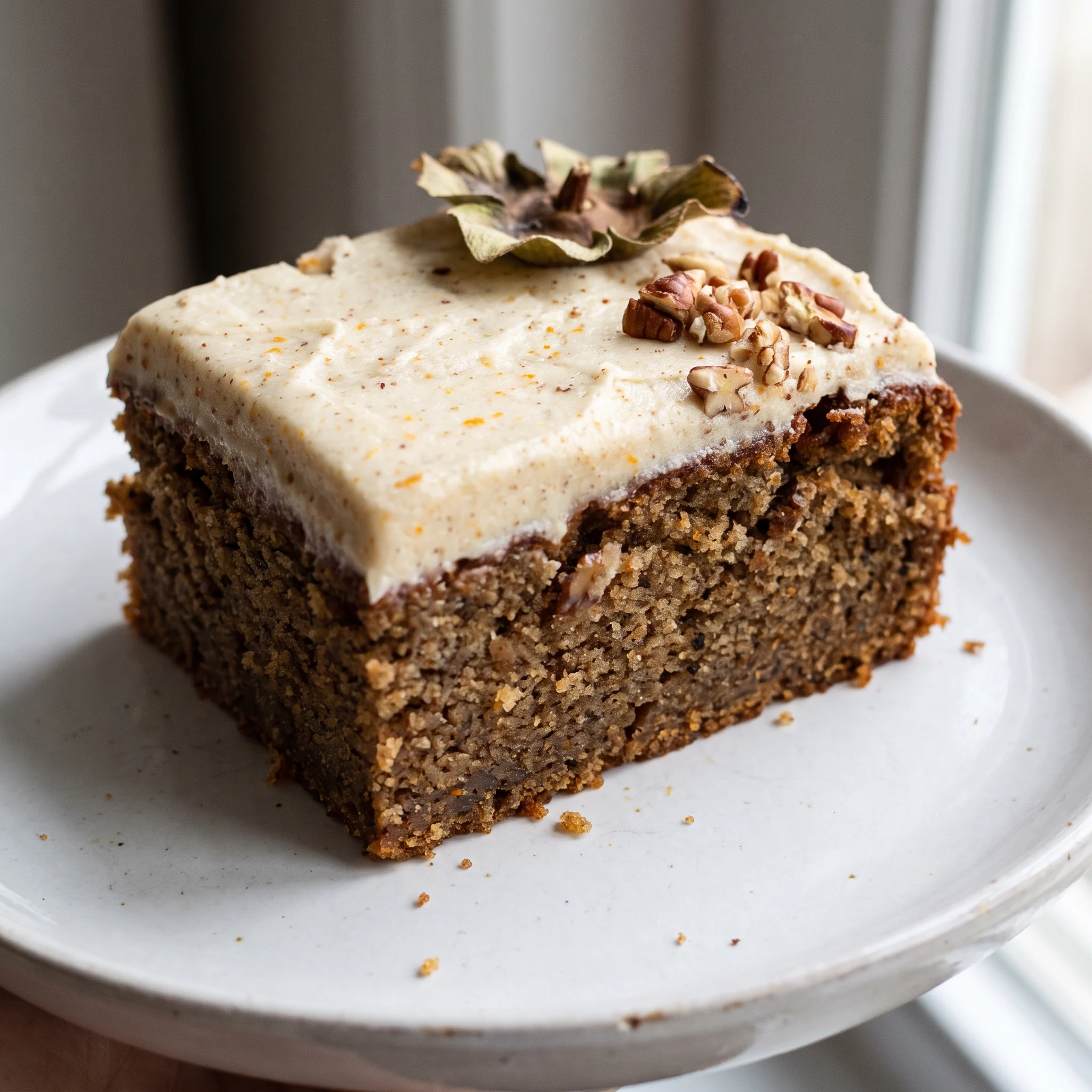
Persimmon Cake with Brown Butter Orange Frosting
Ingredients
Method
- Set oven to 350°F (175°C). Mist an 8×8-inch square baking pan with cooking spray and leave aside.
- In a medium bowl, combine flour, baking powder, baking soda, cinnamon, and salt by whisking. Leave aside.
- In a large bowl, vigorously whisk eggs, sugar, and oil until frothy, about 30 seconds.
- Incorporate persimmon puree, milk, orange zest, and vanilla extract, whisking until thoroughly blended.
- Fold dry ingredients into wet ingredients, stirring only until just combined, then transfer batter to the prepared pan and smooth the top.
- Bake for 30–35 minutes, or until the center is puffed and a toothpick inserted into the center comes out clean. Allow to cool completely on a wire rack.
- As the cake bakes, brown the butter: melt butter in a small saucepan over low heat. Raise heat to medium and continue cooking until butter has browned and smells nutty, about 5–10 minutes. Transfer butter to a medium bowl and let it solidify to the texture of softened butter before making the frosting.
- To the browned butter, add powdered sugar, orange zest, juice, milk or cream, and vanilla, then beat with a hand mixer on medium speed until smooth and creamy.
- Once the bars have cooled, spread frosting evenly over the top and, if desired, garnish with persimmon collars and toasted pecans. Slice into 16 squares and serve!
What to Swap and What to Leave Alone in This Persimmon Cake
Persimmon puree: Canned pumpkin puree or unsweetened applesauce, in the same 1 cup measure. Both bring similar moisture, so the crumb stays tender. Pumpkin tastes earthier and mutes the orange zest; applesauce is sweeter and thinner, so the cake may bake a few minutes faster.
The texture will be a bit less silky than with ripe hachiya, but still good. If using applesauce, reduce the milk by a tablespoon to keep the batter from getting too loose.
Olive oil: Any neutral oil, like grapeseed or canola, or melted coconut oil. Olive oil’s flavor is noticeable here, so a neutral oil lets the persimmon and orange come forward more plainly, which some prefer. Melted coconut oil adds a faint coconut taste and firms up when cold, so the cake may feel slightly drier straight from the fridge.
Use the same 1/2 cup. Don’t swap in butter; it solidifies and makes the crumb tighter.
Milk: Any non-dairy milk, such as oat, almond, or soy. The cake doesn’t depend on dairy for structure, so these work fine.
Oat milk adds a slight sweetness; unsweetened almond is thinner and may make the batter a touch runnier, but it bakes up the same. Use the same 3/4 cup. For the frosting, cream or whole milk gives the richest result; a thin non-dairy milk can make it looser, so add it a teaspoon at a time until the frosting holds a soft peak.
All-purpose flour: A 1-to-1 gluten-free flour blend. These blends vary widely.
Some contain xanthan gum and behave like all-purpose; others don’t, and the cake can turn crumbly. Start with the same 1 3/4 cups, but if the batter looks dry after mixing, add milk a tablespoon at a time until it falls in a slow ribbon.
The baked cake will be a bit more fragile, so cool it completely before frosting.
Tips
- For this wet, fruit-heavy batter, don’t rely on the toothpick alone. Press the center of the cake with a fingertip at 30 minutes: it should feel set and spring back, and the top should look matte rather than wet or shiny. A toothpick can slide through the puree and come out clean while the middle is still underdone, so the fingertip test tells you whether the structure has set. If the center still feels soft or springs back slowly, give it 3 to 5 more minutes and check again.
- Because the persimmon puree, oil, and milk keep this crumb so moist, the cake can look done while the very center is still gummy. Slide a thin knife or skewer into the center and look at what clings to it: a few moist crumbs are fine, but a smear of wet batter means it needs more time. Then check the internal temperature with an instant-read thermometer. This cake is done when the center reads about 200°F to 205°F, and that number is more reliable than any visual cue in a batter this wet. Pull it at 200°F for the softest crumb, and cool it completely in the pan before frosting.
Storage and Serving: How the Bars Hold
Frosted, these bars keep in the fridge for 3 to 4 days, in a single layer in a lidded container with parchment between any stacked rows. The brown butter frosting firms up cold, so it won’t weep or slide, but it will stiffen. Let a square sit out 15 to 20 minutes before eating; the frosting softens back to spreadable and the crumb relaxes.
Eat within the first two days for the best texture, when the crumb is still tender and the orange zest reads clearly. Cut squares dry out fast at the exposed edges, so press plastic wrap directly onto the frosting before lidding, and slice only what you’re serving.
Freeze the unfrosted cake only, wrapped tight, up to 2 months; thaw at room temperature, then make the brown butter frosting fresh, since it doesn’t freeze well. Add any persimmon collars or pecans right before serving, or they soften against the frosting. Cold mutes both the persimmon and the orange, so never serve these straight from the fridge.

Frequently Asked Questions
Can I make persimmon cake ahead of time?
Bake the cake a day before you plan to serve it, keep it wrapped tight at room temperature, and make the brown butter frosting fresh the day you frost. The crumb actually improves overnight, since the persimmon puree and oil have more time to settle in and the spice reads rounder. Frosted bars then hold in the fridge for 3 to 4 days in a single layer, parchment between stacked rows.
Press plastic wrap right onto the frosting before lidding, and pull a square out 15 to 20 minutes before eating so the cold doesn’t mute the persimmon and orange.
Why did my persimmon cake turn out gummy?
Overmixing is the usual culprit. Once the dry ingredients go in, every extra stroke works the flour, and with a cup of persimmon puree already loosening the batter there’s little structure to spare, so it bakes up tight and rubbery rather than tender.
Stir only until no dry streaks remain, lumps and all. If your mixing was minimal, check the bake: the center should spring back under a light press and a toothpick should come out with a few moist crumbs, not wet batter.
A gummy middle that tastes raw means it needed longer, and tenting with foil keeps the top from darkening while the center finishes.
How is persimmon cake different from carrot cake?
Persimmon puree brings more water and less texture than grated carrot, so this cake bakes up silkier and softer, closer to a spice cake than the nubby crumb carrot cake gets from all that shredded vegetable. Carrot cake leans on cream cheese frosting for tang; here the frosting is browned butter, nutty and deep, with orange zest and juice cutting the powdered sugar. Persimmon also tastes floral and mild where carrot tastes earthy and sweet.
The orange in this recipe is a background note, not the lead, so the fruit still comes through on its own.
