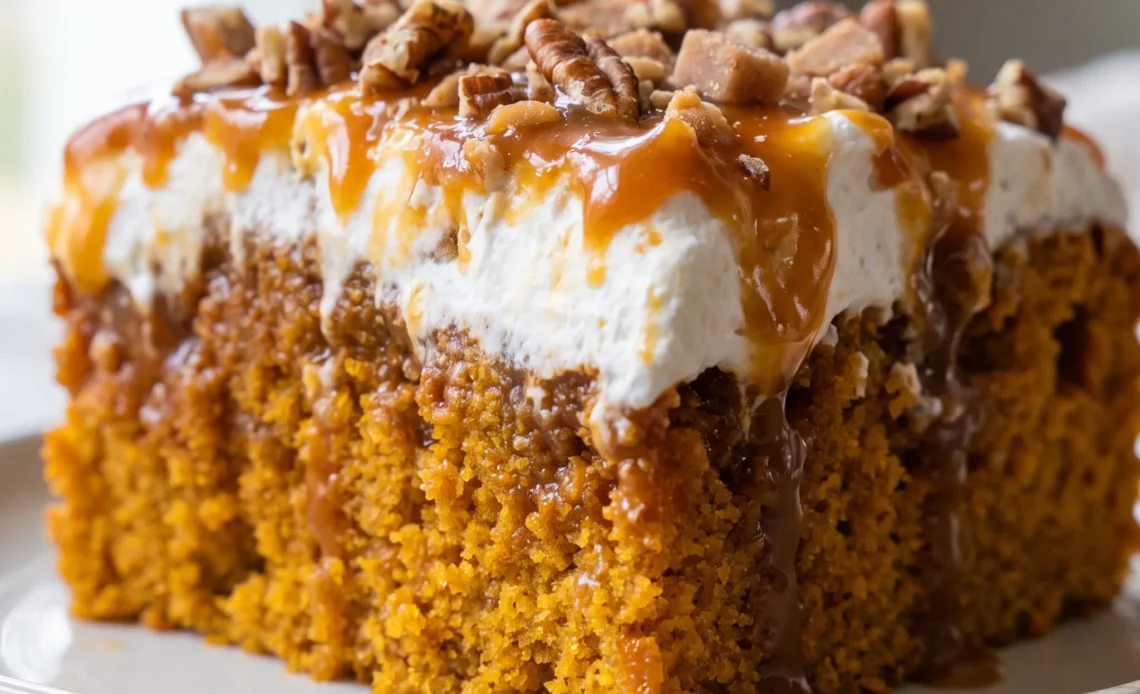
Almost everyone pours the soak over a cake that came out of the oven an hour ago, then wonders why the caramel sits on the surface like syrup in a bowl. A fully cooled crumb holds a clean hole; a warm one smears and closes back up, and the soak rides the top instead of dropping in. That window between baking and pouring is where this caramel pumpkin poke cake is won or lost, and it’s forgiving if you read it right.
Once the caramel sets, the texture turns even from edge to center, dense and sticky in a way that a boxed yellow mix could never manage on its own. Pumpkin keeps the crumb tender enough to drink it all in.
The most common mistake is pouring the caramel soak over the cake while it is still hot. At that point the crumb is soft and the holes are surrounded by steam, so the soak rushes down and pools at the bottom rather than being drawn into the cake structure, leaving a soggy layer and a collapsed center. Allowing the cake to cool briefly first firms the crumb just enough that the viscous caramel-condensed milk mixture clings to the walls of the holes and is absorbed gradually, which is what gives the cake its even, moist texture.
Why Poking Holes Works
A pumpkin cake from a mix bakes up tender but tight. Its crumb holds together, which is good for slicing but bad for soaking: liquid sits on top and turns the surface to paste. Poking holes changes that.
Each hole is a channel, and the caramel mixture follows it down through the cake instead of pooling. The cake’s structure does the rest.
A crumb that’s open enough to absorb but strong enough to stay put means the soak spreads evenly rather than collecting in one spot. Warm cake helps, too.
As it sits, the caramel thickens and the cake drinks in what it can. By the time it’s cold, the liquid is no longer liquid. The texture turns even from edge to center, and a fork cuts through without a puddle underneath.
That’s what separates a soaked cake from a soggy one.
Two Ingredients, One Soak
Sweetened condensed milk and caramel sauce do different jobs. Condensed milk is thick and milky sweet, and it carries the caramel into the cake without making it runny. Caramel sauce alone would taste flat and one-note, and it would slide right off.
Together they hit the right consistency: loose enough to seep into the holes, thick enough to cling to the crumb. That balance matters. Too thin, and the cake turns to pudding at the bottom.
Too thick, and it never gets past the surface. Pouring while the cake is still warm gives the mixture a head start.
The heat thins it slightly and opens the crumb, so it travels farther with less coaxing. Once it cools, the soak sets to a soft, sticky layer that stays where it landed. Each bite carries the same amount of caramel, which is the whole point of a poke cake.
The Topping Isn’t Just Decoration
After the soak, the cake is dense and wet. Whipped topping cuts that. It’s light and airy, and it sits on top like a cloud, so your fork meets less resistance before it hits the cake.
Toffee bits and pecans add the crunch the base lacks. Without them, every bite would be soft and sweet with nothing to break it up.
The bits stay crisp for a while because they’re scattered on top, not folded in, and the whipped topping keeps them away from the moisture below. A dusting of cinnamon does two things: it adds a warm, woody note that plays off the caramel, and it gives the pale topping some color. The result is a forkful with contrast in every direction, and that’s what keeps you coming back.
Pumpkin, Spice, and Caramel Belong Together
Pumpkin on its own is mild and a little earthy. The spices wake it up: cinnamon, ginger, cloves, nutmeg, all warm and sharp. That sharpness matters because the caramel soak is sweet and rich, and without something to cut through it, each bite would tire you out.
The spices do that cutting. They also echo the caramel’s darker notes, so the two aren’t fighting. Vanilla rounds the edges.
It’s not a flavor you pick out, but without it the spice can taste thin and the caramel can taste raw. Together, pumpkin and caramel taste like more than either one alone: one is bright and spiced, the other deep and buttery, and they meet in the middle.
The cake ends up tasting like fall without being heavy about it.
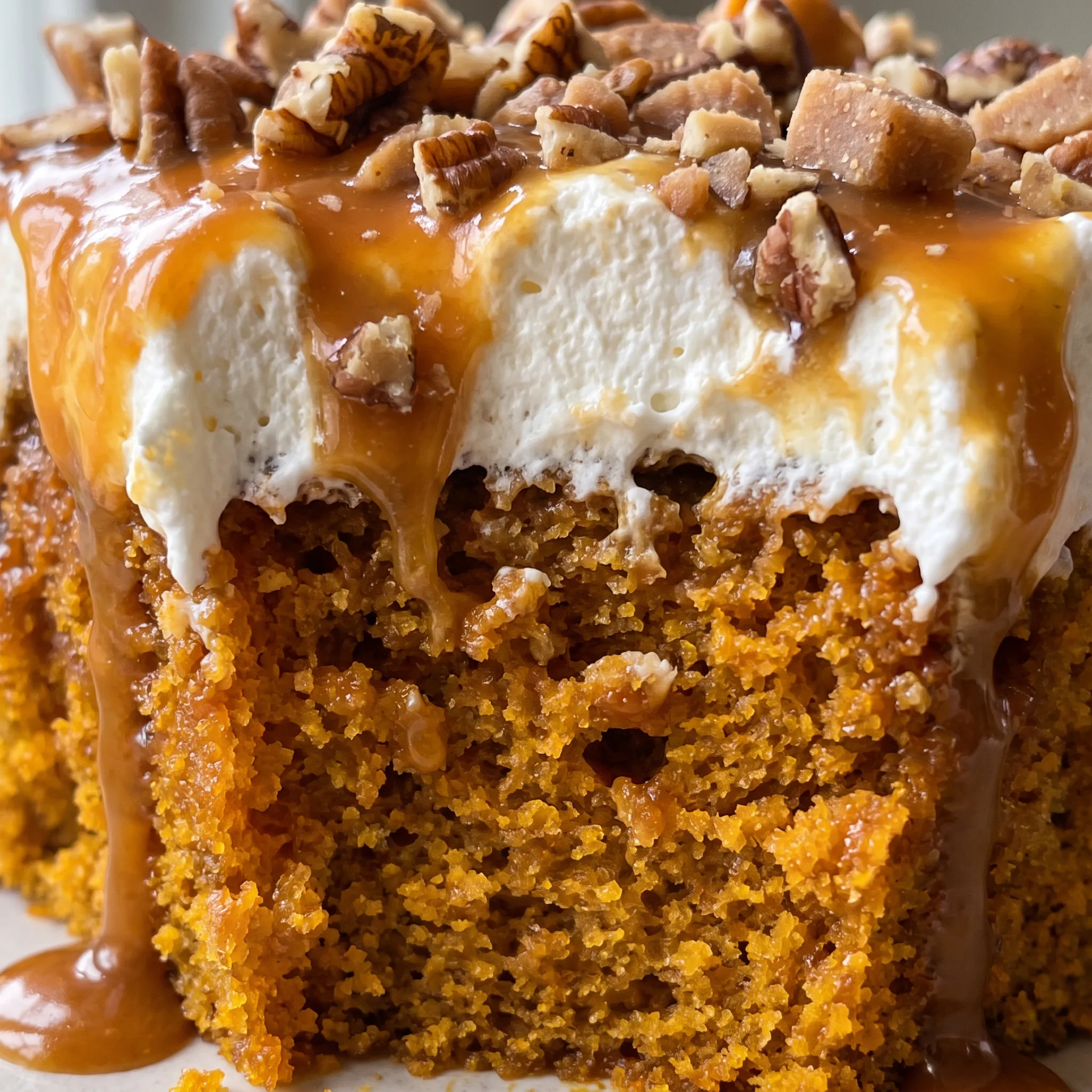
What to Buy for a Cake That Actually Soaks
Pumpkin puree: Buy plain canned pumpkin, not pumpkin pie filling, which is already sweetened and spiced and will push the cake too far.
Yellow cake mix: A standard 432 g box works, but check the weight since some brands run smaller and a light box bakes thin.
Pumpkin pie spice: The blend already carries cinnamon, ginger, cloves, and nutmeg, so the extra teaspoon of cinnamon on top is intentional depth, not redundancy.
Pecans: Toast them first if you have a minute, since raw chopped pecans taste flat against the sweet caramel and toffee.
Toffee bits: The plain bits, not chocolate-covered ones, keep their snap under the whipped topping and won’t streak the pale surface.
Reading the Cake at Every Stage
When the batter stops needing the whisk
The batter is thick, and lumps of dry mix hide in it. Stop whisking when you see no streaks of powder and the color is even.
A few small lumps are fine. Keep going and you knock air out, and the cake bakes flat and tight. If you find a pocket of dry mix after pouring, stop and stir it in with a spatula; don’t whisk the whole bowl again.
The skewer test versus the clock
At 25 minutes, start checking. The center should feel springy and a skewer should come out clean. If the top looks wet or the skewer has batter on it, give it 3 to 5 more minutes and check again.
Overbaking dries the edges and makes the cake harder to soak. Underbaking leaves a wet center that will turn to paste when the caramel goes on.
Poking holes without tearing the cake
Warm cake tears. Let it cool just until the pan is comfortable to touch, about 10 minutes.
Push the spoon handle straight down, twist slightly, and pull up. Space holes about an inch apart.
If the cake cracks, you waited too long and it set; if it smears, it’s too hot. Either way, the soak will still find the holes.
Pouring the soak so it doesn’t run off
Pour slowly, aiming for the holes, not the surface. If the mixture pools at the edges, stop and let it sink in for a minute before adding more.
The cake should look glossy and wet, not flooded. If you rush, the caramel sits on top and the middle stays dry.
Use a spatula to guide any runoff back toward the center.
Knowing when the soak has set
After 1 to 2 hours in the fridge, the top should be tacky, not liquid. Touch it: your finger should come away clean but leave a slight indent.
If it’s still runny, give it another 30 minutes. If you spread the topping too soon, it slides and mixes with the caramel, and the layers blur.
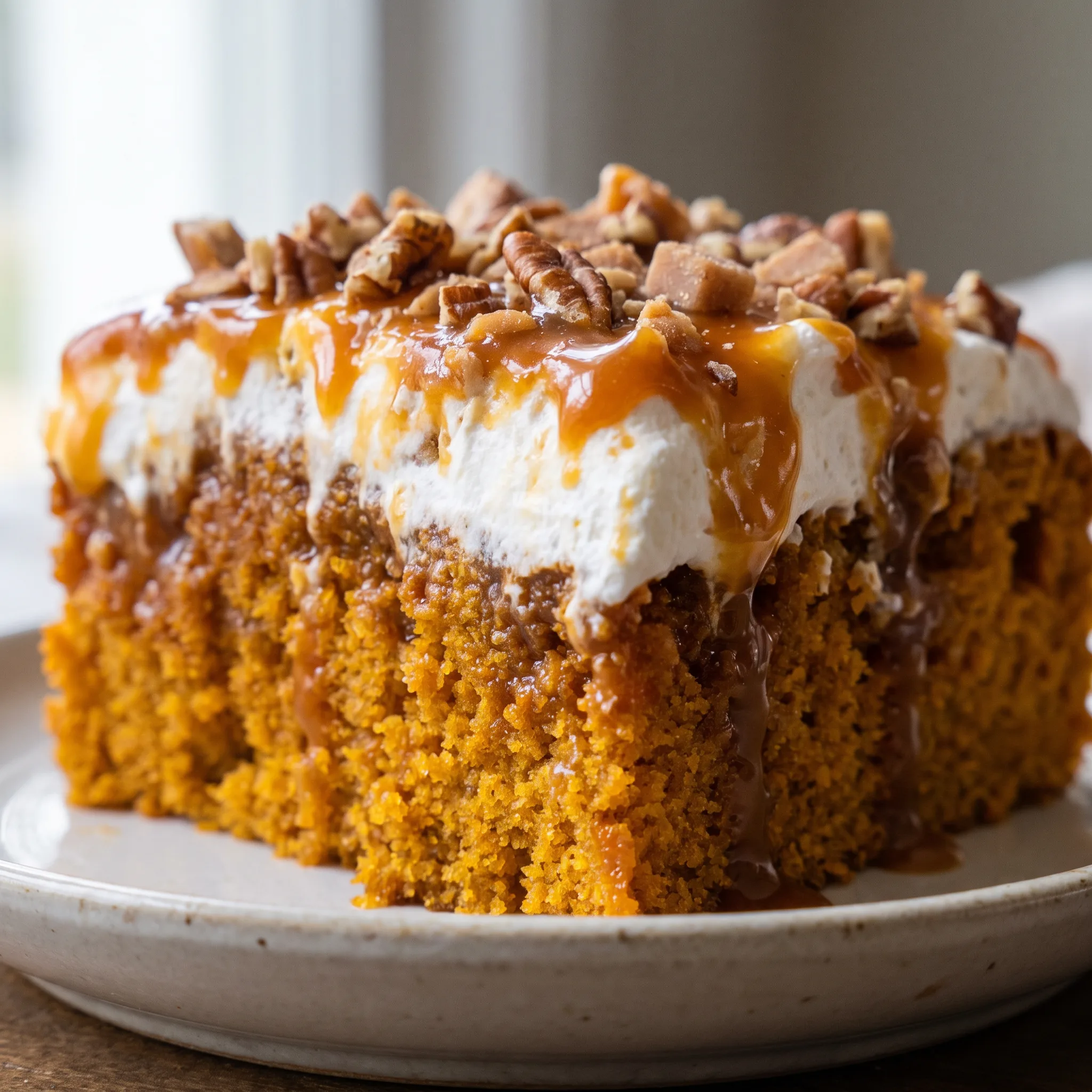
Caramel Pumpkin Poke Cake with Toffee Bits
Ingredients
Method
- Set oven to 350°F (175°C) and grease a 9×13-inch baking pan with cooking spray.
- In a large bowl, combine cake mix, pumpkin puree, eggs, oil, and water; whisk until smooth and homogeneous.
- Pour the batter into the greased pan and bake for 25–30 minutes, until a skewer inserted in the center emerges clean.
- Let cool briefly, then use a wooden spoon handle to poke holes across the cake surface, creating channels for caramel absorption.
- Stir together caramel sauce and sweetened condensed milk, then pour the mixture over the poked cake, making sure it fills every gap.
- Place the cake in the refrigerator for 1–2 hours, letting the caramel set and the flavors blend.
- Gently spread whipped topping over the cooled cake in an even, smooth layer.
- Scatter chopped pecans and toffee bits over the cake, then drizzle more caramel sauce in a decorative pattern for added flavor and visual appeal.
- Slice into neat portions and serve cold or at room temperature.
Swap the Mix or the Pumpkin and the Soak Changes Its Mind
Boxed yellow cake mix: Use a 432 g box of white or vanilla cake mix instead. If you reach for butter recipe or a pudding-in-the-mix yellow, expect more sweetness and a softer crumb. Yellow mix brings a buttery, faintly vanilla base that the pumpkin and spice sit on.
A white mix is sweeter and plainer, so the spice reads colder and the caramel tastes even sweeter. Butter recipe yellow softens the crumb further, and the holes you poke may close as the cake settles, giving the soak fewer places to go. A pudding-style mix holds water differently and can leave the middle gummy once the caramel hits.
If you only have white, cut the vanilla extract to 1/2 teaspoon so it doesn’t fight the spice, and check the cake at 25 minutes since a sweeter batter browns faster.
Canned pumpkin puree: Use homemade cooked and mashed pumpkin or winter squash, drained well. Same 425 g by weight, but expect to pour off liquid first.
Canned pumpkin is dense and consistent, and that’s what keeps the batter thick enough to hold the soak. Fresh puree carries more water. If you use it straight from the pot, the batter runs thinner, the cake bakes up wet and fragile, and the caramel soak has nothing to cling to.
Spread the fresh puree on a tray or line a sieve with paper towels and let it sit for 20 minutes, then measure 425 g. The flavor is brighter and more vegetal, which can make the caramel taste sweeter by contrast.
If the batter looks looser than cake mix alone would give, stop before you add any extra liquid.
Vegetable oil: Melted butter or coconut oil, same 1/3 cup. For a dairy-free cake, keep the oil or use refined coconut oil.
Vegetable oil keeps the crumb tender and helps the cake stay moist after the soak. Melted butter adds flavor but firms up in the fridge, and since this cake chills for 2 hours, butter can make the cold crumb feel slightly heavier. Coconut oil behaves like butter here and leaves a faint coconut note if it’s unrefined, which can clash with the spice blend.
If you’re already using a white mix, butter is the better match. Don’t cut the fat down; a leaner cake drinks the soak faster and turns soggy at the bottom.
Sweetened condensed milk: Leave it. The same goes for the caramel sauce.
Together they set the soak’s consistency, and no single swap keeps both the sweetness and the thickness. Condensed milk is what keeps the caramel from running straight through to the pan. Replace it with evaporated milk and the soak turns watery, the holes fill but don’t hold, and the cake goes wet at the base.
Replace it with more caramel sauce and the mixture is too thick to travel, so it sits on top and glues the whipped topping to the surface. If you want less sugar, cut the caramel sauce to 3/4 cup and keep the condensed milk as written. The soak will be less sweet and slightly firmer, but it still sets.
Tips
- Wait for the cake to cool completely, not just until the pan is comfortable to touch, before you poke. The crumb firms as it cools, so a fully cooled cake holds a clean hole where a warm one smears and closes back up. If the cake feels springy and the pan is cool to the touch, you’re there.
- Poke the holes before you mix the soak, not while it sits. The condensed milk and caramel need a few stirs to come together, and if you poke first you can pour immediately while the channels are still open. A cake that waits 10 minutes between poking and pouring has already started to settle, and the first cup of soak rides the surface instead of dropping in.
Storing and Serving the Soaked Cake
The cake must stay refrigerated. The soak is dairy-based and the topping is whipped, so a countertop is out.
Keep it covered in its pan, or transfer slices to an airtight container, for up to 4 days. Day one is the firmest. The caramel is set but still distinct from the crumb.
By day two the soak has moved deeper and the cake is softer, almost custardy at the center. By day three the topping may weep slightly; blot it with a paper towel before serving.
Eat within 4 days for the best texture. The assembled cake does not freeze well.
The whipped topping separates and the soak turns watery on thaw. You can freeze the unsoaked cake layer for up to 2 months, wrapped tight, then soak and top after thawing.
Serve cold from the fridge for clean slices and a firm set, or let portions sit 15 minutes for a softer, looser crumb. Scatter toffee bits and pecans just before serving; they soften within an hour on the topping.
Add the cinnamon dusting at the same time. Leftover slices are best cold, straight from the container, within that 4-day window.

Frequently Asked Questions
Can I make caramel pumpkin poke cake ahead of time?
Yes, and it’s better behaved if you do. The caramel needs those 2 hours in the fridge to set before the whipped topping goes on, so build in that window and you won’t be spreading topping over a runny surface.
Once assembled, keep it covered in the pan and it holds for up to 4 days. Day one gives the firmest slice, with the caramel still distinct from the crumb. Past day three the topping may weep, so blot before serving.
Why did my poke cake turn out soggy?
Nine times out of ten the cake was underbaked. A wet center has no structure, so the caramel soak has nothing to cling to and the bottom turns to paste.
Check with a skewer before poking: it should come out clean, and the center should feel springy, not damp. The other likely culprit is pouring the soak all at once.
If it pools at the edges, stop and let it sink in before adding more; the surface should look glossy and wet, not flooded.
How long does caramel pumpkin poke cake last in the fridge?
Up to 4 days, covered. The soak is dairy-based and the topping is whipped, so the fridge isn’t optional here. Keep it in its pan or move slices to an airtight container.
Texture shifts as it sits: by day two the soak has moved deeper and the center is softer, almost custardy. Eat within that 4-day window for the best result.
What’s the difference between this and a traditional pumpkin poke cake?
The soak itself. A standard version pours straight sweetened condensed milk into the holes, which is thin and milky sweet.
Here the condensed milk is cut with a cup of caramel sauce, so the mixture is loose enough to travel down the channels but thick enough to cling instead of running to the bottom of the pan. The topping follows the same idea: whipped topping, toasted pecans, toffee bits, and a cinnamon dusting, with more caramel drizzled over.
The result reads more like a caramel cake with pumpkin in it than a pumpkin cake with milk poured on.
Can I serve caramel pumpkin poke cake at room temperature?
Portions can sit out 15 minutes or so, which softens the crumb and loosens the set. The whole cake shouldn’t live on the counter, though.
Between the dairy soak and the whipped topping, it needs the fridge. Cold from the pan gives you the cleanest slices; a short rest on the plate gives you a looser, softer bite. Scatter the toffee bits and pecans right before serving either way, since they soften within an hour on the topping.
