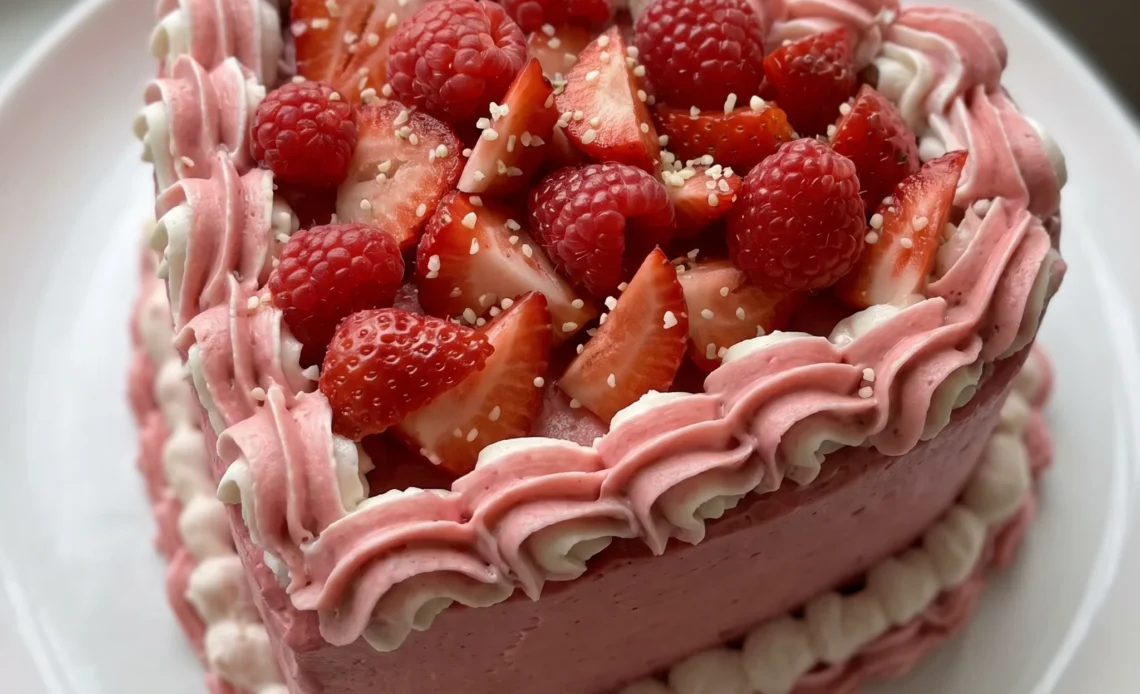
Heart cakes made in a heart-shaped pan usually come out lopsided, with a narrow point that’s hard to frost and even harder to slice. Building the shape from two round layers avoids all of that, but it puts the pressure on the bake.
Those layers need to be flat and even, or the segments won’t sit flush and the vegan heart shaped cake will lean. Raspberries make that trickier still. They hold water, so the center sets later than you’d expect, and the window between underdone and dry is narrow.
Fold them in roughly and they bleed, turning the crumb pink instead of leaving it pale with pockets of fruit. Get past that, though, and you’ve got a cake that looks deliberate, with a tart jam layer and strawberry buttercream that holds the shape cleanly.
When cakes are not leveled, their domed tops cause the segments to tilt when attached, making the heart’s lobes uneven and prone to sliding. The crumb coat may not adhere properly, and the final frosting can pull the segments apart. By the time the cake is fully frosted, correcting the shape is difficult without damaging the structure.
Two Rounds Make a Heart
Baking a heart cake in a heart pan seems simpler, but it often produces uneven layers and a narrow point that’s hard to frost. With two 6-inch rounds, you get more control over the final shape and structure. The heart form comes from slicing each cooled cake into quarters, then removing two opposite segments.
Those cutouts are reattached at the opposite side of the cake, creating the two rounded lobes of the heart’s top. This reassembly, though, means the cake’s silhouette is only as good as its starting layers.
If the cakes have domed, level them first; a flat top ensures the segments sit flush and the heart doesn’t lean. Trimming any uneven edges also helps the pieces meet cleanly. Once the shape is set, the crumb coat goes on more easily because the surface is even and the seams are less likely to crumble.
The result is a heart that looks intentional, not like a patchwork. What you see is a smooth, symmetrical cake ready for its final frosting.
Folding Raspberries Without a Mess
Raspberries are delicate and full of juice. When you stir them vigorously into the batter, they break apart and bleed color, turning the cake pink instead of leaving it light with bursts of fruit.
A gentle fold keeps them mostly whole, so you get pockets of raspberry rather than a uniform tint. But even folding can cause clumping if the berries aren’t spread out. After adding them, give the batter just a few turns until they’re scattered evenly; overmixing crushes them and releases moisture that can make the batter heavy.
Frozen raspberries pose a bigger risk: they carry extra water, which can thin the batter and lead to dense spots. If you use frozen, don’t thaw them first; fold them in still frozen to minimize juice release. Once the batter is in the pans, lifting and dropping each pan on the counter a couple of times forces large air bubbles to the surface and pop.
That helps the cake rise evenly without needing to overmix. The batter should look thick and speckled with berries, not streaked with pink.
Freeze-Dried Strawberry Powder Does the Work
Fresh strawberry puree or jam in buttercream sounds like a good idea, but both add liquid. That extra moisture can make the frosting loose and prone to sliding, especially when you’re stacking a shaped cake.
Freeze-dried strawberry powder, on the other hand, is dry. It packs intense berry flavor and a natural pink color without thinning the buttercream. When you whip the butter and powdered sugar together until light, the frosting becomes airy and stable.
That lightness is what allows it to hold the heart shape, both as a filling between layers and as a coating on the outside. A stiff but spreadable consistency means the frosting won’t sag under its own weight or drip down the sides.
If the buttercream feels too thick, a splash of dairy-free milk loosens it, but add sparingly, because a runny frosting is harder to control. The powder blends in smoothly, leaving no grit.
What you end up with is a frosting that tastes like strawberries and holds its shape.
Jam That Stays Put
A layer of quick jam adds a tart punch that cuts through the sweet buttercream and cake. But jam can also be a liability if it’s too thin: it soaks into the cake or oozes out between layers. That’s why a cornstarch slurry is used.
When cooked with the raspberries, it thickens the mixture to a spoonable consistency that clings to the cake rather than running. The jam should cool completely before it goes anywhere near the frosting. Warm jam will melt the buttercream, turning your neat border into a slippery mess.
Once cooled, its acidity balances the sweetness of the sugar and the richness of the butter, making each bite taste brighter. To keep it contained, you pipe a ring of frosting around the edge of the layer before spooning the jam into the center. That border acts as a dam, so when you set the next cake layer on top, the jam stays where it belongs.
The result is a clean slice with a ribbon of tart fruit in the middle.
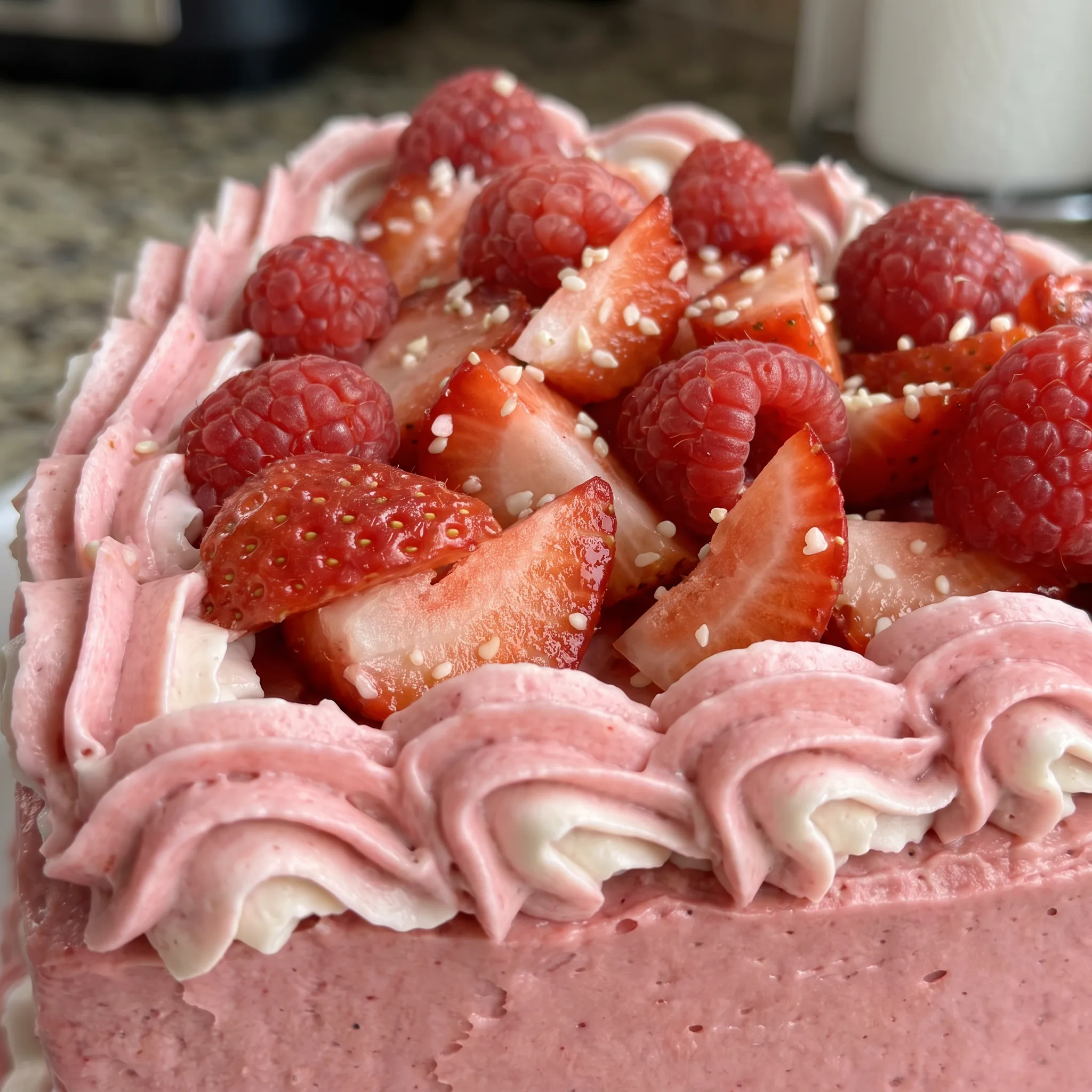
What to Buy and How It Should Look Before You Start
Raspberries (1 1/4 cups for the cake): Fresh or frozen both work, but frozen ones go in still frozen so they don’t bleed juice and pink the batter.
Lemon zest (1 tsp): Zest only the yellow peel; the white pith underneath is bitter and will taste raw against the sugar.
Neutral-flavored oil (1/2 cup): Anything bland works, but olive oil’s flavor carries through the crumb and fights the raspberry.
Freeze-dried strawberry powder (2 1/2 tbsp): Buy the powder, not fresh berries, since it colors and flavors the buttercream without adding water.
Vegan butter (1 cup): The block style, not the tub spread, holds air when whipped and keeps the frosting stiff enough to shape.
Judging the Bake, the Shape, and the Frosting at the Moments That Decide the Cake
Reading the toothpick when the center is still setting
At 43 minutes, the top springs back and the edges pull from the pan. The toothpick is your only view inside. Wet batter means the center is still liquid; a few moist crumbs are done.
The window between those two is narrow because raspberries hold water. If the pick comes out clean but the cake smells faintly raw, give it 2 more minutes. Overbaked, the edges turn crisp and the crumb dries.
When the crumb coat feels dry enough to cover
After 20 minutes in the fridge, touch the frosting. It should feel dry, not tacky. If your finger leaves a mark, the butter is still soft and the final coat will drag.
Give it 10 more minutes. Too cold and the frosting sets hard, so the next layer tears the surface. The crumb coat is a seal, not a finish.
Dry to the touch means the cake is ready for the final pass.
Trimming the segments so the heart sits flat
The cut faces of the segments are the heart’s top. If they’re uneven or slanted, the cake leans and the point won’t meet. Press the segments against the main cake and look from the side.
Any gap or overhang shows now, not after frosting. Trim a sliver at a time; once you cut, you can’t add back. A flush fit means the heart reads cleanly.
Stopping the buttercream at spreadable, not soupy
Powdered sugar goes in 3 to 4 cups. Stop when the beaters leave soft peaks that just hold.
Too little sugar and the frosting slides; too much and it tears the cake. If it stiffens past spreading, a splash of milk brings it back.
The freeze-dried powder thickens as it sits, so aim slightly looser than you think. A frosting that holds a ridge but yields to a spatula is right.
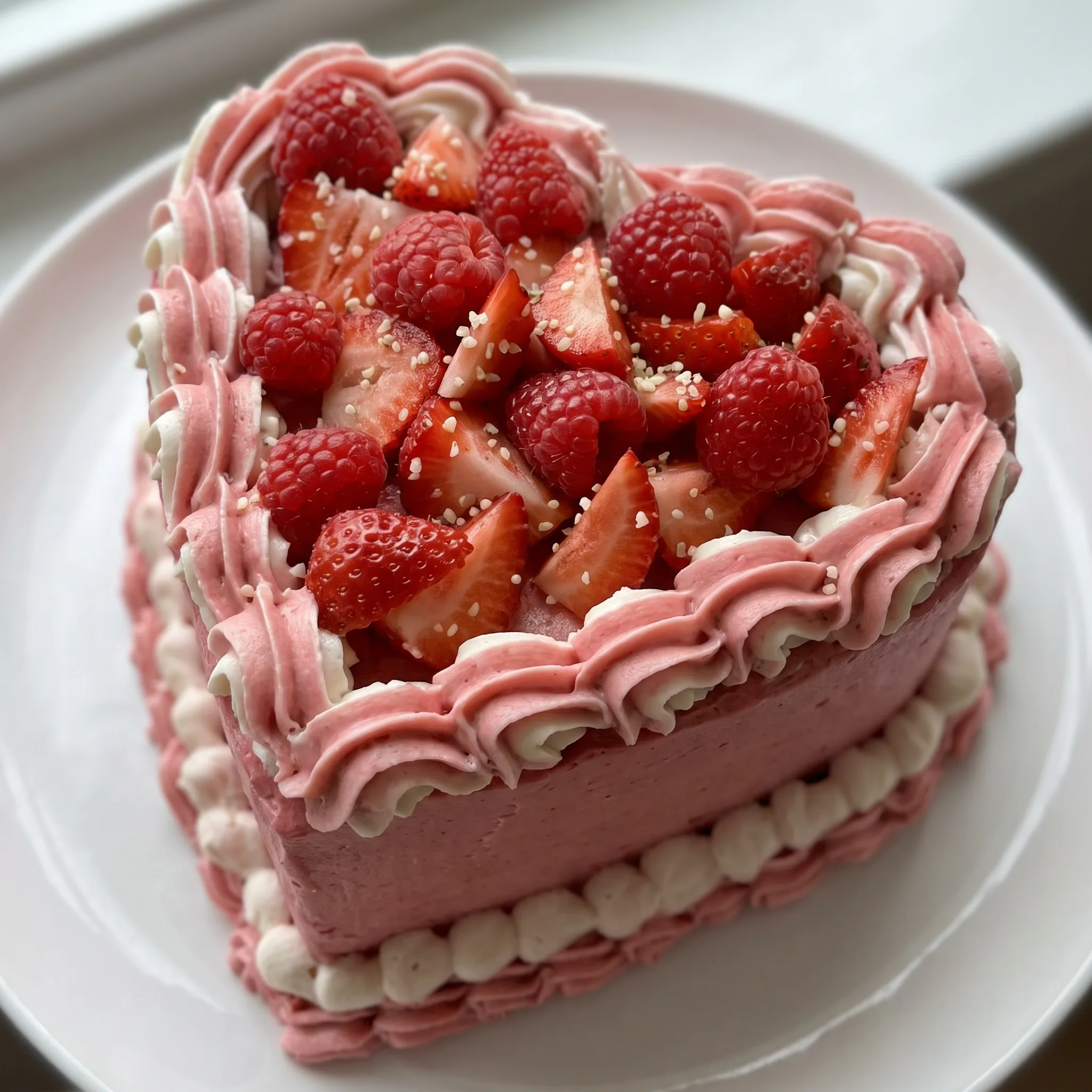
Vegan Heart Shaped Cake with Raspberry Buttercream
Ingredients
Method
- Set oven to 355°F (180°C). Prepare 2 6-inch (15 cm) round cake pans by lining with parchment paper.
- In a large bowl, combine all dry ingredients by whisking until uniform. For enhanced lemon flavor and color, rub the sugar and lemon zest together if desired. Introduce all wet ingredients except the raspberries, whisking until just mixed. Then add raspberries and fold in gently.
- Evenly distribute batter among the prepared pans, making sure raspberries are not clumped. Lift and drop pans firmly on the counter to release large air bubbles.
- Bake for 43–48 minutes, or until a toothpick inserted in the center emerges without wet batter (a few moist crumbs are acceptable).
- Allow cakes to cool in pans for 10 minutes, then move to a wire rack to finish cooling completely.
- In a small saucepan over medium heat, mix raspberries, sugar, and a splash of water. Simmer for 5 minutes, crushing berries with the back of a fork.
- In a small bowl, combine cornstarch with a splash of water. Stir this slurry into the raspberry mixture and cook until it thickens. For a thicker jam, continue cooking; for a thinner consistency, add a splash of water. Set aside to cool entirely.
- In a large mixing bowl or stand mixer, beat butter until it becomes light and fluffy.
- Incorporate powdered sugar, berry powder or food coloring, and vanilla. Mix on low until blended, then raise speed to high and whip until light and fluffy. For a softer frosting, add a splash of milk; for more color, adjust as desired. (Refer to note 3 regarding natural food powders.)
- If the cakes have domes, level them with a serrated knife. Using the blunt side of a knife, lightly score the top of each cake into quarters. With a sharp knife, remove two ‘segments’ from each cake (see images in post). These will become the bottom of the heart cake.
- Set the first cake layer on a serving plate or cake board. Use a bit of frosting to attach the two cake segments to the opposite side of the cake, creating the top of the heart. Trim as necessary.
- For jam filling: spread a thin layer of frosting on the cake surface, pipe a border of frosting around the edge, and spoon jam into the center. If omitting jam, spread about 3/4 cup frosting on the top cake layer.
- Place the remaining cake layer on top of the first. Repeat with the cake segments to form a heart shape and trim as needed. Apply a crumb coat by spreading a thin layer of frosting over the sides and top. Refrigerate for at least 20 minutes, until the frosting feels dry to the touch.
- Coat the heart cake with a thicker layer of frosting and smooth it using an offset spatula or cake scraper. Decorate the remainder with a piping bag fitted with a star or round tip. Just before serving, garnish with fresh berries.
- Keep the frosted heart cake in an airtight container at room temperature for 1 day or in the refrigerator for up to 3 days. If the environment is hot, store it in the fridge. Allow the cake to come to room temperature before serving.
Storage and Serving: The Cut Heart Cake
Frosted and assembled, this cake keeps in an airtight container at room temperature for 1 day, or in the refrigerator for up to 3 days. The difference matters. At room temperature, the buttercream stays soft and spreadable, and the exposed crumb where you sliced into the heart stays tender.
After a day out, though, the cut faces and the jam layer begin to dry and firm. In the fridge, the cold slows that drying, but it also sets the buttercream hard and tightens the crumb.
Before serving from the fridge, let the cake sit at room temperature for 30 to 45 minutes. That wait is what restores the buttercream to a soft, yielding texture and keeps the jam spoonable.
Add fresh berries only at the moment of serving; they wilt and weep within hours. For the best texture, eat within the first day at room temperature, or bring refrigerated slices back to room temperature before you plate them.
Tips
- Rub the 1 tsp lemon zest into the 1 cup granulated sugar with your fingertips before whisking in the flour, baking powder, and salt. The sugar’s abrasion bursts the zest’s oil glands, and because that oil is fat-soluble it disperses through the sugar and then the batter instead of sitting in isolated flecks. You get lemon in every bite without adding liquid or changing how the batter folds or bakes.
Swap With the Job in Mind, Not the Label
Dairy-free milk (1 cup): Soy, oat, and almond all work at the same 1 cup. Rice milk is thin and adds little body. If you reach for canned coconut milk, dilute it to drinkable consistency first, or the batter turns heavy and the crumb tightens.
The milk is most of the liquid here, so its fat and protein decide how the crumb sets. Soy and oat bring enough body that the cake bakes up tender and moist. Rice milk leaves a leaner, drier crumb.
Full-fat coconut milk straight from the can makes a denser cake that domes less evenly, which matters when you’re cutting those layers into heart segments.
Neutral-flavored oil (1/2 cup): Any bland oil works cup for cup. Skip coconut oil and olive oil.
Coconut oil firms up when the cake cools and again in the fridge during the crumb coat chill, so the crumb turns waxy and slightly stiff. Olive oil’s flavor pushes through and clashes with the raspberry and lemon. A neutral oil keeps the cake soft at room temperature, which you want for a shaped cake that gets handled and reassembled.
Vegan butter (1 cup): Use block-style vegan butter, not the tub spread, and measure the same 1 cup. If you only have spread, the frosting will be slack. Block butter whips up light and holds air, which is what lets the frosting keep a ridge and support the heart’s stacked segments.
Tub spread carries more water and less fat, so it beats up loose and slides. You’ll notice it first when the crumb coat won’t dry to the touch and the final coat drags.
Freeze-dried strawberry powder (2 1/2 tbsp): Keep the powder. If you want a different berry, use another freeze-dried powder at the same 2 1/2 tbsp. Don’t swap in fresh strawberry puree or jam.
The powder is dry, so it colors and flavors the buttercream without loosening it. Puree or jam adds water, and the frosting goes soft and prone to sliding, exactly when you’re trying to coat a shaped cake.
If the powder is out and you only need color, a drop of gel food coloring works, but you lose the fruit flavor.
Frequently Asked Questions
Can I make the heart cake ahead of time and assemble it later?
Bake and cool the layers, then wrap them tightly and hold them at room temperature overnight or in the fridge for a day or two. The shape is cut from cold cake, so chilling firms the crumb and makes clean segments easier; wrap well and the cut faces won’t dry out.
Frosting ahead is trickier: once frosted, the cake keeps at room temperature for 1 day or in the refrigerator for up to 3 days, and it’s best to assemble and frost the same day you plan to serve. If you must frost ahead, a crumb coat and a chill before the final coat helps the buttercream set; let the frosted cake sit out 30 to 45 minutes before serving to soften.
Why did my heart cake turn out dry or crumbly?
The usual culprit is overbaking: at 43 minutes the center can still be liquid, and the window to done is narrow because raspberries hold water. Pull it when a toothpick comes out with a few moist crumbs, not clean and dry. If the cake baked correctly but still crumbles, you may have overmixed the batter after adding the raspberries, which crushes them and releases juice that weighs down the crumb.
Also check your flour measurement: spooned and leveled, not scooped, or you’ll pack in extra flour and get a dry, tight crumb. A dry cake can also come from baking in a dark pan that browns the edges too fast; if yours runs hot, check a few minutes early.
How do I keep the heart shape from falling apart when frosting?
Chill the assembled heart before you frost it. The crumb coat needs at least 20 minutes in the fridge, until the frosting feels dry to the touch; that firms the butter and glues the segments together so the cake doesn’t shift when you spread the final coat. When you apply the crumb coat, press the segments gently into place and fill any seams with a little extra frosting; a thin layer that seals the cut faces is what keeps the shape intact.
For the final coat, use an offset spatula and work from the center outward, letting the frosting build up rather than dragging it across the seams. If a segment still feels loose, a dab of frosting on the serving plate under that area acts like glue.
What’s the difference between this vegan heart cake and a traditional heart cake?
The main difference is that this one uses plant-based ingredients: dairy-free milk, neutral oil, and vegan butter in the frosting. That changes the texture in ways you can taste: the oil keeps the crumb soft even when cold, while a traditional butter cake firms up in the fridge. The frosting is also different: vegan butter whips up light but can be softer than dairy butter, so it needs a good chill to hold the heart’s shape.
Flavorwise, the raspberry and lemon come through clearly, and the freeze-dried strawberry powder gives the buttercream a fresh berry taste without the water that fresh puree would add.
