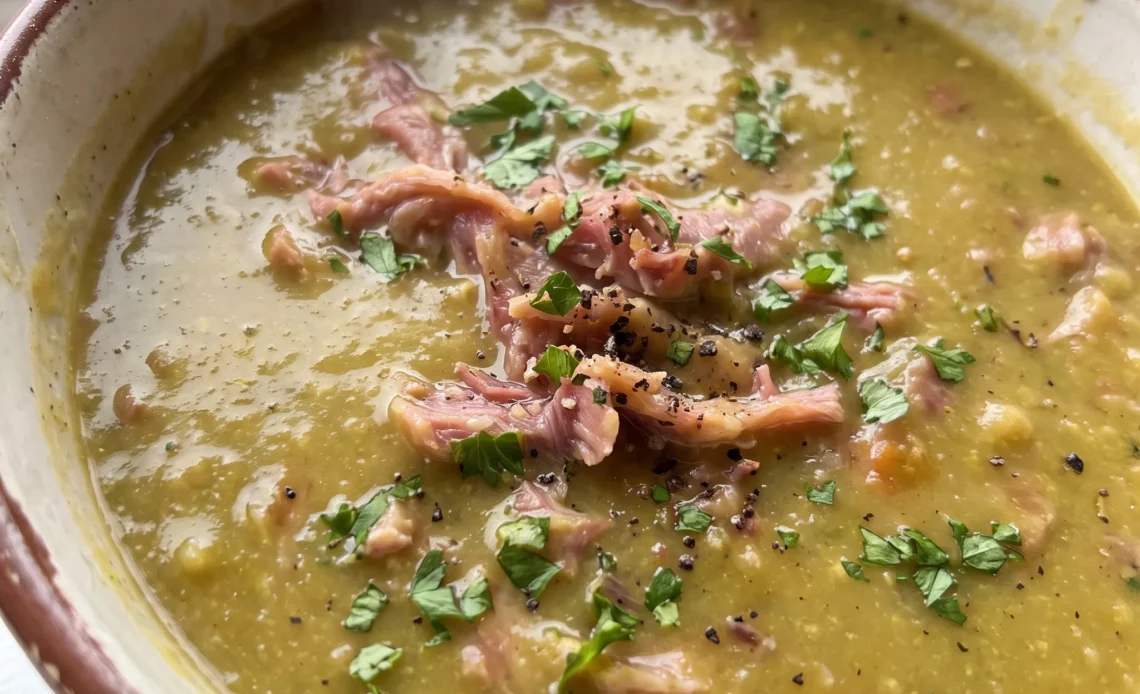
People salt the pot at the start and then wonder why the finished soup tastes like the sea. A ham hock keeps giving up salt the whole time it sits in there, so the seasoning you add before it goes in is guesswork, and the guess usually runs high. This split pea and ham soup is forgiving in most other ways.
The peas thicken the broth on their own, the sealed pot barely loses a drop, and a cheap bone does the heavy lifting. What isn’t forgiving is the water level. A lid that doesn’t seat right lets steam escape, the peas soak up what’s left, and you end up with something closer to a stew than a soup, with no way to tell until you lift the lid.
Hold the salt. Watch the liquid, not the clock.
Does the ham bone make or break this soup?
Cured pork is where most of the flavor comes from. A ham hock or bacon hock gives up smoked, salty depth and enough body to make the broth feel substantial rather than thin. A meaty leftover ham bone does similar work, though the amount of meat left on it varies wildly, and that changes how much ham you end up stirring back in.
Salt is the thing to watch. Only 1/4 tsp goes in at the start, because the hock keeps releasing salt as it sits.
Taste a spoonful after the ham goes back in and decide from there. Some hocks are salty enough that anything more would wreck it; a lean bone might want a pinch more.
The meat itself: pull it off the bone once the soup is done, shred it, and return it. Left in from the start, it would cook down to strings with no bite left. Added back at the end, you get distinct shreds against the soft peas.
Why do split peas thicken the pot without any flour?
Peas are the whole thickener here. Give them hours of gentle heat and they collapse, clouding the water and giving the soup a body that coats a spoon. No roux, no cornstarch, nothing else needed.
Blending is a texture dial, not a step you have to complete. Two or three quick pulses from a stick blender break up enough of the peas to make the soup noticeably thicker while chunks of ham and the odd pea skin survive. Run it longer and you land somewhere closer to a puree, which is fine if that’s what you want.
Neither version is more correct. A soup left completely unblended still tastes right, just looser and more rustic.
What you’re after is a consistency you can judge by looking: pull the blender out and watch how the surface settles back. Thick and slow is the goal for most people. The peas do the work; you’re just deciding how far to push it.
What the sealed slow cooker does to the broth
Water goes in at 8 cups, and most of it stays there. A slow cooker with the lid on loses very little to steam, so you’re not concentrating the soup the way an open pot on the stove would. That’s why the liquid amount matters more than it looks: add extra water “just in case” and you thin the whole thing out, and the soup tastes weak even though nothing went wrong.
Gentle heat is the other half. Nothing boils hard, so the ham bone and the aromatics give up their flavor steadily over the long cook without the harshness you get from a rolling boil. The peas soften at the same pace.
Expect the level to drop only slightly by the time you lift the lid. If it’s noticeably lower than you started, your lid wasn’t sealing well. Otherwise, leave the water alone and let the peas and ham carry the seasoning.
Fine chopping keeps the vegetables in the background
Onion, carrot, and celery go in small for a reason. This soup is about peas and ham, and the vegetables are there to build a base, not to show up as distinct pieces on the spoon. Chopped fine, they soften into the pea base and you taste them as depth rather than as carrot or celery.
Size also decides whether they cook through. Under slow, moist heat, small pieces go tender in the same stretch the peas need to break down. Coarse chunks might still have a bit of bite when the peas are ready, which reads as undercooked next to everything else.
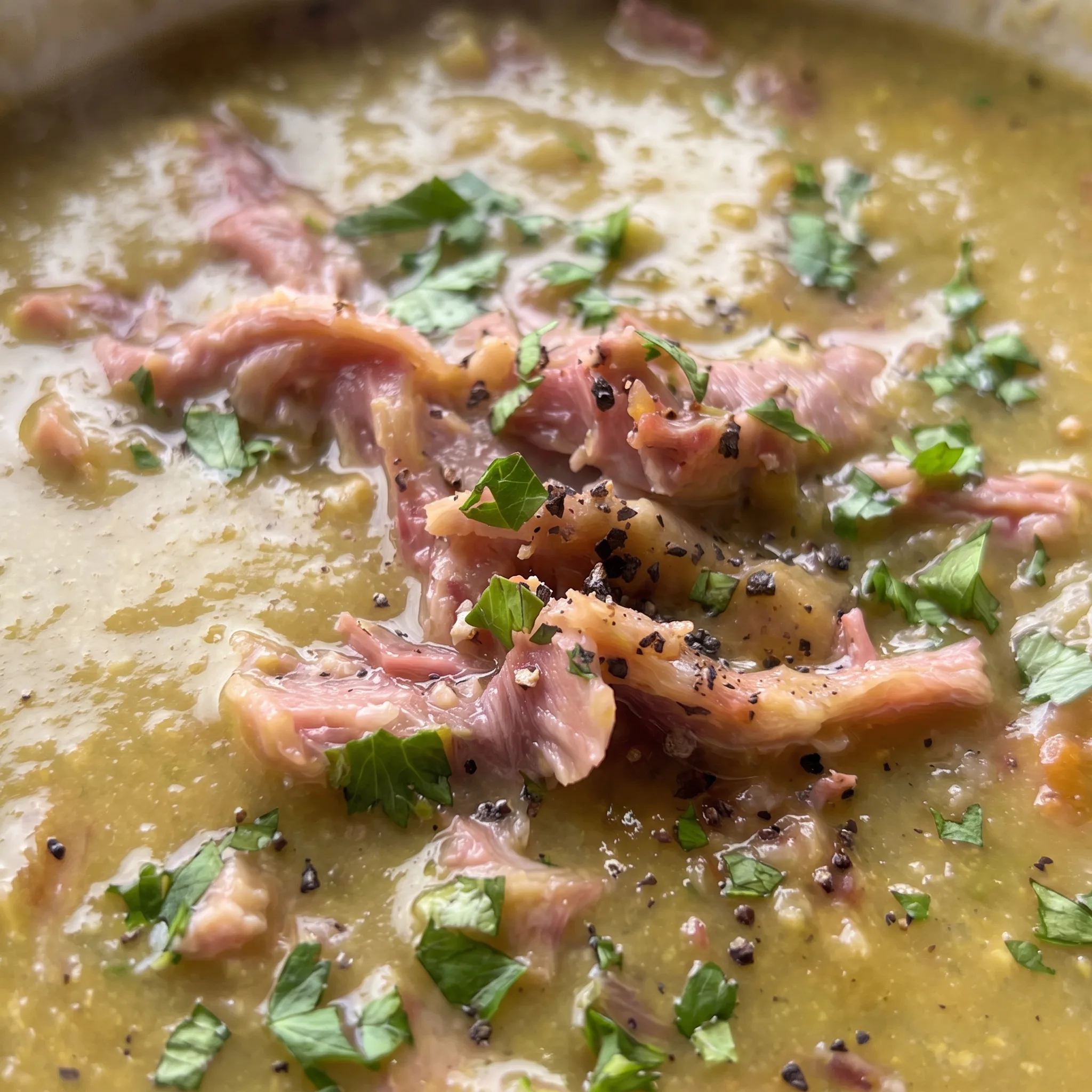
What lands in the bowl is a fairly uniform soup, thick with peas and shredded ham, flecked with green from the parsley at the end. The vegetables have done their job when you can’t pick them out.
The ingredients that decide how this soup turns out
Ham hock: A smoked hock gives the broth its salty depth, but a meaty leftover bone leaves you with more shreds to stir back in.
Split peas: Old peas from the back of the cupboard stay stubborn and never soften properly, so buy a fresh bag.
Onion, carrot, and celery: Chopped fine, they disappear into the peas and taste like depth rather than distinct vegetables.
Bay leaves: Dried or fresh both work, but count them in so you can fish them all out before blending.
Judging the pot by look, smell, and feel
Reading the liquid level before you lift the lid
Peek through the lid if it’s clear, or lift it just enough to see. The water should have dropped only a little from the 8 cups you started with.
A big drop means steam escaped, and the soup will be thicker and saltier than intended. If that happens, stir in hot water a splash at a time until it looks right. Trust the level over the clock.
Knowing when the peas have fully collapsed
Press a pea against the side with a spoon. It should give instantly, with no firm center.
If peas still hold shape after the full cook time, the heat was too low or the lid was off too often. Give them another hour on LOW.
Don’t blend yet; hard peas won’t break down in the blender, and you’ll get a gritty texture.
Judging how much to blend
Two or three pulses should thicken the soup without making it uniform. Stop when you see a mix of smooth and chunky.
Over-blending turns the ham into paste and the peas into wallpaper paste. Under-blending leaves it brothy. Aim for a consistency that coats a spoon but still has visible pieces of ham and vegetables.
You can always pulse once more, but you can’t undo it.
Tasting for salt after the ham goes back
The ham hock releases salt throughout cooking, so the soup may be saltier than you expect. Taste a spoonful after you stir the shredded ham back in. Add salt only if the broth tastes flat, not just because the recipe lists it.
If it’s already salty, a squeeze of lemon or a splash of water can balance it. Remember, the ham is the main source of salt.
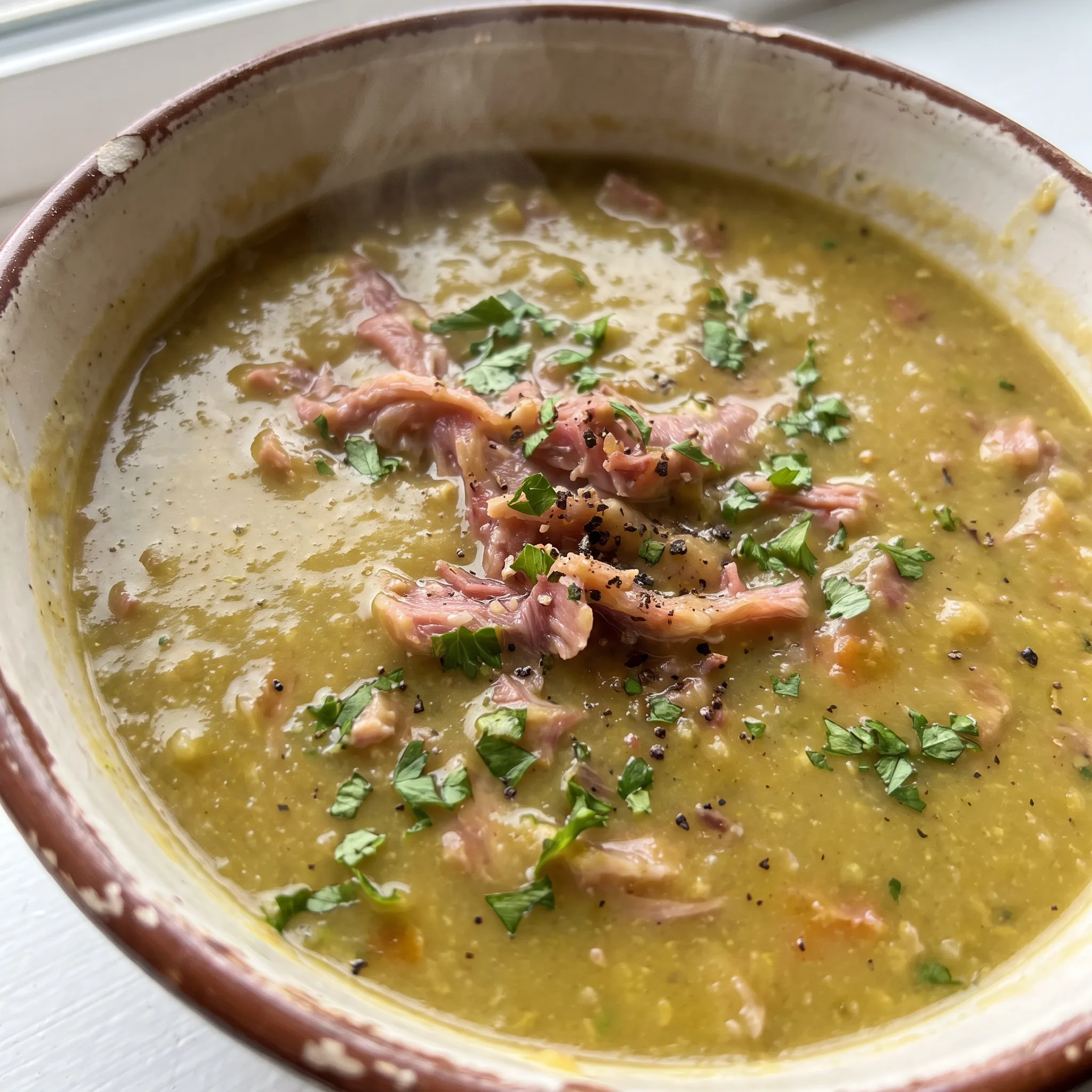
Slow Cooker Split Pea and Ham Soup
Ingredients
Method
- Put peas into slow cooker, press ham down into them. Sprinkle all ingredients around ham bone, then pour water over.
- Cook on LOW for 8 to 10 hours or on HIGH for 6 hours. (Alternatively, 2.5 hours on low on stove, 1 h – 1 hr 20 min in pressure cooker/Instant Pot on HIGH)
- Take out ham bone, shred ham meat. Throw away bone and fatty skin.
- Discard bay leaves. Use stick blender to pulse 2 or 3 times – thickens soup but doesn’t make it completely smooth (my preference, you can blend completely if you want).
- Put ham back into slow cooker, stir. Taste and add more salt if needed (soup gets lots of salt from ham).
- Serve garnished with parsley. Serve with crusty bread for dunking – make a quick Irish Soda Bread, Garlic Bread or upgrade to Cheesy Garlic Bread!
How to Store and Reheat Split Pea and Ham Soup
Chill the soup uncovered until it stops steaming, then lid the pot and refrigerate. It thickens a lot overnight because the peas keep pulling in liquid. Expect it to look more like a stew the next day.
Reheat it on the stove over low heat and stir in water or stock a splash at a time until it loosens back to the texture you want. It’ll take more than you think.
The ham and peas hold up for several days in the fridge without separating or going grainy.
The soup freezes well, since the peas and ham don’t break down further in the cold. Freeze in portions, leave headroom in the container, and thaw in the fridge overnight. Reheat the same way: low heat, thin with liquid as it warms.
Eat it the day it’s made if you can. The texture is at its best within an hour of the ham going back in: thick, with distinct shreds. Add the parsley to each bowl at serving, not to the pot, or it goes dark and limp in the leftovers.
What you can swap in split pea soup without wrecking the pot
Ham hock (or bacon hock, meaty leftover ham bone): Use a smoked turkey leg or wing instead of the pork hock, or a meaty leftover ham bone if that’s what you have. A smoked turkey leg gives a lighter, less salty broth and less fat, so the soup may taste a bit thinner. You might want to add a pinch more salt at the end.
A leftover ham bone works, but the amount of meat varies, so you may need to add extra diced ham. 5 kg) range; for turkey, one large leg is about right.
Dried split peas: Use yellow split peas instead of green. They cook the same way and need no soaking or pre-cooking. Yellow peas break down just as well and give the same thick body, but the soup will be a paler gold color instead of green.
The flavor is slightly sweeter and less earthy. Use the same 1 lb (500 g).
Crusty bread (serving suggestion): Skip the bread or serve with any bread you have, or none at all. It’s an optional side, not part of the soup. The soup is complete without it; bread just adds crunch and soaks up the broth.
If you’re avoiding gluten, leave it out or choose a gluten-free loaf. No adjustment to the recipe needed.
Salt: Hold the salt until after the ham goes back in, then taste and add only if needed. The ham hock releases salt as it cooks, so the soup can end up saltier than expected. Starting with the 1/4 tsp is fine, but taste before adding more.
If it’s already salty, a squeeze of lemon or a splash of water can balance it.
Tips
- Pour the 1 lb of dried split peas into a sheet pan or wide bowl and spread them in a single layer before rinsing. Stray stones, clumps of dirt, and shriveled peas sit at the same size as the peas, so they hide in a bag and a 6 to 10 hour cook softens peas but never a pebble. Pick out anything that isn’t a smooth, uniform pea, then rinse in a colander until the water runs clear.
- Rinse the ham hock under cold water and pat it dry before pressing it into the peas. Hocks and bacon hocks carry a film of curing residue and sometimes loose bone fragments on the surface, and that rinse water goes down the drain instead of into the 8 cups that stay in the sealed pot. Skipping it puts that residue straight into a broth you can’t dilute later without thinning the soup.
The 8 cups of water is calibrated for a slow cooker’s sealed, low-evaporation environment, where the soup reduces only slightly during the long cook. Because evaporation is minimal, any extra water stays in the pot and dilutes the flavor extracted from the ham bone and aromatics, leaving the soup tasting weak and thin rather than concentrated. The peas thicken the soup naturally, but excess water prevents that body from becoming substantial.
Frequently Asked Questions
Can I make split pea and ham soup ahead of time and reheat it?
Yes, and it’s arguably better suited to it than most soups. Ladle it into containers, chill it down, and reheat gently on the stove, thinning with a splash of water or stock as it warms because the peas keep drinking liquid in the fridge. Keep the parsley out of the pot and add it to each bowl, or the leftovers go dark and limp.
Freezing works too, so a double batch is a reasonable move.
Why did my split pea soup turn out too thick or too thin?
Too thick usually means liquid escaped during the cook. Check whether the water dropped much below the 8 cups you started with; a poorly seated lid lets steam out, and the peas soak up what’s left. Stir in hot water a little at a time until the spoon coats the way you want.
Too thin is either undercooked peas that never collapsed or a pot you didn’t blend at all, which leaves it brothy and rustic rather than thick. Press a pea against the side first: if it still has a firm center, the texture problem is doneness, not liquid.
What is the difference between this slow cooker version and classic stovetop split pea soup?
Time and evaporation, mostly. 5 hours on low, and an open pot loses water to steam, so the soup concentrates as it cooks and can thicken faster than you expect.
The slow cooker sits sealed for 8 to 10 hours on LOW, so the level barely moves and the peas and ham soften without any hard boiling. Flavor-wise you end up in the same place: salty, smoky broth and collapsed peas.
The stovetop version just asks you to watch the pot and top it up.
How do I know when the ham hock is cooked enough to shred?
The meat should pull away with almost no resistance where it meets the bone. Grab a chunk with tongs or two forks and tug; if it comes off in a solid piece, give the pot more time, and if it slides into strands, it’s ready.
Color helps too: the exposed meat darkens and looks ragged at the edges. A hock that’s still tight and springy hasn’t given up its collagen yet, and shredding it early leaves you with chewy chunks instead of soft strands.
