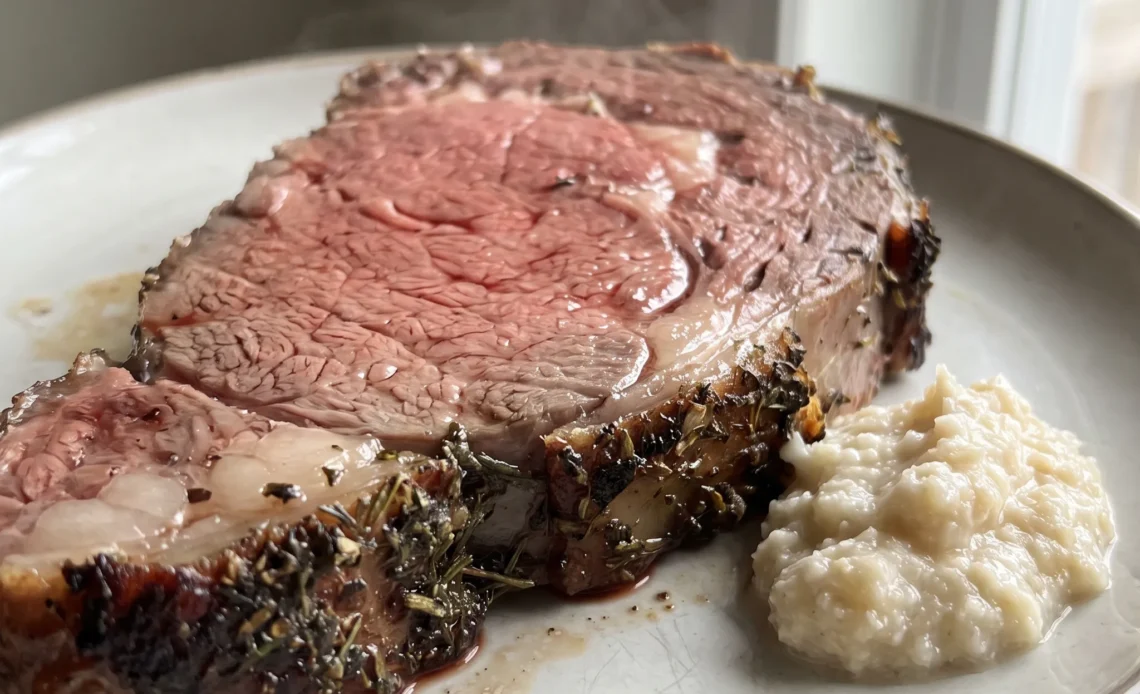
Slice into a slow roasted prime rib and the first thing you notice is how little resistance the knife meets, then the smell of toasted garlic rising off the crust. What looks like a restaurant centerpiece is mostly patience. A five pound bone-in roast gives you five servings, and the narrow part isn’t the roasting, it’s the margin.
Pull it a few degrees late and carryover pushes a rosy medium rare into medium before you’ve even picked up the knife. The bones aren’t decoration either; they lift the meat off the pan and shield the underside, which buys back some of that room for error. Get the pull temperature and the rest right and the roast eats juicy from edge to bone.
Why Room Temperature Matters
A 5 pound bone-in prime rib pulls a lot of cold from the fridge. Sit it on the counter for at least 2 hours and the chill fades from the center. That matters because a cold middle lags behind the outside.
The oven hits the surface first, and by the time the middle catches up, the outer bands are already past where you want them. You end up with gray edges and a cool, nearly raw core. Letting the roast warm through evens the starting line.
The whole piece climbs toward doneness at a similar pace, so the slice from the center looks like the slice from the end. Salt it first, cover loosely, and leave it alone. This is separate from roasting.
It’s about giving the meat a head start before heat ever touches it. When you slide the pan in, the roast should feel cool at most, never cold.
That’s your cue it’s ready.
Garlic Herb Butter as a Flavor Base
Six cloves of garlic, a teaspoon of dried thyme, half a teaspoon of rosemary, salt, and pepper go into softened butter. That paste does two jobs. First, it clings to the surface and seasons every bite that gets crust.
Second, as the roast sits in the oven, the butter melts and carries the garlic and herbs into the scored fat and the meat just beneath. You get a savory edge that plain salt can’t build. Dried herbs work here because they rehydrate in the butter and release slowly, not in a burst.
The garlic sweetens as it roasts, losing its raw bite. What you’re after is a crust that tastes seasoned all the way through the first quarter inch, not just on top.
That’s flavor work, not cooking work. It doesn’t determine doneness.
It determines whether the outside of the roast is worth eating on its own. When you pull it from the oven, the crust should look lacquered, dark gold, and smell of toasted garlic.
The Rest Before Carving
Right out of the oven, the roast is tense. Heat has pushed juices toward the surface, and if you cut now, they pour onto the board. Wait, and those juices pull back into the muscle.
The meat relaxes, the fibers open, and each slice stays wet. That’s the difference between a juicy slice and a dry one, and it happens off the heat. The roast also keeps climbing in temperature while it sits.
Remove it 5 to 10 degrees before your target, because carryover will finish the job. That’s not guesswork; it’s what the thermometer shows if you leave the probe in. Resting is separate from roasting.
It doesn’t add doneness so much as settle it. A roast that rests slices clean and tastes full.
A roast cut early bleeds out and eats dry. When you finally carve, the juices should stay on the plate, not under it.
Bone-In Structure and Moisture
The bones on a prime rib aren’t just for show. They act as a rack, lifting the meat off the pan so heat moves around it.
They also insulate the bottom of the roast, slowing how fast that side cooks. That means the meat closest to the bone stays a touch cooler and juicier while the top crusts.
You get a built-in buffer against overcooking. Boneless roasts cook more evenly, sure, but they lose that protection and often dry out at the edges.
The bone also gives the roast its shape, so slices hold together better when you cut between them. Flavor-wise, the bone and the fat around it baste the meat as they heat, adding a savory depth you can taste in the first bite near the center. Choose bone-in for the texture and the insurance.
The reward is a roast that eats juicy from edge to bone.
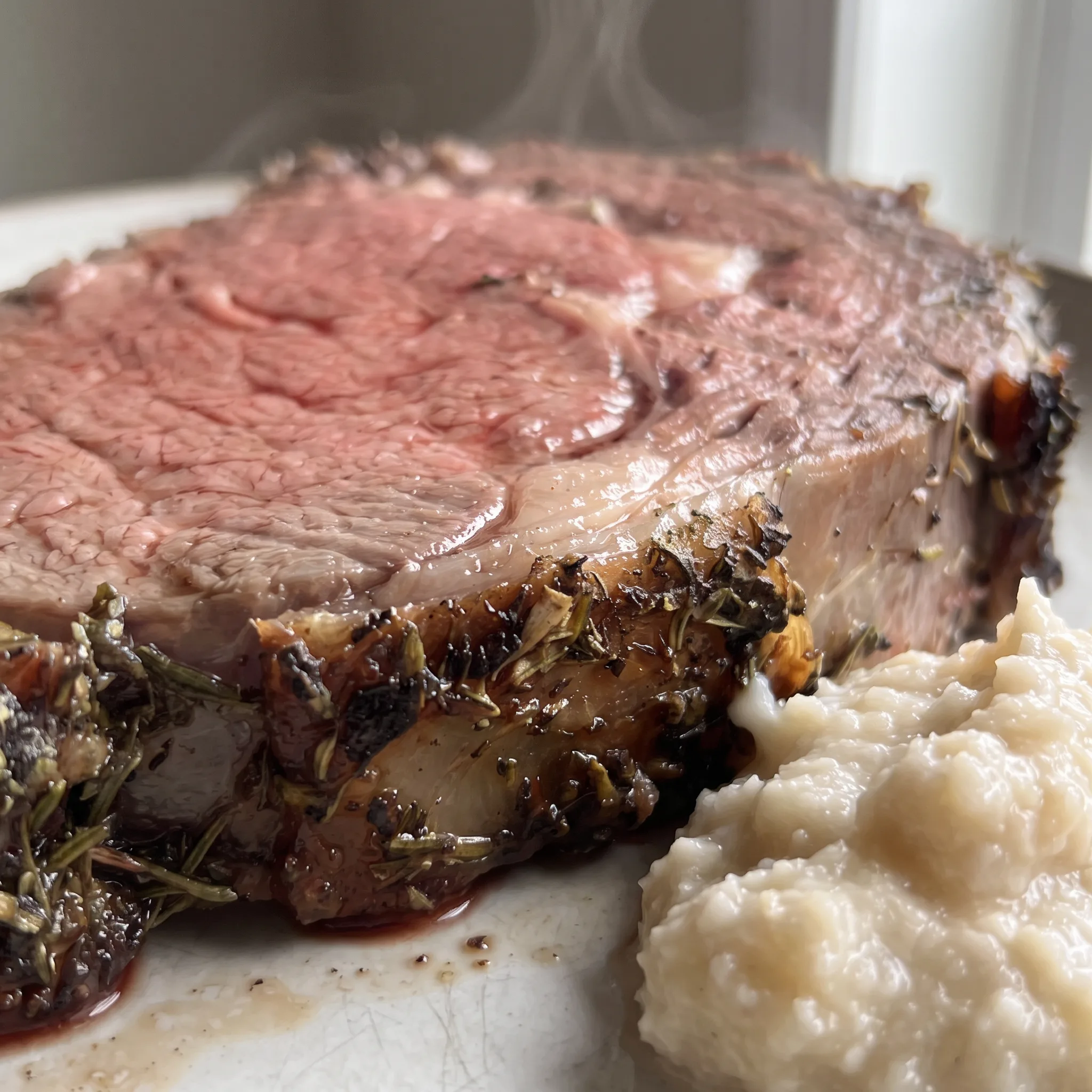
What to Buy and Prep for This Roast
bone-in prime rib roast: A 5 lb bone-in roast gives you five servings, and the bones act as a rack that insulates the bottom.
unsalted butter: Use 3 tablespoons softened unsalted butter so you control the salt, since you also salt the roast.
garlic: 6 cloves minced fresh garlic sweetens as it roasts, while the jarred stuff tastes sharp and raw.
dried thyme and rosemary: Dried herbs rehydrate in the butter and release slowly, so check your jar dates before using.
The single mistake most cooks make with prime rib is pulling it from the oven when the thermometer already reads the target doneness, because the roast is still hot and the exterior carries enough heat to push the center past that number. The recipe’s own warning, remove it 5, 10 degrees before it reaches your optimal temperature, exists precisely because a 5 lb bone-in roast will continue cooking during the 30-minute rest, and a roast taken out at 130°F for medium rare can easily coast to 140°F, landing in medium territory with a drier, less pink interior. The fix is to treat the thermometer reading as a moving target: pull the roast 5, 10°F below your desired final temperature and let carryover finish the job.
Reading the Roast: The Moments That Decide How It Eats
Judging the sear at 15 minutes
At 500°F, the outside sets fast. At 15 minutes, open the oven and look.
You want a dark, burnished crust across the fat cap and top, not black. If corners are already charring, the butter and garlic are burning.
That bitterness will taste through the slice. Drop the heat to 325°F right then, no waiting. If the crust looks pale, leave it another two minutes, but don’t walk away.
This is the only moment the outside can go too far before the inside is anywhere close.
Catching the pull temperature before carryover
The card says remove 5 to 10 degrees before your target. That’s the judgment: a 130°F medium rare roast comes out at 120°F to 125°F. Check in the thickest part, away from bone and fat.
If you wait until the thermometer reads 130°F in the oven, the rest will push it to 140°F, which is medium. You can’t undo that. Pull early and let the rest finish the job.
The probe should slide in with little resistance.
Knowing the rest is done by feel, not the clock
Thirty minutes is the minimum, but the roast tells you when it’s ready. Touch it: it should feel warm, not hot, and the surface dry to the touch.
Juices on the board should be minimal. If it’s still steaming, give it more time.
Cutting early and the juices run out, leaving dry slices. The internal temperature will also stop climbing.
That’s your signal. A roast that rests properly slices clean and stays wet.
Carving against the grain on a bone-in roast
With bones, you have two options: cut the bones off in one piece, then slice the meat, or slice between the bones. Either way, look at the direction of the muscle fibers. They run lengthwise along the roast.
Cut across them, perpendicular, into ½-inch slices. If you cut with the grain, each slice chews long and tough. The first slice shows you the grain.
Adjust your angle if needed. The bone side gives you a guide: slice parallel to the bones.
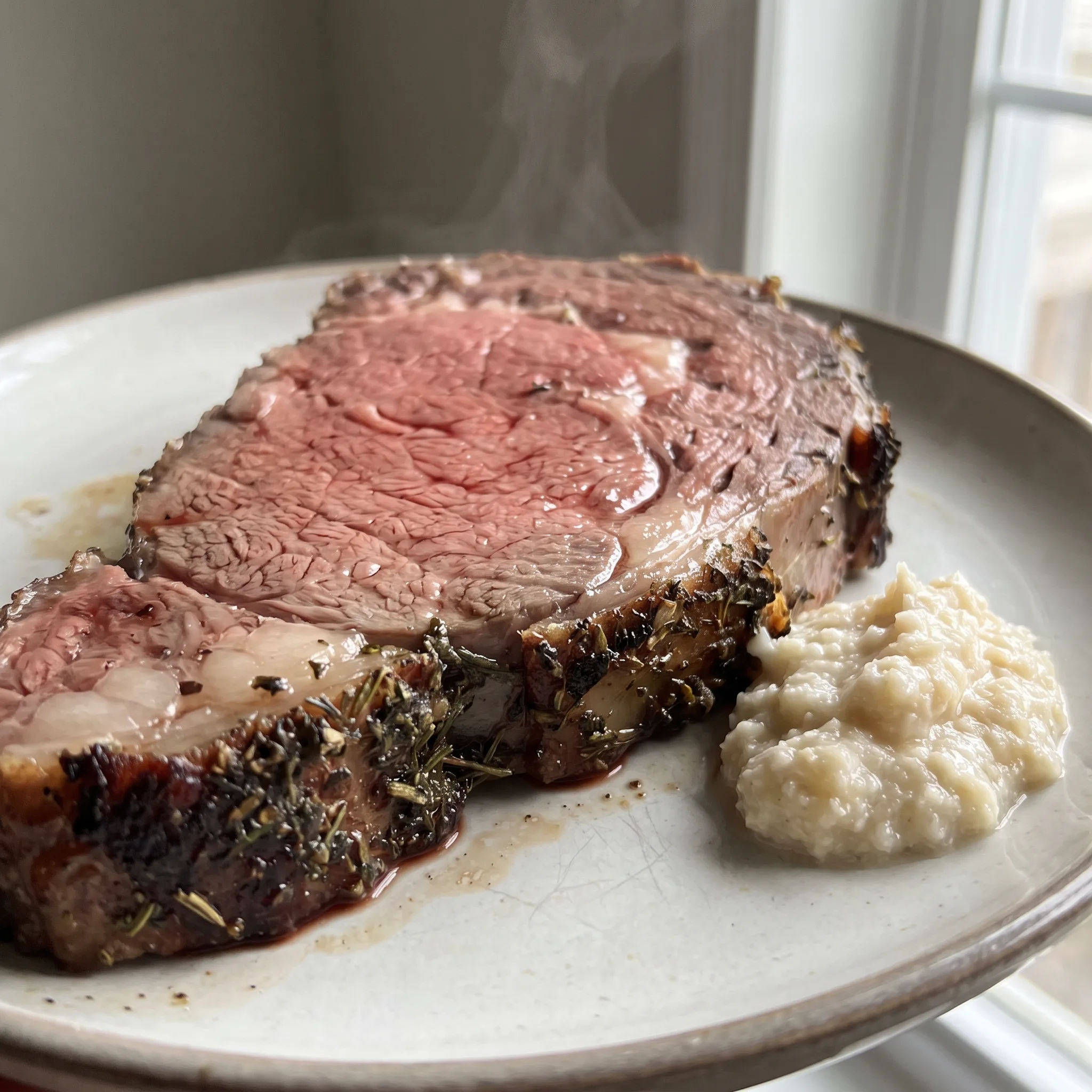
Slow Roasted Prime Rib with Garlic and Herbs
Ingredients
Method
- Take the rib roast out of its packaging and place it bones down in a roasting pan. Sprinkle salt over all surfaces, cover lightly with plastic wrap, and allow it to reach room temperature for at least 2 hours.
- Set the oven to 500°F (260°C). Use paper towels to dry the roast.
- In a small bowl, mix the softened butter, olive oil, minced garlic, 1 tsp salt, pepper, thyme, and rosemary until thoroughly combined. Take off the plastic wrap and apply the mixture uniformly over the whole roast.
- Place the prime rib in the preheated oven and roast for 15 minutes, then lower the oven temperature to 325°F (165°C) and keep roasting until the desired doneness. Use a meat thermometer to monitor the internal temperature: Rare: 120°F (50°C) (about 15–17 minutes per pound); Medium Rare: 130°F (55°C) (about 17–20 minutes per pound); Medium: 140°F (60°C) (about 20–23 minutes per pound); Medium Well: 150°F (65°C) (about 23–25 minutes per pound). Note: The beef will continue to cook as it rests out of the oven, so remove it from the oven 5–10 degrees before it reaches your optimal temperature.
- Take the roast out of the oven and cover it loosely with foil. Let it rest for 30 minutes before carving.
- Carve the prime rib roast by slicing against the grain into about ½-inch thick slices. Serve with au jus and horseradish, if desired.
Storing and Serving the Roast After It Rests
The window opens the moment the rest ends. Sliced prime rib at its peak is warm, still shedding a little juice, and tender from edge to bone. Serve it within 20 minutes of carving.
Past that, the slices cool, the fat firms, and the texture tightens. Leftovers keep in the fridge for 3 days, tightly wrapped or in a shallow container. The crust softens first, and by day 3 the garlic herb butter has faded into the meat.
Reheat gently: a 250°F oven, covered, 15 to 20 minutes, or a quick sear in a hot pan for single slices. High heat dries the meat because the moisture left in the slice flashes off. Freezing works only for the bones and drippings, which hold 2 months and make a future au jus.
Sliced meat frozen and thawed turns grainy and wet. If you want the finishing touch, spoon warm au jus over the slices right before they hit the table, not before.
What You Can Swap on a Prime Rib and What You’ll Regret
5 lb bone-in prime rib roast: A boneless ribeye roast of the same weight. The bones act as a rack and insulate the bottom, so without them the roast sits flat in the pan and the underside cooks faster. You lose that buffer, and the meat near where the bone was can dry out.
If you go boneless, set it on a rack so heat moves underneath, and start checking the internal temperature 10 minutes earlier than the times in the recipe. The shape also flattens, so slices may not hold together as neatly.
3 tbsp unsalted butter: Same amount of olive oil or a plant butter. Butter carries the garlic and herbs and browns into that lacquered crust. Olive oil works, but it stays liquid and the crust looks glossier, less set.
Plant butter often has more water, so it can steam the surface instead of browning. If you use either, watch the 15-minute sear closely; the garlic can scorch faster without the milk solids in butter to buffer it.
1 tsp dried thyme: 1 tsp dried oregano or 1 tbsp fresh thyme. Dried thyme rehydrates in the butter and releases slowly.
Oregano is louder and more minty, so it can dominate the rosemary. Fresh thyme has water in it, which thins the paste and may make it slide off the roast; you’ll need to press it on and expect less herb flavor in the crust.
1/2 tsp dried rosemary: 1/2 tsp dried sage or 1 1/2 tsp fresh rosemary, chopped fine. Rosemary’s piney edge cuts through the fat.
Sage goes earthy and can taste musty against beef. Fresh rosemary, if not chopped fine, stays needle-like and turns tough in the oven; you’ll bite into woody bits. Dried is more reliable here because it softens in the butter.
Tips
- Take your first reading at the 17-minute-per-pound mark for medium rare, then leave the probe in and check every 5 minutes. On a 5 lb roast that puts you near 85 minutes of 325°F time, and the climb slows as the meat approaches the target, so readings get closer together. Pulling at 120°F to 125°F instead of waiting for 130°F is what keeps carryover from pushing you into medium.
- Insert the probe from the side, horizontally, into the center of the thickest muscle, not down through the fat cap on top. Going in from above passes the probe through the garlic butter and the fat layer, and the tip can stop in a pocket of rendered fat that reads 10 to 15 degrees hotter than the meat around it. That false high reading makes you pull the roast early and end up with a rare center. Slide it in level, aim for the middle of the eye of the meat, and keep the tip clear of the rib bones.
Frequently Asked Questions
Can I make prime rib ahead of time and reheat it?
Prime rib is at its peak when served within 20 minutes of carving. That’s the window the rest opens. If you must cook ahead, roast it, rest it, then chill the whole roast tightly wrapped for up to 3 days.
Reheat gently in a 250°F oven, covered, for 15 to 20 minutes, or sear single slices in a hot pan. High heat flashes off the moisture left in the slice and dries it out.
How do I know when the prime rib is done without a meat thermometer?
You can’t know exactly, and guessing is how roasts get overcooked. The recipe relies on a thermometer for good reason: the internal temperature climbs fast near the end, and carryover adds 5 to 10 degrees after you pull it. Without a probe, use the clock as a rough guide only.
For medium rare, figure about 17 to 20 minutes per pound at 325°F after the initial 15-minute sear. Then start checking early. A roast pulled at 120°F to 125°F will finish at 130°F during the rest.
If you skip the thermometer, you’re guessing, and the margin between rare and medium is narrow.
Why did my prime rib turn out tough and dry?
The most likely cause is carving with the grain instead of against it. The muscle fibers run lengthwise along the roast; cut across them, perpendicular, into ½-inch slices. If you cut parallel to the fibers, each slice chews long and tough.
A second check: did you let it rest long enough? Thirty minutes is the minimum. Cutting early lets the juices run onto the board instead of staying in the meat.
What is the difference between prime rib and standing rib roast?
They’re the same cut. Prime rib is the name used when the roast is bone-in and cooked as a whole, usually with the bones acting as a rack.
Standing rib roast is the more general butcher term for a rib roast with the bones attached, standing on them in the pan. A boneless ribeye roast is the same muscle without the bones, and it cooks differently because it sits flat and loses the insulation the bones provide.
