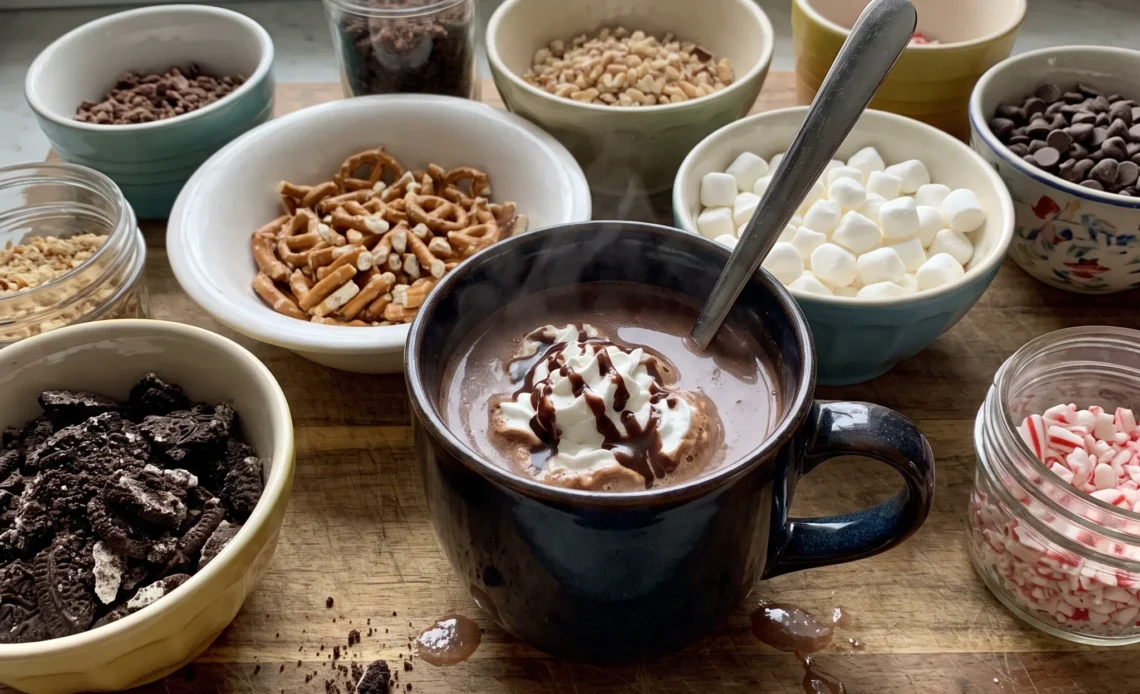
A slow cooker hot chocolate bar isn’t a pot you stand over with a whisk. It’s a blender slurry dumped into a low cooker while you cut cookies into peppercorn-size rubble and line a muffin tin with paper cups.
Cocoa powder will seize if it hits hot milk straight, which is the failure most people hit and blame on the cocoa. Blending it into cold milk first sidesteps that entirely, and the slow cooker holds the batch warm without ever pushing the dairy past the point where it breaks.
Curdling is the real risk here; once milk grains out, stirring won’t bring it back. Set the topping spread, keep the pot low, and let guests build their own cups while you stay out of the way.
Slow cookers are designed to hold low, even heat, while stovetop methods can easily overshoot into a simmer. At high temperatures, milk proteins coagulate and fat globules coalesce, breaking the emulsion and creating a grainy, curdled texture. This recipe uses the slow cooker on low precisely because its gentle, stable heat keeps the milk proteins below the coagulation threshold, maintaining a smooth emulsion.
Blender first, lumps never
Cocoa powder hates water. Drop it straight into a pot of warm milk and it seizes into stubborn little pebbles that float on top no matter how hard you whisk.
The blender sidesteps that by forcing the powder into just one cup of cold milk, where it disperses before any heat hits it. You’re making a slurry, not a batter, so a smooth, uniform liquid is what you’re after. Scrape the blender jar with a spatula and get every bit of that dark paste into the slow cooker.
Cocoa settles fast, and whatever you leave behind is cocoa that won’t sweeten the batch. What you should see after blending is a glossy, even mixture with no dry pockets. That’s the sign the cocoa is fully suspended and ready for the rest of the milk and cream.
Why low heat only
Milk turns on you above a gentle simmer. At high heat the proteins tighten and squeeze out the fat, and what was a smooth liquid becomes grainy flecks that never recombine, no matter how much you stir. Curdling is one-way.
You can’t whisk it back. A slow cooker on low holds a temperature that warms the mixture through without ever pushing it to that breaking point. The heat comes from all sides, slowly, so the cocoa, sugar, and dairy stay together as one body.
After about two hours, the surface will look uniform with a faint steam rising, and a spoon pulled through leaves a clean trail that closes slowly. If you see any speckling or separation, cut the heat and whisk hard; sometimes you can catch it early. Otherwise, let it ride.
The texture should be fluid and silky, never watery or slick.
Build your topping spread
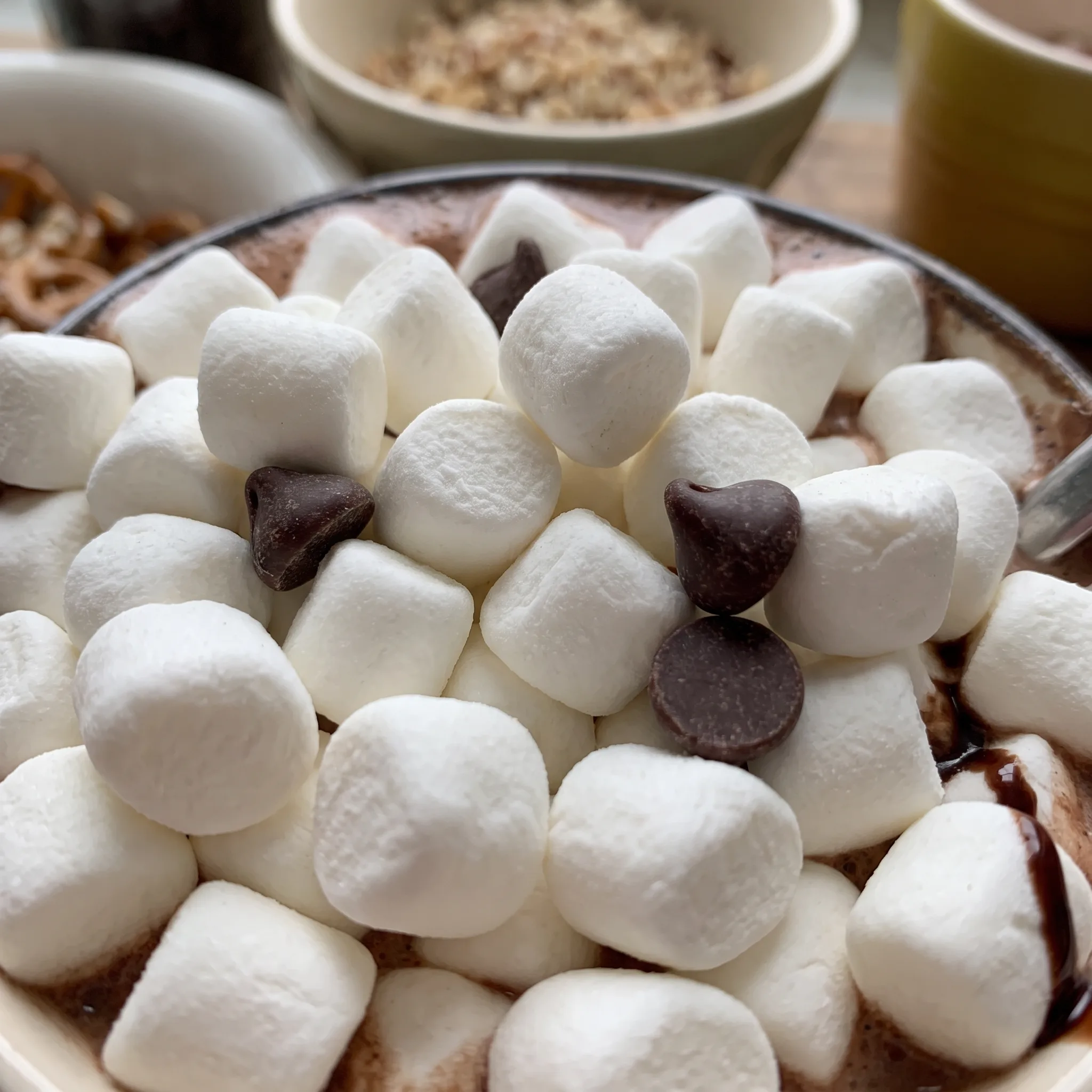
A mug of rich hot chocolate is a base, not a finished drink. Crunchy, salty, and creamy toppings give you contrast against the sweet, heavy liquid: crushed pretzels for salt, broken cookies for snap, whipped cream for coolness.
Set them out and suddenly everyone’s cup is different. That’s the draw. Self-serve means guests tailor their own without you playing bartender, and it keeps the host free to refill the slow cooker or chat.
Use a muffin tin lined with paper cups or a row of small bowls to hold each option. Group similar textures together so the spread reads at a glance.
The display should look abundant but not cluttered; a few well-chosen toppings beat a chaotic pile. When the bar is ready, people linger, and the hot chocolate stays the center of attention.
Sugar, a dial you turn
Start with three-quarters of a cup. That’s intentionally shy of sweet. Toppings like cookies, whipped cream, and flavored syrups bring their own sugar, and a batch that tastes balanced on its own can turn cloying once loaded.
Taste the hot chocolate after it’s fully warmed, before you set out the cups. If it needs more, stir in a spoonful at a time and give it a minute to dissolve. You can always add, but you can’t take away.
The cocoa’s bitterness should still come through, a faint edge behind the sweetness. When you sip, the finish should feel clean, not sticky.
That’s your cue that the ratio is right for the crowd you’re serving. Adjust to your own preference; there’s no single correct number.
What to buy and what form it should be in
Dutch process cocoa powder: Dutched cocoa is darker and less acidic than natural, and its lower acidity keeps the milk from tightening up.
Granulated sugar: Plain white sugar dissolves cleanly in warm milk; coarse or raw sugar leaves a sandy trace at the bottom of the mug.
Whole milk: Whole milk’s fat buffers the cocoa’s bite and gives body; anything leaner reads thin once the cream and toppings hit.
Heavy cream: Heavy cream is the richness dial here, so if you pour in more milk instead, expect a lighter, less coating cup.
Vanilla extract: Real extract, not imitation, since the alcohol cooks off and leaves only the round, slightly floral note behind.
Reading the pot: what tells you the hot chocolate is where it should be
Telling a warm batch from a scalded one
Low holds the milk below a simmer, so the surface stays still and a spoon dragged through leaves a trail that closes slowly. If you see bubbles breaking at the edge or a skin forming fast, the pot’s too hot. Cut it off and whisk.
Grainy flecks that won’t smooth out mean the dairy has already turned, and no amount of stirring brings it back.
Deciding when the cocoa has actually dissolved
After the blender, the mixture should look glossy and even, with no dry pockets lurking at the bottom of the jar. Cocoa settles the moment it hits the pot, so scrape the jar and stir right away. Any powder you leave behind reads as a chalky streak in the finished cup, and once it’s in the milk, it won’t disperse.
The two-hour mark as a check, not a deadline
Warmth to your liking is the real finish line, and two hours on low is the reference point, not a rule you obey. Taste at that point. If the cocoa still bites too hard against the sugar, give it another fifteen minutes and stir.
Push longer and you risk the dairy breaking, which no stir fixes.
Knowing when the sugar is right before the cups go out
Taste after the batch is fully warm, before anyone ladles. Three-quarters of a cup is deliberately shy, because cookies, whipped cream, and syrups add their own sugar. The cocoa’s bitter edge should still show behind the sweet.
If it tastes flat or sticky, add a spoonful at a time and let it dissolve.
Slow Cooker Hot Chocolate Bar with Toppings
Ingredients
Method
- In a blender, combine the cocoa powder, sugar, salt, and 1 cup of the whole milk. Blend until smooth.
- Pour the blended cocoa mixture into a slow cooker, ensuring you scrape out every bit.
- Pour in the remaining 5 cups of milk, heavy cream, and vanilla extract. Stir to combine.
- Cover the slow cooker and set it to low. Cook for approximately 2 hours, stirring occasionally. The hot chocolate is ready once it’s warmed to your liking. (Don’t cook on high; this can curdle the milk.)
- To get your toppings just the right size, use a nut grinder, small food processor, or a mini blender. Pulse down cookies, pretzels, and nuts to your desired coarseness. Once you’ve prepped all your toppings, grab a muffin tin and line it with muffin liners, or use miniature bowls, to organize and display each choice.
- Organize your serving area with the Crock-Pot of warm hot chocolate, any sauces and/or toppings, and whipped cream. Ensure hot chocolate cups are available for guests to use.
- Once warmed, ladle the hot chocolate into mugs. Top with your preferred toppings and enjoy!
Swap the dairy, never the cocoa (and why)
Dutch process cocoa powder: Natural cocoa powder is not a safe substitute here. The recipe’s sugar and color are built around Dutched cocoa’s lower acidity and darker hue. Natural cocoa is more acidic and lighter in color.
It will fight the milk, potentially causing it to tighten or curdle, and the hot chocolate will taste sharper and look pale. If you must use it, start with the same amount the recipe calls for and adjust sugar after tasting, but expect a different, less smooth result.
Heavy cream: Replace the 2 cups heavy cream with additional whole milk (so 8 cups total milk). The body turns lighter and less coating.
The cocoa’s bitterness may show more, so taste after warming and add sugar if needed. This is the swap for a leaner cup.
Whole milk: For dairy-free, use unsweetened oat milk or canned coconut milk (full-fat) in the same amount. Avoid skim or watery plant milks. Oat milk gives a neutral base with some body; coconut milk adds a distinct flavor and more richness.
Both can curdle if heated too fast, so keep the slow cooker on low and stir often. The result won’t be as thick as with dairy, and you may need less sugar since these alternatives can taste sweeter.
Granulated sugar: For a lower-sugar version, reduce to 1/2 cup and taste after warming. For a different sweetener, try coconut sugar or maple syrup, but start with the same amount and adjust after tasting.
Less sugar lets the cocoa’s bitterness come forward, which some prefer. Coconut sugar adds a slight caramel note and doesn’t dissolve as cleanly, so you might see a faint speck at the bottom.
Maple syrup thins the liquid slightly and brings its own flavor. Add sweeteners gradually; you can’t take them out.
Tips
- Pulse the cookies, pretzels, and nuts in short bursts and stop while the pieces are still uneven, roughly the size of peppercorns. A finer, powdery crumb dissolves into the drink on contact and turns the topping bar into a paste, while a coarser, even crumb sits on the surface long enough to be tasted. Keep each topping in its own small bowl with a spoon, and set the bowls on a tray you can move in one trip; loose crumbs spread across a counter get tracked into the hot chocolate and the floor.
Holding, Reheating, and Leftovers That Keep
Serve within the first hour of the two-hour cook for the best texture: the cocoa stays suspended and the surface stays fluid, no skin yet. Leftovers keep in the fridge up to 3 days in a sealed container. Cold, the fat separates and a skin forms; that’s normal.
Reheat on low heat or in the slow cooker on warm, whisking often. Never boil, or the dairy curdles and no whisk fixes it. Freezing doesn’t work: the milk and cream break, and thawing leaves a grainy, separated liquid.
For serving, ladle from the warm pot into mugs and add whipped cream and toppings immediately, so crunch and coolness stay intact. If you’re setting out a stored portion, reheat it gently first, then top at the last second.
Frequently Asked Questions
Can I make this hot chocolate bar ahead of time for a party?
You can blend the cocoa, sugar, salt, and 1 cup of milk up to a day ahead and stash it covered in the fridge; give it a stir before it goes in the slow cooker, since cocoa settles. But the cooking itself has to happen close to serving, because the batch holds its best texture within the first hour after the two-hour cook. Set out the toppings in their muffin tin or bowls ahead, and keep anything crunchy sealed until guests arrive.
Leftovers keep in the fridge up to 3 days, so if you’re working with a stored portion, reheat it gently and add whipped cream and toppings at the last second.
Why did my slow cooker hot chocolate curdle?
The pot ran too hot, most likely because it was set to high or left on low well past the point where the dairy was warm enough. Once milk breaks, the grain stays, and no amount of whisking brings it back. If you see bubbles breaking at the edge or a skin forming fast, cut the heat and whisk hard; sometimes you catch it early.
Other things to check: whether the cocoa went in as a smooth slurry from the blender, and whether your slow cooker runs hot on its low setting, since some do.
How is this different from regular stovetop hot chocolate?
Stovetop means standing at the pot, and this recipe trades that for a slow cooker set to low for about two hours, so you can set out the topping spread while it warms. The blender step is the other real difference: cocoa powder forced into cold milk disperses evenly instead of seizing into pebbles the way it does when it hits a hot pot. What you get is a big, steady batch that stays warm for a crowd, and a texture that’s fluid and even rather than something you have to keep rescuing with a whisk.
