
Watery raspberry pretzel salad almost always traces back to frozen berries that thawed on the counter before they went in, and a cream cheese layer that never quite reached the pan’s edge. Get those two right and the whole thing works.
What you’re building is a study in contrast: a buttery pretzel base that shatters under a fork, a tangy cream cheese middle that stays firm, and a jewel-toned raspberry top that quivers just enough to know it set. The salty-sweet swing is the reason this raspberry pretzel salad keeps showing up at potlucks decades after it first did.
Where most people trip is patience at the seams, the parts that don’t look like they matter until they do.
The cream cheese layer is the only barrier between a water-based gelatin topping and a dry, crunchy pretzel crust. If that layer does not cover the crust completely, edge to edge, the gelatin’s liquid finds the exposed pretzel and the crust turns soft and soggy. The fat in the cream cheese and whipped topping repels water, so a continuous seal is what keeps the pretzels crisp.
Why does a warm crust ruin the cream cheese layer?
Pull the baked crust from the oven and it’s still giving off heat from the butter that soaked into the pretzels. That warmth will loosen the cream cheese mixture the moment it touches down. You’ll see the spread start to slump at the edges, and the neat layer you aimed for turns into a slippery pool that never quite firms back up.
A fully cooled crust feels neutral against your palm, no warmth lingering. The baked set of the pretzels and butter creates a firm, almost brittle surface that keeps the cream layer sitting on top instead of working its way down into the crevices. If the crust is still warm, the fat in the cream cheese softens too much, and the whole structure loses its grip.
Give it twenty minutes on the counter, or slide it into the fridge if you’re in a hurry. The surface should feel cool and dry before you proceed.
What keeps the pretzel base from getting soggy?
The cream cheese layer isn’t just a filling. It’s a seal. Spread it all the way to the pan’s edges, pressing gently so it meets the glass or metal on every side.
Any gap, even a thin one, gives the wet gelatin a path down to the pretzels. The fat in the cream cheese and whipped topping pushes water away, so the gelatin sits on top instead of soaking through. If the seal breaks, the pretzels lose their snap within an hour.
You’ll know because the base starts to taste damp and the bars sag when you lift a corner. A complete cover means the crust stays crunchy for days.
Run a spatula along the edge of the dish to check that none of the pretzel mixture is peeking through. The cream layer should look like a smooth, unbroken blanket from corner to corner.
Why frozen raspberries instead of fresh?
Fresh berries would water down the topping and leave it tasting thin. Frozen ones do two jobs at once. As they thaw in the hot gelatin, they release cold juice that starts the mixture setting right away, so you’re not waiting on the fridge alone to firm it up.
That early chill also keeps the berries intact instead of turning them to pulp. The flavor is sharper and more concentrated than fresh, almost like a jam that hasn’t been cooked. You get bursts of tartness against the sweet cream and salty pretzels.
Add them while they’re still frozen solid. If they’ve thawed in the bag, the topping turns soupy and the texture goes flat.
A handful straight from the freezer frosts the surface of the gelatin as you stir. That’s exactly what you want.
The four-hour chill is not optional
Set a timer. Four hours in the fridge is the minimum for the gelatin to firm up enough to slice. Pull it out early and the topping will slide off the cream cheese in wet sheets when you cut.
The cream layer itself needs that time to firm up and support the weight of the fruit and gelatin. If it’s still loose, you’ll see it wobble like a waterbed when you nudge the pan.
A fully set salad holds a clean edge on the knife and the layers stay bonded. Press the surface with a fingertip: it should feel firm and barely give. The pretzels underneath stay crisp because the cream layer has had time to settle into its role as a barrier.
After a full chill, each square lifts out with all three layers intact. That’s when it’s ready.
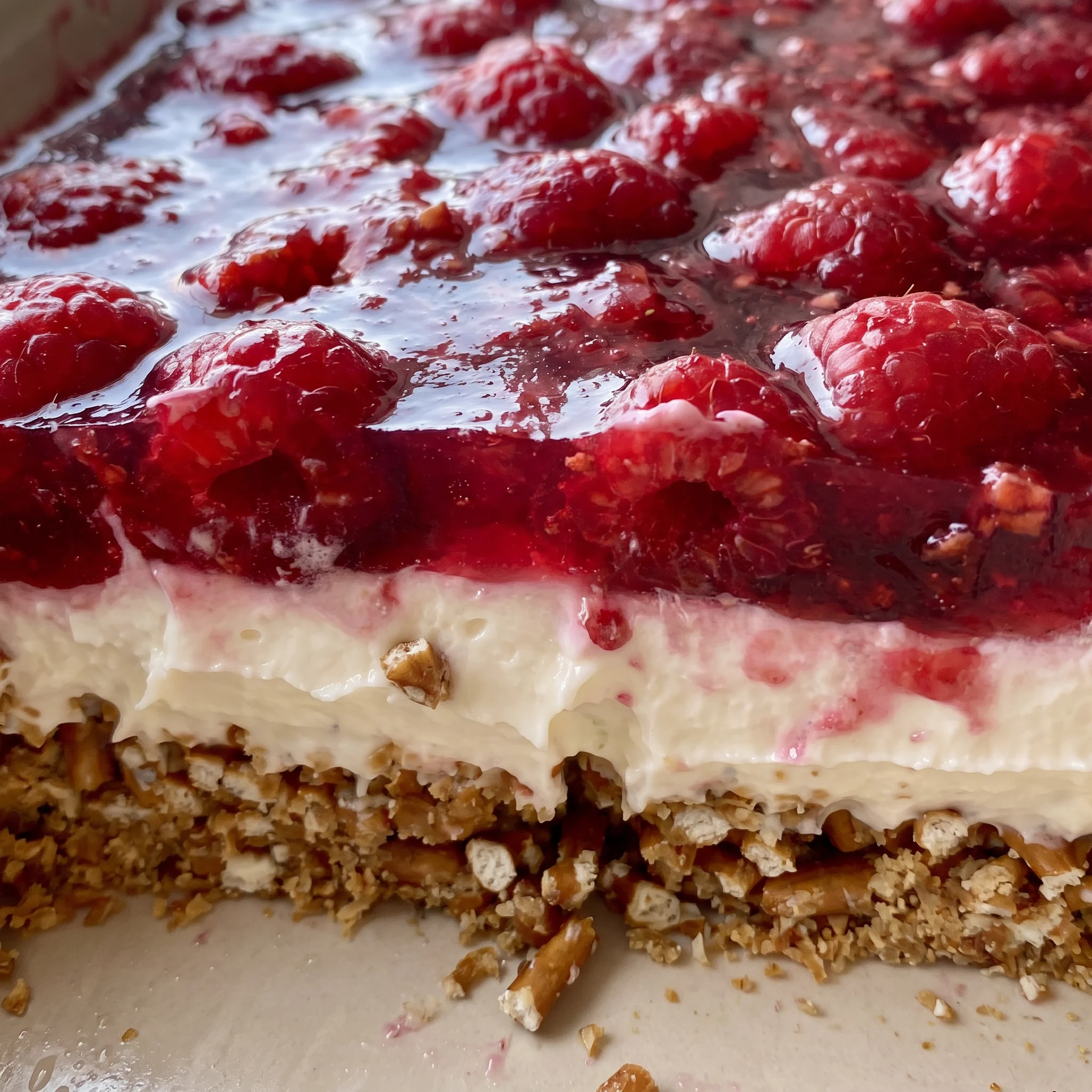
Read the Label Before You Melt, Beat, or Pour
Pretzels: Crush them to a mix of fine crumbs and visible shards so the base packs tight but keeps some snap.
Unsalted butter: Use unsalted so the salty pretzels stay the only source of salt in the crust.
Cream cheese: Full-fat blocks, not spreadable tub cream cheese, which stays soft and never firms into a seal.
Whipped topping: Thaw it in the fridge until it’s scoopable, since cold clumps won’t fold smoothly into the cream cheese.
Raspberry gelatin: The 6-ounce box, not two 3-ounce boxes, so the topping sets firm enough to slice cleanly.
How to Read This Salad While You’re Building It
Judging the press on the pretzel base
Press until the mixture stops moving under your palm and the surface looks matte, not glossy. Loose patches feel springy and shift when you push; those spots will crumble when you cut.
Use the flat bottom of a measuring cup to even it out. If the butter pools at the edges, you’ve overpressed.
A properly packed crust feels dense and slightly slick from the butter, and it holds a fingerprint for a second before fading.
When the cream cheese layer is smooth enough to seal
Beat until you can’t see or feel any lumps when you rub a bit between your thumb and finger. Lumps mean the cream cheese was still cool, and they’ll leave channels for the gelatin to seep through.
Scrape the bowl once and beat again. Fold in the whipped topping just until no white streaks remain; overworking deflates it and makes the layer thin. The finished mixture should hold a soft peak when you lift the spatula.
Reading the set of the gelatin before you pour
The gelatin should be liquid but slightly thickened, like warm syrup, when you add the frozen raspberries. If it’s still steaming hot, it will melt the cream cheese layer on contact. Let it cool for a few minutes until you can hold your hand against the side of the bowl without flinching.
The berries will frost the surface and start to set the mixture immediately. Pour gently over the back of a spoon to avoid digging into the cream layer.
Testing the chill without cutting in
After four hours, nudge the pan. The gelatin should barely wobble, and a fingertip pressed into the center should meet firm resistance with no give. If it still ripples, it needs more time; cutting now means the topping slides off in sheets.
The cream layer underneath should feel set, not soft. When it’s ready, the blade of a knife will come out clean and the layers will stay bonded as you lift a square.
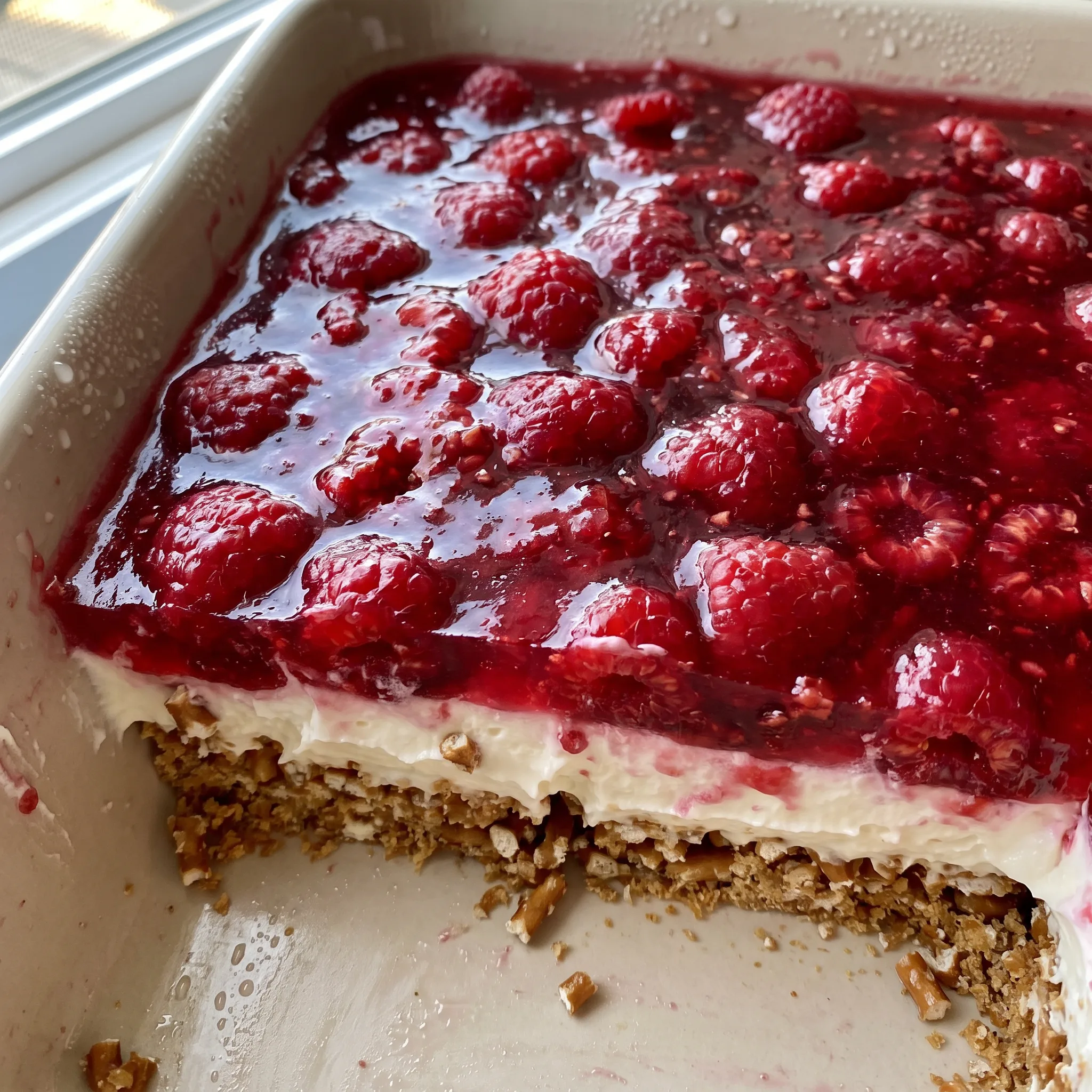
Raspberry Pretzel Salad with Cream Cheese
Ingredients
Method
- Set oven to 350°F (175°C).
- In a mixing bowl, stir together the crushed pretzels, melted butter, and 3 tablespoons sugar.
- Firmly press the mixture into the bottom of a 9×13-inch baking dish.
- Bake the crust for 10 minutes, then allow it to cool completely.
- Beat the softened cream cheese with 1 cup granulated sugar until smooth.
- Gently fold in the whipped topping.
- Spread the cream mixture over the cooled pretzel crust.
- Dissolve the raspberry gelatin in 2 cups boiling water.
- Add the frozen raspberries to the gelatin mixture.
- Pour the gelatin mixture over the creamy layer.
- Refrigerate for at least 4 hours, or until fully set.
- Slice into squares or rectangles to serve.
Storing and Serving Raspberry Pretzel Salad
Cover the dish tightly with plastic wrap pressed to the surface, or transfer cut squares to an airtight container. The gelatin will weep moisture into the air, and exposed pretzel edges pull that moisture back in within a few hours. Eat within two to three days.
The cream layer stays fine longer, but the crust softens day by day, and by day four the base tastes damp instead of snappy. Serve cold, straight from the fridge, within ten minutes of pulling it out.
A square left on the counter for half an hour sags at the cut edge. If you want it back to its best, chill the portion again for fifteen minutes before eating. Freezing the assembled salad doesn’t work; the gelatin and whipped topping separate and the pretzels go limp.
You can freeze the baked crust alone for up to a month, wrapped well, then thaw and build on it later.
Tips
- Crush the pretzels in two batches and stop when the pieces are mostly fine crumbs the size of peppercorns, then sift out any shards larger than a pea and re-crush them. Shards that size survive the 10-minute bake as hard pebbles that tear the cream cheese layer when you spread it and crack loose when you cut squares.
- Measure the 2 cups of pretzels after crushing, not before. Whole pretzels vary in density, so 2 cups of large pieces can crush down to under 1 1/2 cups of crumbs, leaving the 3/4 cup of melted butter to pool and the crust to bake greasy and loose instead of firm.
Swap the Three That Hold This Salad Together and Expect a Different Bar
Crushed pretzels: Salted pretzel sticks or thin twists work, but crush them to a mix of fine crumbs and shards rather than a uniform powder. Gluten-free pretzels are a straight one-for-one if you need them. The base sets the salt line for the whole dish, so a sweeter cracker in this spot leaves the cream cheese tasting flat.
Too fine a crush and the crust bakes into a hard slab that shatters when you cut. Gluten-free pretzels often run drier and absorb more butter, so add it a tablespoon at a time until the crumbs just hold when squeezed.
Whipped topping: Real whipped cream, whipped to soft peaks, can replace it. Start with the same 8 ounces the recipe calls for and fold gently.
Whipped cream is less stable, so the cream layer stays softer and the seal against the pan edge gets sloppy sooner. It also carries more water than the tub version, which is the one thing standing between the gelatin and the pretzels.
Use it only if you plan to eat the whole pan within a day.
Raspberry gelatin: Sugar-free raspberry gelatin sets up thinner and can weep liquid after a day in the fridge. Unflavored gelatin with raspberry juice needs testing, since the juice brings its own sugar and acidity that change how firmly it sets. The 6-ounce box is what firms the topping enough to slice, so a lighter box gives you a soft set that slumps off the cream layer.
If you go sugar-free, add an extra half teaspoon of unflavored gelatin to the boiling water and let it dissolve fully before the berries go in.
Cream cheese: Neufchatel or a light block cream cheese can stand in, but not the spreadable tub kind, which never firms into a seal. Plant-based cream cheese works if it’s the firm block style. Lower-fat cream cheese is softer at room temperature and stays that way, so the barrier over the pretzels is weaker.
Expect the crust to lose its snap a day earlier than with full-fat. The spreadable tub product is the one swap here that ruins the dish outright; it stays loose no matter how long you chill it.
Frequently Asked Questions
Can I make raspberry pretzel salad the night before?
Yes, and it often slices cleaner the next day. The gelatin gets a longer, more complete set, so the topping holds a sharp edge when you cut. Keep it covered in the fridge overnight.
Just know that by the next day the pretzel base has already started to soften. The salad is best within two to three days, so eating it the day after you make it is well within that window. If you want the crust at its snappiest, serve it the same day you assemble it.
Why is my raspberry pretzel salad watery?
The usual culprit is frozen raspberries that thawed before they hit the gelatin. They release their juice into the mixture instead of frosting the surface, and that extra liquid thins the topping. Use them straight from the freezer.
A second check is the cream cheese layer: if it wasn’t spread all the way to the pan’s edges, the gelatin seeps down and the top looks wet. Make sure that layer is a complete seal before you pour.
If the salad has already been sitting a while, some weeping at the cut edges is normal, especially after day two or three.
How do I keep the pretzel crust from getting soggy?
The cream cheese layer has to cover the entire crust, corner to corner, with no thin spots. That fat-rich layer is what blocks the wet gelatin from reaching the pretzels.
Press it gently into the edges so it meets the pan all the way around. If you see any pretzel peeking through, smooth more cream over that spot. Once the salad is assembled, the crust will stay crisp for a couple of days; after that it softens no matter what you do.
Can I use fresh raspberries instead of frozen?
You can, but the topping will be looser and the flavor less concentrated. Frozen berries do two things: they chill the gelatin as they thaw, which starts the set immediately, and they hold their shape better. Fresh berries won’t bring that cold, so the mixture stays warmer longer and the set takes more time in the fridge.
If you do use fresh, keep them whole and expect a softer topping. The salad will still taste good, just different in texture.
How long does raspberry pretzel salad last in the fridge?
Two to three days is the sweet spot. The cream layer holds up longer, but the pretzel base loses its snap day by day. By day four the crust tastes damp instead of crunchy.
Cover the dish tightly with plastic wrap pressed to the surface, or move cut squares to an airtight container. Serve it cold, straight from the fridge, within ten minutes of pulling it out.
A square left on the counter sags at the cut edge, so chill any portion again for fifteen minutes before eating.
