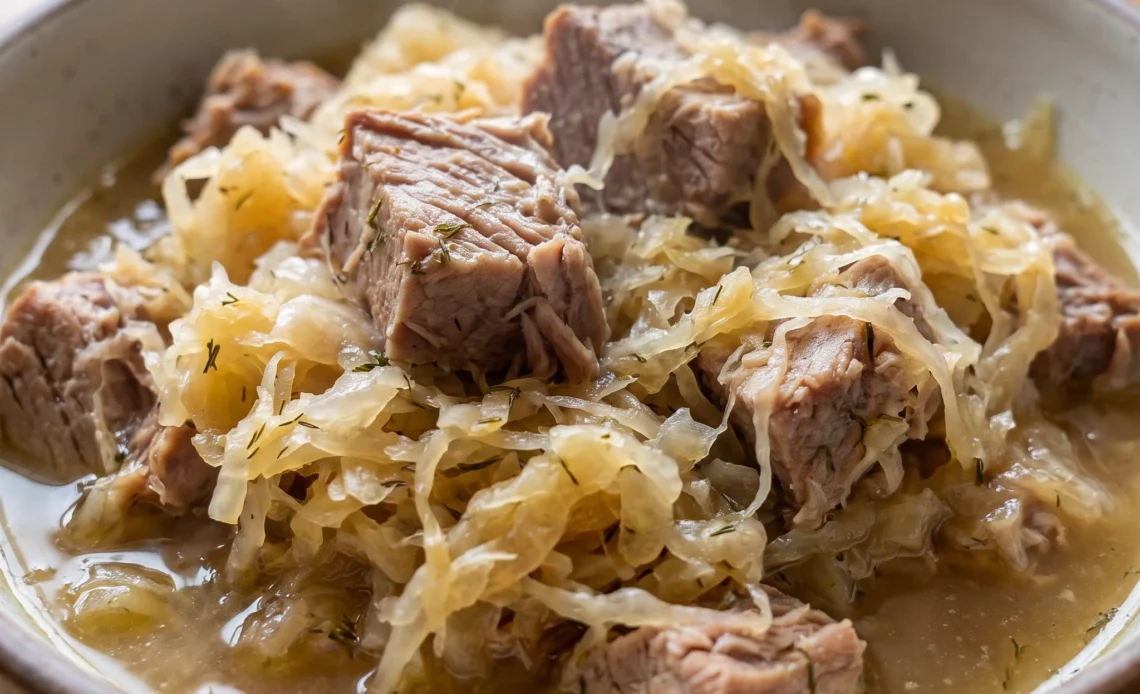
Sauerkraut doesn’t cook down into something soft and mild, and this pot isn’t trying to make it. What you get is pork and sauerkraut with the kraut still tasting like kraut.
Assembly takes about as long as browning nothing and chopping nothing, fifteen minutes of dumping and one firm press to sink the meat, then the slow cooker takes over. The hard part isn’t the cooking.
It’s knowing when to pull the apple half before it collapses into the brine and sweetens the whole batch, and recognizing the point where the pork gives easily but hasn’t started to shred. Get those two calls right and dinner is tangy, tender, and unmistakably German-American.
Miss them and you’ll still eat well, just sweeter and softer than intended.
Why is there a whole apple half in the sauerkraut?
That apple half isn’t meant to be eaten. It goes in whole, cut side down, and gets fished out before the pork hits the table.
While it cooks, it softens and releases a mild sweetness that takes the sharp edge off the sauerkraut’s acidity. The effect is subtle: the kraut tastes rounder, not like dessert. What you’re after is a gentle balance, and a whole half does that without turning the dish into something sweet.
If you leave it in, it breaks down completely, clouding the liquid and pushing the whole pot toward candy territory. I’ve pulled a stray chunk out too late and the difference is noticeable.
So when the pork is tender, scoop out what’s left of the apple and toss it. The sauerkraut should still taste like sauerkraut, just less biting.
Two heat settings, one reason
Starting on High for the first hour gets the pork cooking right away and brings the whole mixture up to a safe temperature fast. After that, dropping to Low for the remaining five hours lets the meat finish gently. That slow finish is what makes the pork tender without turning the sauerkraut into soft, lifeless strands.
Keep it on High the whole time and the kraut goes limp while the pork might still be tough. The two-stage approach gives you both: pork that shreds under a fork and sauerkraut that still has some bite. You’ll know it’s working when the liquid barely simmers and the smell turns mellow, not sharp.
When the pork gives no resistance to a fork, it’s done. That’s the cue to pull the apple and serve.
How does the liquid ratio affect texture?
A 32-ounce jar of sauerkraut, juice and all, brings plenty of moisture on its own. No broth or water needed; adding more would dilute the flavor and leave you with a soupy pot. The beer contributes depth and a mild acidity, and since the alcohol cooks off during the long simmer, what’s left is a subtle maltiness that backs up the kraut.
Cut the pork into one-inch cubes so they cook evenly and end up distributed through every spoonful. If the cubes are uneven, some will shred while others stay chewy.
After six hours, the liquid should just cover the meat and kraut, not drown them. Taste a piece of pork: it should be tender but still hold its shape. That’s when you know the ratio is right.
What do garlic, mustard, and dill bring?
Garlic and onion salt form the savory base, seasoning the pork and sauerkraut from the inside out as they cook. Dry mustard adds a quiet tang that sharpens the kraut’s natural acidity without making it sour.
Dill brings a fresh, herbal note that cuts through the richness of the pork, especially after hours of slow cooking. None of these shout; they’re background players.
Together they nudge the dish toward a German-American profile that feels familiar but not heavy. You won’t taste any one seasoning distinctly, and that’s fine.
What you will notice is a rounded, savory flavor that doesn’t rely on the sauerkraut alone. When you lift the lid, the aroma should be tangy, herby, and a little sweet from the apple. That’s your sign the seasonings have done their job.
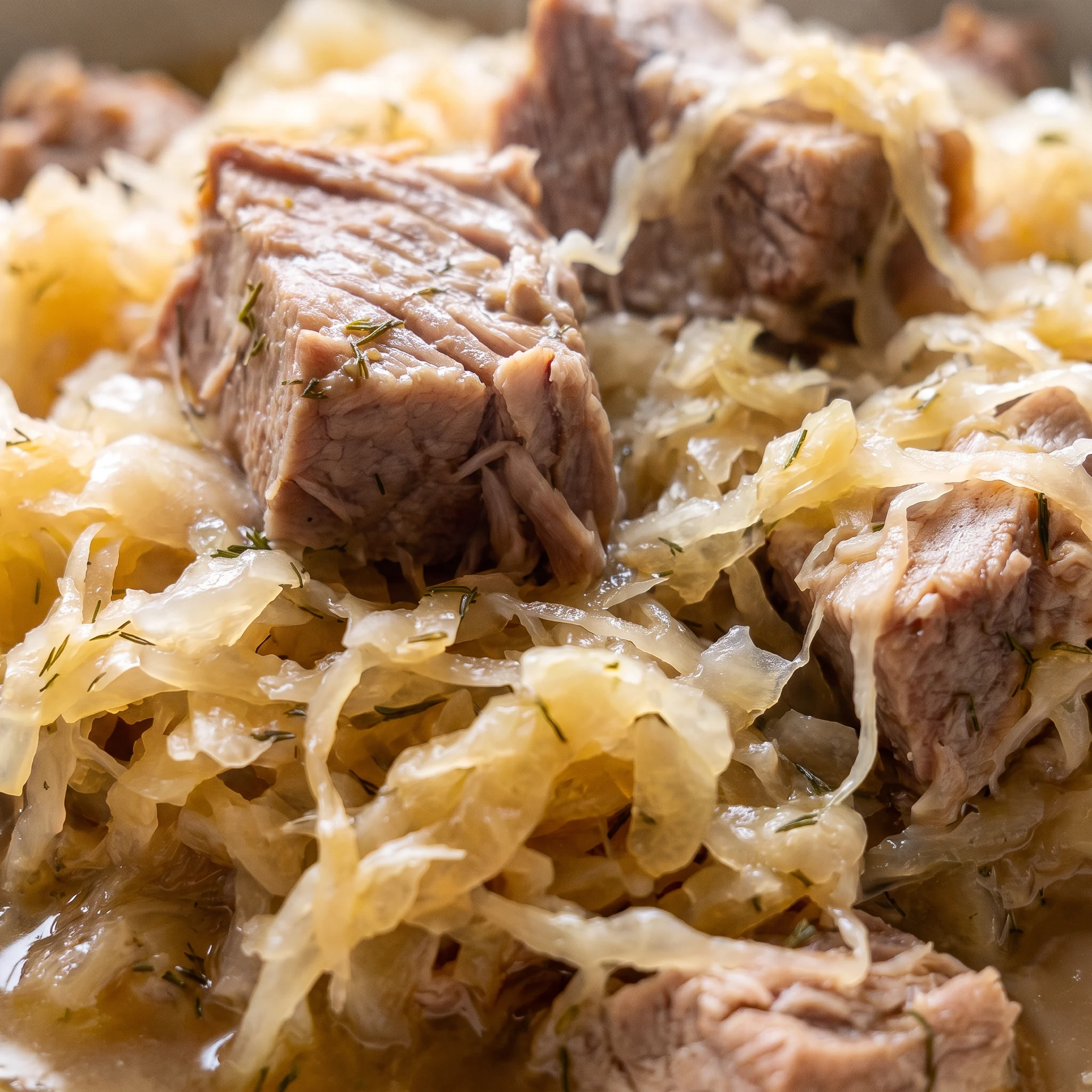
The four ingredients that decide how this pot turns out
Sauerkraut: Buy a jar packed in its own juice, not the kind rinsed and re-brined, because that liquid is the only moisture this dish gets.
Pork roast: Cut it into 1-inch cubes yourself rather than buying pre-cut stew meat, which is often uneven and cooks to different textures in the same pot.
Beer: A plain lager or pilsner works; anything hoppy or dark will leave a bitter edge that the sauerkraut can’t hide.
Apple: A firm, tart apple like Granny Smith holds its shape through six hours, while a soft one collapses early and sweetens the whole pot.
What to watch for once the lid goes on
Reading the first hour on High
After 60 minutes on High, lift the lid and look. The liquid should be steaming, with small bubbles breaking the surface around the edges.
If it is still cold or barely warm, your cooker runs cool; switch to High for another 30 minutes before dropping to Low. If it is already at a hard boil, the cooker runs hot, so drop to Low early. This first check tells you how your particular machine behaves.
Judging the pork by feel, not by the clock
At the five-hour mark on Low, pull a cube of pork and press it to the touch or cut it with a fork. It should give way with almost no resistance, but still hold its shape.
If it shreds apart at a touch, you are past tender and into falling-apart; the meat will still taste fine, but the texture will be soft. If it resists, give it another 30 minutes and check again.
When the sauerkraut still has bite
Sauerkraut can go from tender-crisp to limp in the last hour. Taste a strand at the five-hour mark. It should still have a slight chew, not dissolve on your tongue.
If it is already soft, the pork is likely done too; pull the apple and stop cooking. If the kraut is still crunchy and the pork is tender, you have a mismatch: the pork is ready, so remove the apple and serve, accepting the extra crunch.
The apple’s last call
The apple half softens as it cooks, and near the end it can start to break down. After five hours on Low, check it: if it still holds its shape, leave it until the pork is done.
If it is collapsing into the liquid, pull it out now with a slotted spoon. Left too long, it clouds the juices and sweetens the whole pot. A little sweetness is fine; a lot turns the dish dessert-adjacent.
Reading the liquid level at the end
After six hours total, the liquid should just cover the meat and kraut, not swim above it. If there is too much, remove the lid and let it cook on High for 15 to 20 minutes to reduce.
If the top is dry, add a splash of beer or water. The ratio matters for texture: too wet and the kraut loses its edge, too dry and the pork tightens.
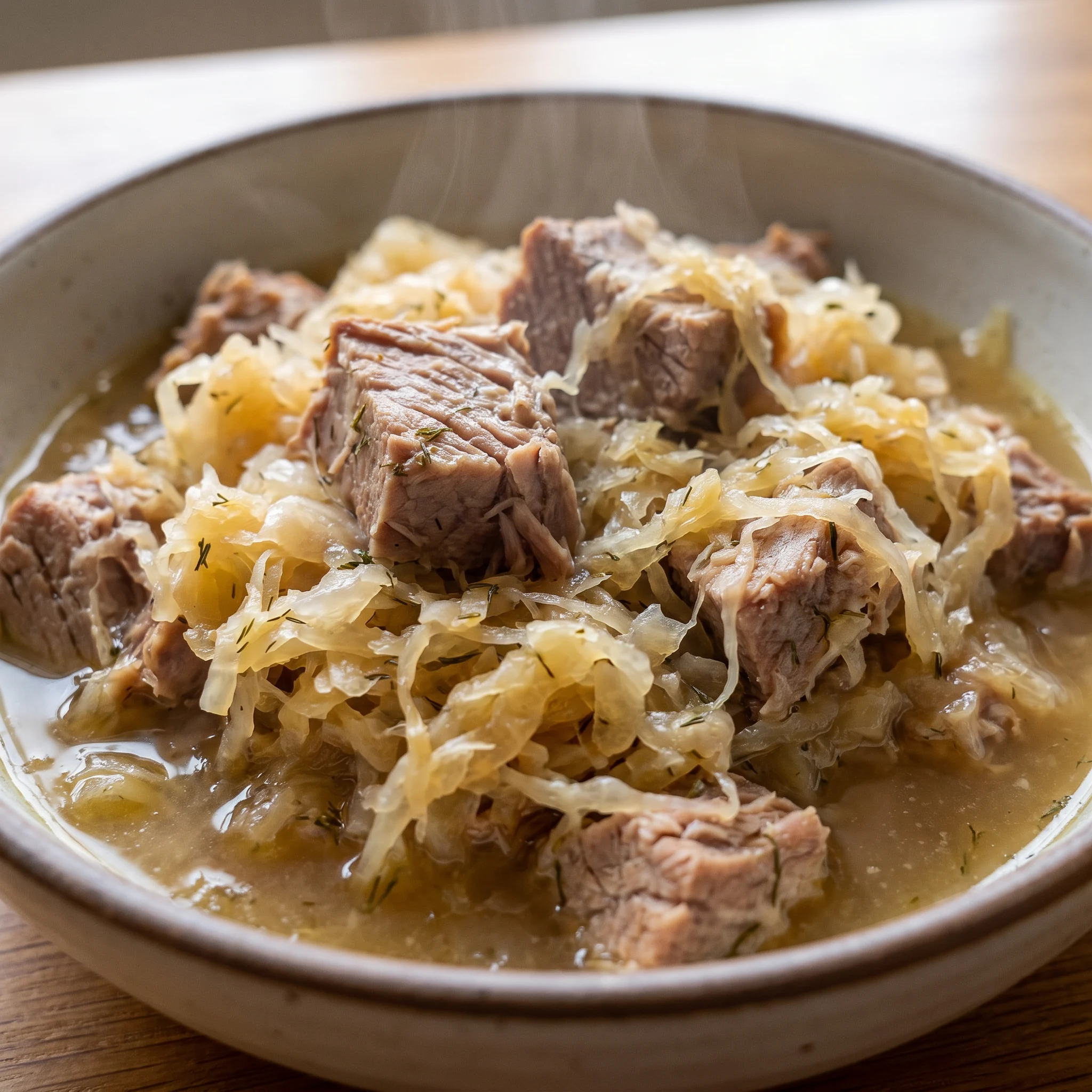
Slow Cooker Pork and Sauerkraut with Apple
Ingredients
Method
- Combine the sauerkraut with its liquid, pork cubes, beer, garlic, onion salt, dry mustard, and dill in a slow cooker, stirring until evenly mixed. Submerge the apple half by pressing it into the mixture.
- Cook on High for 1 hour. Turn the setting to Low and continue cooking until the pork is done, about 5 more hours. Remove and discard the apple before serving.
Swap the Beer, Not the Ratio
Beer: For a non-alcoholic version, use the same amount of a light vegetable broth or a mix of broth and a splash of apple cider vinegar. If you want to keep some maltiness, a non-alcoholic lager works too.
Broth alone will taste flatter and less complex, but the sauerkraut and pork still carry the dish. A splash of vinegar brings back some of the tang the beer would’ve added, so start with a teaspoon and taste the liquid before cooking.
Non-alcoholic lager gets you closer to the original, though the finish is a bit sweeter.
Pork roast: Pork shoulder or pork butt are the best stand-ins for the roast called for here. If you only have pork loin, you can use it, but watch the clock closely. Shoulder and butt have more fat and connective tissue, so they stay tender through the long cook and might even shred a little at the end.
Loin is leaner and can dry out after five hours on Low; start checking at four hours and pull it as soon as a cube gives easily to a fork.
Onion salt: Use 1 teaspoon of onion powder plus 1/4 teaspoon of table salt. If you’re watching sodium, cut the salt to 1/8 teaspoon and add more at the table.
You’ll get the same savory onion flavor, but the salt level is in your hands. The sauerkraut is already salty, so starting with less salt is safer; you can always add a pinch after tasting the finished dish.
Sauerkraut: No swap. The 32-ounce jar with its juice is the backbone of this dish, and changing the amount or rinsing it will throw off the liquid balance and the flavor.
Rinsing the sauerkraut washes away the brine that seasons the pork and provides all the moisture. Using less sauerkraut means less liquid and a weaker tang; using more overwhelms the pork.
Leave it as written.
Tips
- Press the pork cubes down into the sauerkraut and beer so they sit mostly submerged before you close the lid. Any cube left poking above the liquid cooks by steam alone and comes out dry and firm on the exposed side, while the submerged meat stays tender. The sauerkraut is dense enough to hold the cubes in place, so a single firm press at the start is all it takes.
Storage, reheating, and when to eat it
Eat this the day you make it if you can. Right after the six hours, the pork still holds its shape and the sauerkraut has a little chew left. That contrast is the whole texture of the dish, and it fades.
Cool leftovers within two hours and refrigerate in a sealed container. It keeps four days. Each day the kraut softens and the flavors sharpen and intensify, so day three tastes more sour and more seasoned than day one, and the pork goes from tender to shreddy.
Reheat a portion in a saucepan over medium-low with a splash of beer or water, covered, just until it steams. The microwave works but tightens the pork at the edges. Don’t boil it; that’s what dries the meat out.
If you’re freezing, freeze only the pork and kraut without the liquid pulled to the top, up to two months; the kraut goes limp on thaw, so plan to eat it as a topping rather than a side. Serve in shallow bowls with the juices spooned over.
If you want dill on top, add it after reheating, never before storing.
The apple half is a flavor-balancing tool: its sugars and mild acidity mellow the sauerkraut’s sharpness during the long cook. If left in, the apple breaks down completely, turning the sauerkraut overly sweet and cloudy. Removing and discarding it before serving prevents this.

Frequently Asked Questions
Can I cook this on Low the whole time instead of starting on High?
You can, but the pork takes longer to get going and the sauerkraut sits in a cooler pot, so it stays crunchier. The one hour on High gets the whole mixture steaming fast, which is why the recipe starts there. On Low the whole way, plan on the pork needing extra time, and check it by pressing a cube: it should give easily but still hold together.
The sauerkraut will still have some bite, which some people prefer.
How do I know when the pork is done without overcooking it?
A cube of pork should give way with almost no resistance when you press it, but still hold its shape. If it shreds at a touch, it’s past tender and the texture goes soft; if it resists, give it more time. The sauerkraut is your other cue: it should still have a slight chew, not dissolve.
When both line up, pull the apple and serve.
Can I make this ahead and reheat it later?
You can cook it, cool it within two hours, and refrigerate it; it keeps four days. Reheat a portion in a saucepan over medium-low with a splash of beer or water, covered, just until it steams. The microwave works but tightens the pork at the edges.
Don’t boil it, and add any fresh dill after reheating, not before storing.
What’s the difference between this and traditional German sauerkraut and pork?
Traditional versions often use cuts like pork shoulder or ribs and simmer on the stovetop or in the oven, sometimes with juniper or caraway. This one goes in a slow cooker with beer, garlic, mustard, and dill, and a whole apple half for subtle sweetness. The pork is cubed, so it cooks evenly and mixes through the kraut.
The result is a set-it-and-forget pot with a milder, herby profile than many stovetop versions.
