
Dried black-eyed peas are the one New Year’s dish that punishes a crowded stove. Soak them overnight and they still demand a pot you have to watch, and on January first every burner is already spoken for.
A slow cooker black-eyed peas recipe sidesteps that fight entirely, but the trade is real: the pot hides everything, so you’re cooking blind for most of the day. The peas give up their starch slowly and the liquid thickens on its own schedule, which means the pot likker tells you more at the end than any peek at hour three ever will.
Get the pork and the broth right going in and the rest is patience. Get them wrong and no amount of last-minute salt rescues it.
Seven Cups, Locked In
Seven cups of chicken broth in a slow cooker look excessive next to a stovetop pot. On the stove, steam escapes, liquid reduces, and a cook tops off the pot as it cooks down. A sealed slow cooker traps that steam.
The lid stays on, the moisture cycles back into the peas, and the broth you poured at the start is the broth you serve. That’s why the amount matters more here than on a burner. Change it and you change the pot likker: less broth and the peas sit in a thick, starchy paste; more and the liquid stays thin and the peas taste washed out.
Mid-cook, the level can look low. Topping it off dilutes what the peas have already given up, and the final seasoning won’t land right. Judge the level at the end, not at hour three.
The finished pot should have enough liquid to spoon over rice, with a slight body from the peas themselves.
How the Pork Builds Its Two Tiers
Bacon and smoked sausage don’t go in at the same time, and that’s deliberate. The bacon fries first, about five minutes, until the fat renders and the edges curl.
That fat stays in the pan and becomes the cooking medium for the onion, celery, garlic, and thyme. Toss the bacon back into the slow cooker at the start and it dissolves into the peas, giving every spoonful a deep, salty pork note. Hold it back, crumble it over the bowl at the end, and you get crisp shards against the soft peas, plus a cleaner broth underneath.
Both are good, just different bowls. The sausage goes in raw, diced, right with the peas.
Over seven hours, its smoke and paprika bleed into the broth, and the peas soak that up without turning the whole pot into a smoke bomb. Two pork elements, two jobs. One seasons from within; the other finishes on top.
Seasoning Before the Long Haul
Dried black-eyed peas absorb salt slowly, and they don’t distribute it evenly if you wait. Creole seasoning, bouillon powder, paprika, and a bay leaf go in at the start, with the raw peas and the broth. As the peas plump, they pull in that seasoned liquid, so the flavor reaches the center of each pea, not just the skin.
Bouillon powder does the heavy lifting as a salt-and-savory baseline; without it, the peas come out flat even if you salt later. The final salt adjustment happens after the peas are tender because only then can you taste the real balance. Early salting can also keep the skins tight, so the peas stay firm longer than you want.
Taste a spoonful of broth and a pea together before you decide. A pot that tastes right at hour two often tastes weak at hour seven.
The peas will tell you.
The Texture Comes from the Peas Themselves
No thickener, no puree, no cornstarch slurry. The body of this pot comes from the peas breaking down on their own.
A long, gentle simmer softens the outer skins, and some peas collapse entirely, releasing their starch into the broth. That starch is what gives the pot likker its slight creaminess and cling.
The peas you want to see are mostly whole, plump, and yielding when pressed with a spoon, not falling apart into a uniform paste. Stirring too often, or lifting the lid to check, lets heat out and disrupts the even cooking. The peas at the bottom stay cooler and firmer while the ones near the top soften faster.
Leave it alone, and the texture settles into something consistent. Scoop a spoonful from the edge and one from the center before serving; they should feel the same.
If they don’t, give it more time.

What to Buy and How to Prep It
Dried black-eyed peas: Buy dried peas, not canned; sort and rinse to remove shriveled peas and any small stones before they go in.
Bacon: Choose thick-cut bacon so the chopped pieces render fat without turning to crisps before the vegetables go in.
Smoked sausage: Use a firm smoked sausage like andouille; dice it small so each piece disperses its smoke evenly through the pot.
Creole seasoning: Creole seasoning varies in salt; taste yours first, since the bouillon powder already adds a salty baseline.
Fresh thyme: Fresh thyme leaves strip easily from the stem; mince only the leaves and discard the woody stems.
What to Look For When Only the Pot Can Tell You
Judging the Bacon Before It Goes Too Far
The bacon is ready when the fat has rendered and the edges curl, about five minutes. If it’s still pale and floppy, keep going; if it’s dark brown, you’ve gone too far and the fat will taste bitter.
That fat is what cooks the vegetables, so it needs to be liquid and plentiful, not burnt. Pull the bacon out when it’s crisp but not hard, and leave the fat behind.
If you’re garnishing later, set it aside now; otherwise, it goes back in the pot and will soften into the peas.
When the Vegetables Are Sweated, Not Browned
Onion, celery, garlic, and thyme go into the bacon fat for about three minutes. You want them soft and glossy, not colored.
If they start to brown, the garlic will turn bitter and the onion will taste roasted rather than sweet. The pan should smell fragrant, not acrid. If the heat is too high, pull the pan off early; the residual heat will finish the job.
These vegetables are the base, and their flavor should stay clean, not caramelized.
Reading the Broth at the End, Not Mid-Cook
After seven hours, the peas should be tender and the liquid should have body, enough to spoon over rice. If the broth looks thin and watery, the peas haven’t given up enough starch; give them more time, lid on.
If it’s thick like paste, you’ve lost too much liquid, but you can stir in a splash of broth or water to loosen it. Don’t judge the level at hour three; the steam is still cycling, and it will look lower than it is.
Tasting for Salt After the Peas Are Tender
Salt goes in at the end, once the peas are soft. Before that, the peas are still absorbing liquid and salt won’t distribute evenly. Taste a pea and a spoonful of broth together.
If the broth tastes seasoned but the peas taste flat, they need more time to absorb. If both taste salty, add a splash of unsalted broth.
The Creole seasoning and bouillon already carry salt, so adjust carefully. A pot that tastes right at hour two often tastes weak at hour seven.
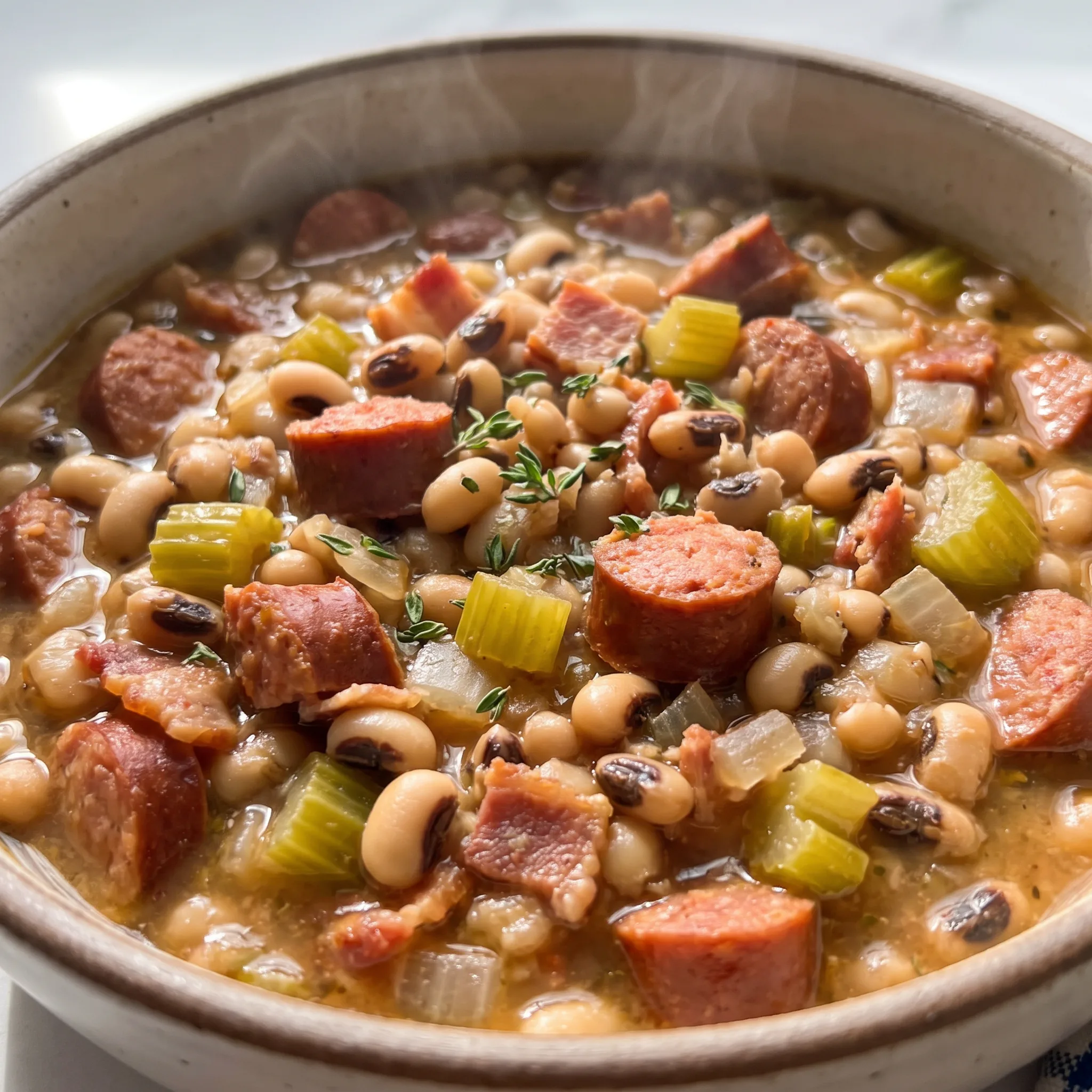
Slow Cooker Black-Eyed Peas with Smoked Sausage
Ingredients
Method
- In a pan, fry the bacon for about 5 minutes. Take it out and transfer to the slow cooker, or reserve for garnishing later.
- Place onion, garlic, celery, and thyme into the pan; cook for about 3 minutes, then take the pan off the heat.
- Put the black-eyed peas into the slow cooker.
- Introduce the sausage, bay leaf, paprika, Creole seasoning, bouillon powder, pepper, and the sautéed vegetables into the slow cooker.
- Add the chicken broth. Mix, put the lid on, and simmer on high for 7 hours. Keep the lid closed throughout cooking.
- Once the peas are done, season with salt and modify the seasoning as desired.
- Top with the cooked bacon and serve.
Swap With the Salt in Mind, Not Just the Name
Smoked sausage: Use a different smoked sausage or add 1 teaspoon of liquid smoke. Andouille is the default for a reason: its coarse grind holds up over seven hours and its smoke is bold enough to season the whole pot.
A softer sausage like kielbasa breaks down into the broth and the peas lose that distinct pork smoke. If you go with a milder sausage, the pot will taste flatter. Adding liquid smoke to a mild sausage brings the smoke back, but a little goes far; start with 1/2 teaspoon, taste the broth after a few hours, and add more only if the smoke is faint.
Too much and the whole pot tastes like an ashtray.
Creole seasoning: Use Cajun seasoning, or a mix of paprika, garlic powder, onion powder, cayenne, and black pepper. Creole seasoning is a salt-forward blend; Cajun often has more cayenne and less salt.
If you swap one for the other, the heat and the salt both shift. Taste your blend first, then decide how much bouillon to add.
A homemade mix without salt means you’ll need more salt at the end, but wait until the peas are tender to add it. The goal is a seasoned pot, not a spicy one; you want the peas to taste like peas with a background hum, not a five-alarm chili.
Bouillon powder: Use 7 cups of salted chicken broth and skip the bouillon, or use 7 cups unsalted broth plus 1 tablespoon of soy sauce or 1 teaspoon of salt. Bouillon powder is your baseline salt and savory depth. If you use salted broth, you’re adding salt twice; the pot can turn salty before the peas are tender.
Start with unsalted broth and add the bouillon, then adjust at the end. Soy sauce adds a different kind of savory note and a bit of color, but it also brings salt, so treat it like the bouillon and taste before adding more.
Without any of these, the peas taste flat no matter how much salt you add later.
Bacon: Use 2 tablespoons of bacon fat or 1 tablespoon of olive oil plus 1/2 teaspoon of smoked paprika. Bacon does two jobs: it renders fat to cook the vegetables and it adds a salty pork note. If you skip the bacon, you need another fat for the vegetables and another source of smoke and salt.
Bacon fat gives you the fat and some pork flavor; olive oil with smoked paprika gives you fat and smoke but no pork. In either case, you’ll want to taste the broth at the end and adjust salt, since you’re missing the bacon’s salt.
The texture of the peas won’t change, but the depth will be lighter.
After the Pot Cools: Storage, Reheating, and When to Eat It
Eat this the day it’s made if you can. The peas hold their shape, the pot likker is spoonable, and bacon added at the end stays crisp.
As the pot sits, the peas keep drinking broth and the starch tightens the liquid, so day-two leftovers come out thicker, more stew than soup. That’s fine, it just needs loosening.
Reheat on the stove over low heat with a splash of chicken broth, stirring until the likker flows again. Skip the microwave if texture matters; it heats unevenly and can pop the peas. Refrigerate within two hours in a shallow container, lid slightly vented until cool, then sealed.
The pork and long simmer mean it keeps about four days in the fridge and three months frozen, though the peas go softer after thawing. Freeze in portions with their liquid.
Reheat from frozen on the stove, adding broth as needed. Add the reserved bacon only at serving; it softens in storage and reheats limp.
Tips
- Sort the peas on a sheet pan in a single layer under good light, then slide them into a colander and rinse. Broken peas and split skins release their starch early, so a handful of them thickens the broth into paste by hour seven while the intact peas are still firm; shriveled ones never soften at all and read as hard bits against the tender ones. Pulling them out takes a few minutes and keeps the whole batch on the same clock.
Dried black-eyed peas need to absorb water through their seed coats before starch can gelatinize, and both salt and acid slow that hydration by strengthening pectin and proteins in the coat. This recipe delays salt until after the peas are tender and uses a sealed slow cooker, so the peas hydrate in a nearly neutral, non-evaporating liquid; salting at the start would instead firm the skins and leave the centers chalky even after seven hours.

Frequently Asked Questions
Can I put everything in the slow cooker at once instead of frying the bacon and vegetables first?
You can, but you lose the fat that carries the rest of the pot. Tossing raw bacon in with the peas means no rendered fat to cook the onion, celery, garlic, and thyme, so those vegetables go in raw and taste sharper and more sulfurous after seven hours instead of sweet and soft.
The bacon itself turns pale and spongy rather than crisp, and its salt spreads unevenly through the broth. If you’re short on time, the closest shortcut is to skip the bacon entirely rather than dump it in raw.
Why are my black-eyed peas still hard after 7 hours on high?
Most likely the lid came off, or the peas were old. Every peek releases the trapped steam that’s doing the cooking, and the pot never gets back to the temperature it held before.
Old dried peas, especially ones that have sat in the pantry for a couple of years, will stay chalky no matter how long they simmer; squeeze one to the touch and if it’s still firm at the center with no give, age is the culprit. Check that the peas were sorted and rinsed, since a batch with a lot of shriveled ones will cook unevenly.
If the lid stayed on and the peas are fresh, give them more time with the lid sealed; the pot will tell you when they’re done.
How far ahead can I make these black-eyed peas for New Year’s Day?
Up to four days in the fridge, or three months frozen in portions with their liquid. Cook them the day before and they’ll be thicker the next day, since the peas keep drinking broth and the starch tightens the likker; reheat on the stove over low heat with a splash of chicken broth to loosen it.
If you’re freezing, thaw overnight in the fridge and reheat the same way. Hold the bacon back until you serve it, because it softens in storage and reheats limp. Eat them the day they’re made if you can, since that’s when the peas hold their shape best.
What makes this slow cooker version different from traditional stovetop black-eyed peas?
The sealed pot changes how the liquid behaves, and that changes the whole dish. On the stove, steam escapes and a cook tops off the pot as it cooks down; here, seven cups go in and seven cups come out, so the broth you pour at the start is the broth you serve. The pork also works in two tiers: some bacon goes in at the start to season from within, or it stays out and crumbles over the bowl at the end for crunch against the soft peas.
The texture comes from the peas breaking down on their own, no thickener needed, which gives the pot likker a slight body that clings to a spoon.
