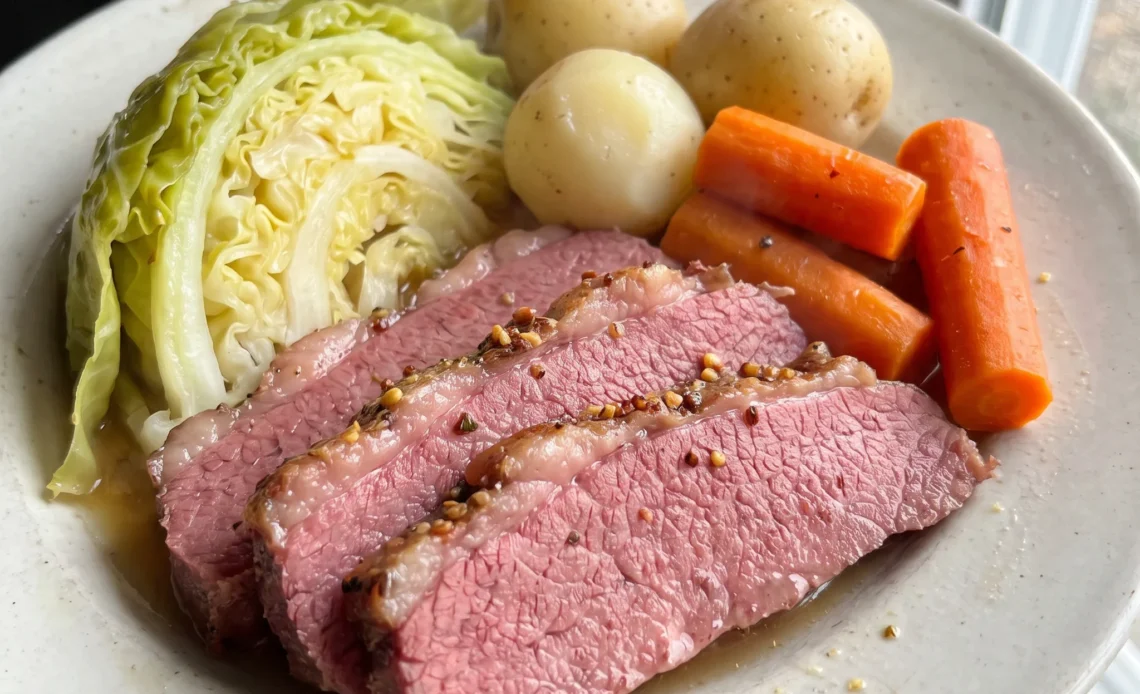
Ninety minutes of pressure and a quarter hour of sitting builds the whole dinner, but the margin for error hides in what happens right after: the meat comes out, the liquid gets strained, and the vegetables go in for a quick pass. Get that sequence wrong and you’re eating soft cabbage with dry beef. Get it right and a four-to-five pound flat brisket plus cabbage, carrots, and potatoes feeds eight at 340 calories a serving.
Corned beef and cabbage rewards patience more than skill. The vegetables cook in broth the meat already seasoned, so they taste like the roast, not like boiled cabbage. Whole grain mustard at the table, and that’s the plate.
Why Does the Brisket Sit on the Rack and Face Fat Up?
Resting the beef on the steamer rack lifts it clear of the liquid below. That gap keeps the meat in steam, not in the beer and broth.
If the brisket were submerged, it would stew. The result would be a pot-roast texture: loose, watered-down, and tasting more of the liquid than of the cured beef. The fat cap faces up for a reason.
As the heat builds, that fat renders and drips down the sides, basting the lean meat underneath. Fat side down would trap the fat against the rack and leave the top dry.
With the cap on top, the surface stays glossy and the meat picks up some richness from its own drippings. The rack also keeps the seasoning packet and garlic from washing off into the liquid.
They stay on the meat where they can do their work. When you lift the lid, the brisket should look lacquered and smell of spice and garlic, not of boiled meat.
Why Do the Vegetables Go In After the Beef?
Cabbage, carrots, and potatoes can’t take the same pressure time as a four-pound brisket. They would collapse into a soft, shapeless mass long before the meat is sliceable. So the beef cooks first, alone.
Once it’s out and resting, the liquid gets strained. That step removes spent peppercorns, bay leaf, and the spent seasoning packet, which by then have given all they have. Leaving them in would make the broth bitter and gritty.
The strained liquid goes back into the pot, now rich with beef and beer. The vegetables go in and cook briefly under pressure.
In that short window they absorb the seasoned broth without turning to paste. Cabbage keeps some bite, carrots stay sweet, potatoes hold their shape.
The broth that comes out is concentrated enough to spoon over the sliced meat. Taste a piece of carrot straight from the pot: it should carry the corned beef flavor all the way through.
Why Does the Beef Need a 25-Minute Rest?
The pressure release and the rest are part of cooking the brisket, not a pause after it. When the pressure drops naturally, the meat finishes gently. A quick release would jolt the brisket: the sudden change in pressure tightens the muscle fibers, and you get a tougher, drier slice.
Letting the pressure fall on its own for 15 minutes keeps the meat relaxed. Then the beef comes out and sits for 10 to 15 more minutes. During that off-heat rest, juices that were pushed to the center migrate back out.
The fibers reabsorb them. Slice too soon and those juices end up on the board, leaving the meat crumbly and dry.
Wait, and each slice stays moist. The brisket should still be warm when you cut it, but not steaming. A thin slice should bend without breaking.
That’s your cue that the rest did its job.
What Do the Beer and Broth Actually Do in the Pot?
The beer and beef broth aren’t just there to make steam. They season the meat from below while the seasoning packet and garlic work from above.
That two-sided approach gives you a deeper flavor than water alone could. An ale or other non-bitter beer adds a malty backbone that plain water lacks. Skip the IPA or anything aggressively hoppy; those turn harsh under pressure and leave a bitter edge in the broth.
The broth itself is salty and beefy, so it reinforces the cure. Two cups of liquid is enough to create the steam needed for pressure cooking without rising high enough to touch the meat on the rack.
If you used more, the brisket would boil. The seasoning packet and smashed garlic go on top, where they cling to the fat cap and crust. As the fat renders, it carries some of that spice down the sides.
The result is a brisket that tastes seasoned all through, not just on the surface.
How Should You Cut the Cabbage, Carrots, and Potatoes?
Different densities need different treatment. Cabbage is mostly water and goes limp fast under pressure, so it’s cut into wedges or thick slices, not shredded. Shreds would disintegrate.
Wedges keep their shape and still cook through. Carrots and potatoes are denser. They need to be in chunks about the same size as each other: roughly one-and-a-half to two inches.
If carrots are left whole and potatoes are quartered, the potatoes will overcook before the carrots are tender. Cut them to a similar size and they finish together. When you open the pot, the cabbage should be translucent and soft but still in pieces.
Carrots should give slightly when pierced with a knife. Potatoes should be creamy inside, not falling apart. If the cabbage has vanished into the broth, the pieces were too small.
If the potatoes are still firm, they were cut too large. Aim for vegetables that hold their shape on the plate.
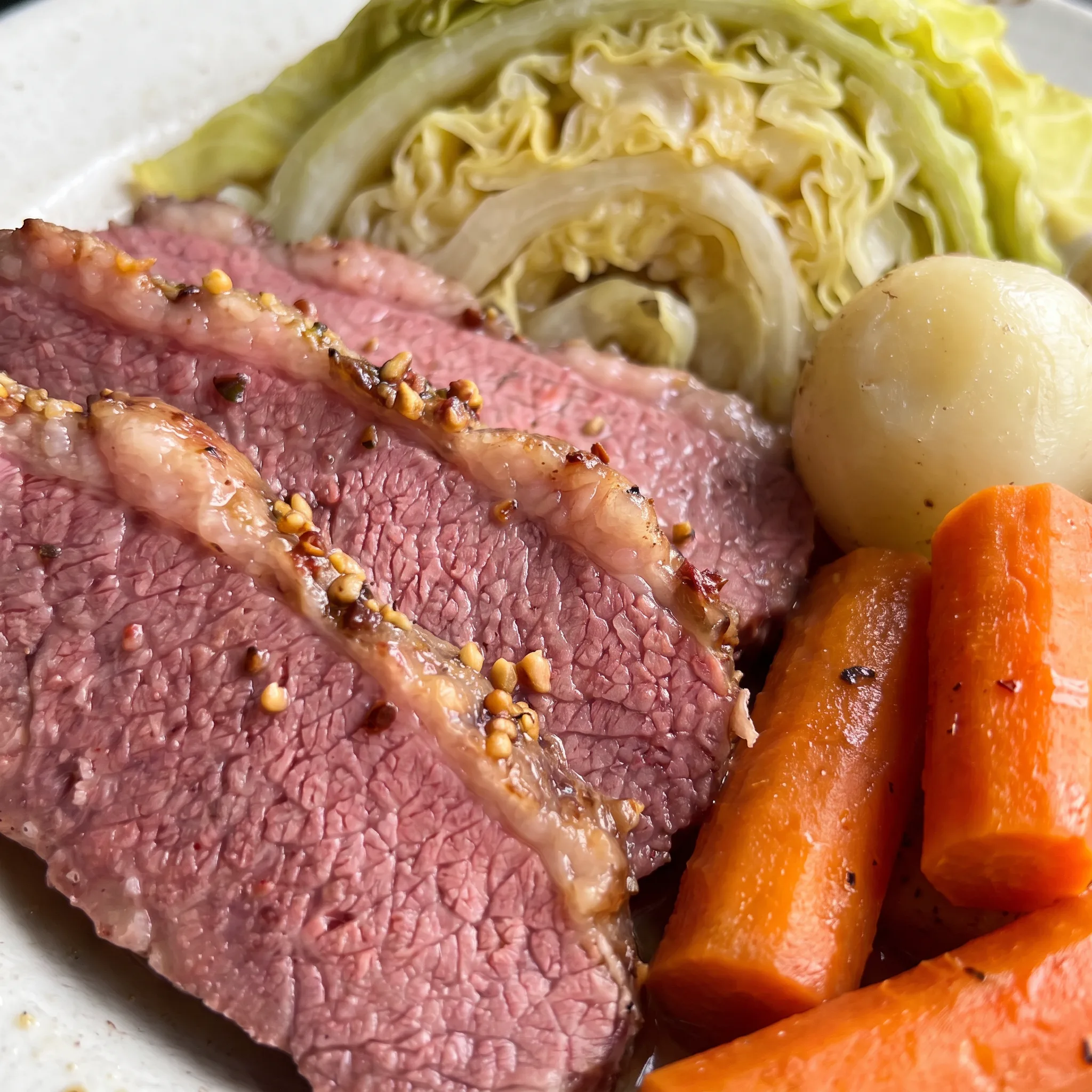
What to Buy and How to Prep for This Pot
Flat corned beef brisket: Buy a flat cut with the seasoning packet included; the even thickness slices cleanly and fits the 4, 5 lb range.
Beer: Choose an ale or other non-bitter beer; hoppy styles turn harsh under pressure and leave a bitter edge in the broth.
Garlic cloves: Smashed, not minced, so they stay put on the fat cap and release flavor without burning.
Cabbage: Cut into thick wedges, not shreds, so the pieces hold their shape through the short pressure cook.
Carrots and small white potatoes: Cut both into roughly 1 1/2 to 2 inch chunks so they finish cooking at the same time.
How to Read the Pot at the Moments That Decide This Dish
Reading the pressure release before you open the lid
The card says natural release for 15 minutes, then quick-release what’s left. That 15-minute window is where the brisket finishes.
If you hear a steady hiss and the pin is still up after 15 minutes, hit the quick-release. If the pin drops on its own before 15 minutes, the seal was loose and the meat got less time under full pressure. It will still be tender, but check a slice for resistance before you commit to the full rest.
Judging the brisket by how it slices, not by the clock
After the 10 to 15 minute rest, cut one thin slice from the narrow end. It should bend without cracking and the fibers should separate with a gentle pull.
If it crumbles, the meat went past tender: slice thicker and spoon liquid over each portion. If it fights the knife, the brisket needed more time under pressure. Return it to the pot with a cup of the strained liquid and give it 10 more minutes at high pressure.
Knowing when the vegetables are done before they collapse
Five minutes at high pressure is a short window and the pot keeps cooking after the quick-release. Open the lid as soon as the pin drops.
Piercing a carrot with a knife should meet slight resistance, not a slide. Cabbage should be translucent but still in wedges. If the cabbage has started to break into threads, you lost it.
The potatoes tell you the most: creamy when cut, not watery at the edges.
Tasting the strained liquid before the vegetables go in
After you filter out the peppercorns and seasoning, taste a spoonful of the liquid. It should be salty, beefy, and slightly malty from the beer.
If it tastes flat or watery, the vegetables will come out bland because that broth is their only seasoning. If it tastes harsh or bitter, the beer was too hoppy. A splash of broth or a pinch of salt fixes flat.
Nothing fixes bitter, so taste before you commit the vegetables.
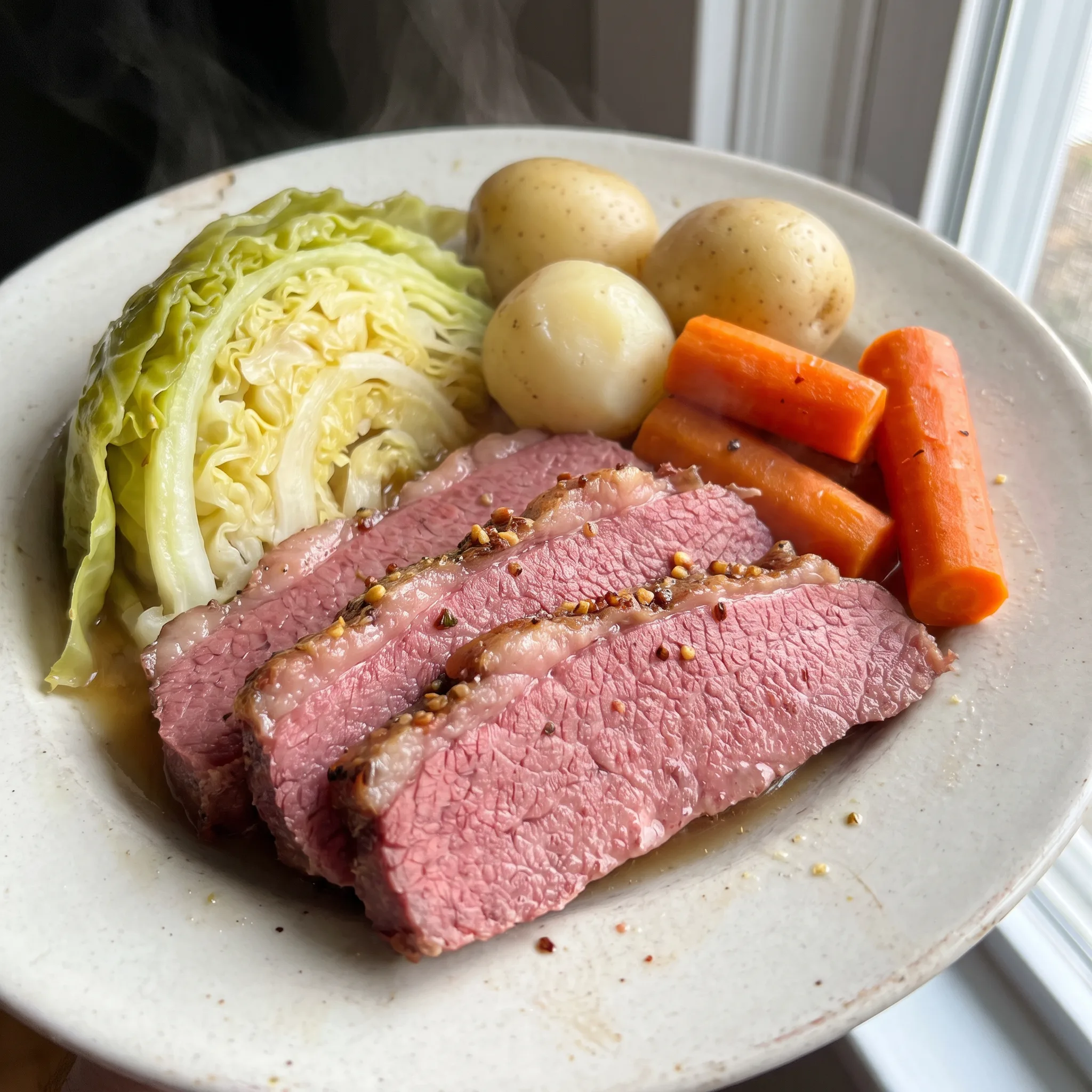
Instant Pot Corned Beef and Cabbage
Ingredients
Method
- Take the corned beef out of its packaging and rinse it well to eliminate extra salt and brine.
- Place the beef on the steamer rack inside the Instant Pot, with the fat side facing up. Apply the seasoning packet evenly over the top and distribute the smashed garlic cloves over it.
- Introduce the bay leaf and crushed red pepper to the beef. Pour the beer and beef broth over everything.
- Cook under high pressure for 90 minutes. Let the pressure come down naturally for 15 minutes, then quick-release any leftover pressure.
- Take the beef out of the Instant Pot, allow it to rest for 10–15 minutes, then cut it into slices.
- As the beef rests, filter the cooking liquid to eliminate the peppercorns and seasoning, then put the strained liquid back into the Instant Pot.
- Put the cabbage, carrots, and potatoes into the Instant Pot and cook under high pressure for 5 minutes.
- Quick-release the pressure. Place the vegetables and sliced corned beef on a plate, spoon some of the cooking liquid over them, and serve accompanied by whole grain mustard.
What You Can Swap in This Pot, and the Two Things You Shouldn’t Touch
Beer: No ale on hand? Use the same amount of a non-bitter lager, a gluten-free beer, or a 50/50 mix of beef broth and water.
If you want zero alcohol, replace the beer with an extra cup of beef broth. Ale brings a malty backbone that plain broth doesn’t have.
A lager keeps that malty quality but can taste a little cleaner. Gluten-free beer works the same way, though some brands are sweeter. If you go with broth and water, the finished broth will taste beefier and less complex.
Don’t use an IPA or any aggressively hoppy beer: under pressure, those turn harsh and leave a bitter edge that nothing fixes.
Beef broth: Water plus a bouillon cube or a spoonful of Better Than Bouillon, mixed to the same strength you’d want in a soup, works. If you only have water, use it plain. The broth seasons the meat from below and becomes the liquid the vegetables cook in.
Weak broth means bland vegetables and a flat-tasting brisket. Water alone gives you corned beef that relies entirely on the seasoning packet and garlic for flavor. That’s fine in a pinch, but taste the strained liquid before the vegetables go in and add salt if it’s flat.
Flat corned beef brisket: A point-cut corned beef works, but it’s thicker and fattier. Look for one in the same 4, 5 pound range, and if it’s thicker than three inches, add 10 minutes to the pressure time.
Point cut gives you more marbled meat, which can be more forgiving, but it won’t slice as neatly. The pieces will be more irregular and some will shred.
It also throws off more fat into the liquid, so skim the strained broth before the vegetables go in or they’ll taste greasy. Stick with flat if you want clean slices for sandwiches.
The seasoning packet and the rinse step: Leave both alone. The packet is the cure’s built-in spice blend, and it’s calibrated to that brisket. If you toss it and add your own pickling spice, you’re guessing at a ratio you can’t taste until the meat is done.
The rinse step is just as fixed: skipping it leaves the surface salty and the broth will taste like brine. No swap improves either one.
Tips
- Dry the brisket thoroughly with paper towels before you set it on the rack. A wet surface keeps the seasoning packet and garlic sliding around, and they end up in the liquid instead of on the meat. Patting it dry gives the spice something to grip so it stays put through 90 minutes of pressure.
- Trim the fat cap to about a quarter inch thick and even across the whole flat. A thick, uneven cap renders slowly and leaves a waxy layer on top, while a thin patch lets the spice burn onto bare meat. An even quarter inch bastes the brisket as it drips without burying the seasoning packet under unrendered fat.
Storing, Reheating, and the Window for Serving
Serve this the day you cook it. Sliced brisket holds its moisture for about an hour at room temperature, and the vegetables are at their best within 30 minutes of coming out of the pot. Past that window, the cabbage keeps softening and the potatoes go grainy at the edges.
If you’re holding dinner, keep the sliced beef and the strained broth together in a covered pot on the lowest heat, and leave the vegetables in their liquid off the heat.
Leftovers keep four days in the fridge. Store the beef and vegetables in separate containers, both moistened with strained broth, because the meat dries out first and the cabbage releases water that would waterlog the potatoes.
Reheat gently: beef in broth in a covered skillet, vegetables in the microwave covered, or everything together in a 325°F oven for 15 minutes. Freeze only the sliced beef, covered in broth, for up to three months.
The vegetables don’t survive freezing. Whole grain mustard goes on at the table, never on stored portions.
The recipe uses a 15-minute natural release followed by a 10 to 15 minute off-heat rest, rather than an immediate quick-release. A quick-release drops pressure suddenly, causing the brisket’s collagen and muscle fibers to seize and expel moisture, yielding dry, crumbly meat; the gradual natural release lets the pressure equalize slowly, and the subsequent rest allows juices to redistribute throughout the slice. This two-stage rest is what makes the brisket sliceable and moist instead of tough or shredded.

Frequently Asked Questions
Can I make corned beef and cabbage in the Instant Pot ahead of time and reheat it?
Cook it the day you plan to eat it. Sliced brisket holds its moisture for roughly an hour at room temperature and the vegetables peak within 30 minutes of leaving the pot; past that, the cabbage keeps softening and the potatoes go grainy at the edges. If you’re holding dinner for late arrivals, keep the sliced beef and strained broth together in a covered pot on the lowest heat and leave the vegetables in their liquid off the heat.
Leftovers do keep four days in the fridge, stored in separate containers and both moistened with broth, and they reheat gently without drying out. Freezing only works for the sliced beef covered in broth, up to three months; the vegetables don’t survive it.
Why did my corned beef come out tough and dry?
The usual cause is a fast pressure release. When you flip the valve instead of letting the pot come down on its own, the sudden drop tightens the meat and you get a slice that fights the knife and crumbles at the edges. Let the pressure fall naturally for 15 minutes, then release whatever is left.
The other check is the rest: cut into the brisket while it’s still steaming and the juices run onto the board, leaving dry slices behind. A thin slice from the narrow end should bend without cracking; if it cracks, the meat needed longer under pressure, and a second pass with a cup of strained liquid will bring it back.
How is Instant Pot corned beef and cabbage different from the traditional boiled version?
The beef never touches the liquid. It sits on the rack above the beer and broth, so it cooks in steam while the fat cap renders and bastes the lean meat from above.
Traditional boiling submerges the brisket, which pulls flavor out of the meat and into the water and leaves you with a pot-roast texture. Here the seasoning packet and garlic stay put on the surface instead of washing away. What comes out is a lacquered, sliceable brisket rather than a boiled one, and the vegetables cook separately in the strained broth so they pick up its flavor without turning soft.
Do I need to rinse the corned beef before cooking it in the Instant Pot?
Yes, rinse it well. The brine on the surface is concentrated salt, and skipping the rinse leaves the exterior salty while the broth underneath tastes like brine rather than beef and beer.
There’s no swap that improves on this step, so treat it as fixed. Pat the brisket dry afterward so the seasoning packet and smashed garlic cling to the fat cap instead of sliding off into the pot.
What should I serve with Instant Pot corned beef and cabbage?
Whole grain mustard at the table, spooned onto each portion rather than stirred into stored leftovers. The vegetables are already seasoned from cooking in the strained broth, so they don’t need much else; a little of that liquid spooned over the sliced beef ties the plate together.
If you want bread alongside, a sturdy rye or soda bread holds up to the mustard and the salty meat. Keep it simple, since the brisket and its broth carry most of the flavor.
