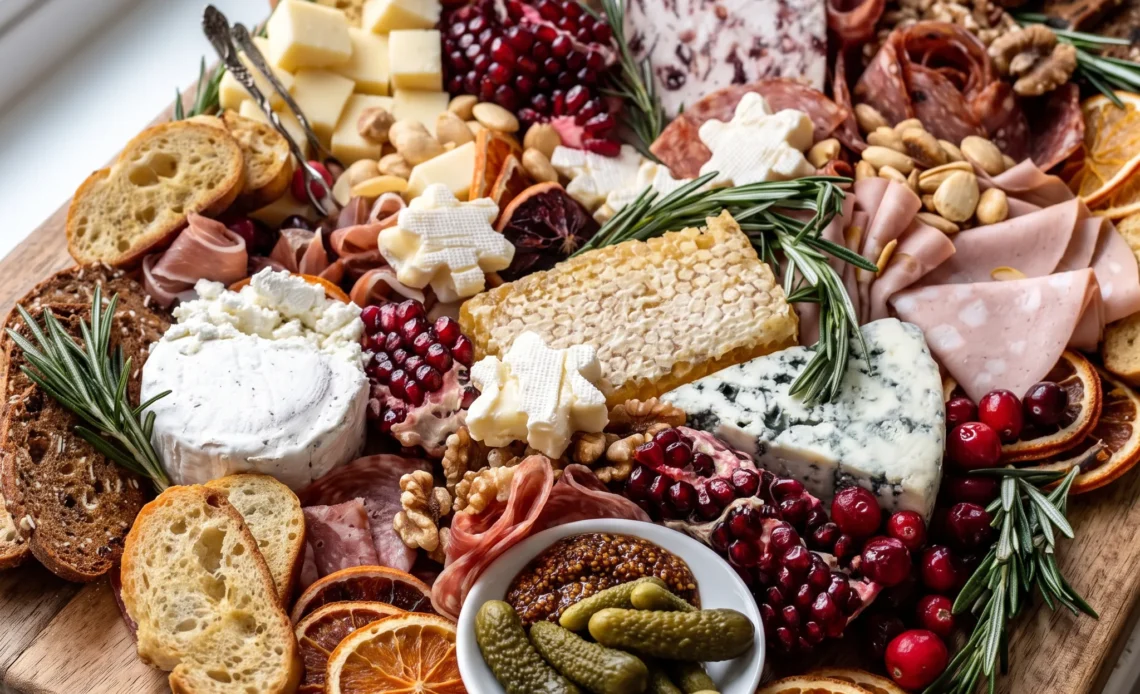
Fifteen minutes gets a holiday cheese board on the table, and almost all of that is placement, not cooking. The real margin for error sits in the surface you choose: everything has to sit in one layer with bare board between the piles, and a surface that’s too small turns the whole spread into a heap before you’ve unwrapped the Brie.
Soft cheeses want to lose their chill first, since cold Brie tears instead of spreading. Wet items like mustard and cornichons are the quiet saboteurs, leaking onto rinds and leaving the board looking tired within the hour.
Get the order and the spacing right and ten store-bought components read as a centerpiece. Get them wrong and you’ve made an expensive pile.
Why This Order Works
Start with the cheeses. In the middle of a large board, they anchor everything else. A wedge of Brie or a log of chèvre won’t slide when someone reaches across for a slice of salami.
The cheeses also stay the visual focus, which matters when you’re feeding a crowd: people see them first and know where to start. Next, the meats go around the cheese, not underneath. If you tuck prosciutto under a wedge of Cheddar, it gets buried and torn when someone pulls out the cheese.
Laid around the edges, the folds of meat stay accessible and invite pairing. Then come the small items: almonds, walnuts, pomegranate quarters, dried cranberries, and honeycomb. These fill the gaps and add texture without overcrowding.
A board that’s packed too tightly feels chaotic and makes it hard to pick anything up. Finally, the mustard and cornichons go into small bowls.
Mustard is runny; cornichons are wet. In bowls, they stay put instead of leaking onto the cheese and making everything sticky. The board stays tidy, and the flavors don’t muddle.
A well-ordered board invites grazing; a jumbled one discourages it.
Five Cheeses, One Balanced Spread
Five cheeses on one board might sound like a lot, but each brings something the others don’t. Chèvre, a goat cheese, is tangy and soft. Sharp Cheddar delivers a firm bite and a pronounced acidity.
Double cream Brie is rich and buttery, almost spreadable at room temperature. Parmesan, broken into rough chunks, offers a salty, crystalline crunch.
Blue cheese, like Saint Agur, is bold and pungent. Together, they cover a range of milk types and textures, from crumbly to creamy to hard.
That variety keeps a group happy: someone who avoids blue can reach for Brie; a fan of bold flavors goes for the blue. The contrast also prevents palate fatigue.
If every cheese were mild, the board would taste flat after a few bites. The sharp Cheddar and blue cheese reset your taste buds, making the next bite of creamy Brie taste fresh again. These cheeses also pair well with the meats and fruits.
Cheddar with salami, blue with honeycomb, chèvre with prosciutto. The combinations are endless, but the selection ensures there’s a match for every craving.
Sweet and Acidic Elements Cut the Richness
Cheese and cured meats are rich. After a few bites, your palate needs a reset.
That’s where the sweet and acidic elements come in. Pomegranate seeds and dried cranberries bring tartness and a little sweetness.
They cut through the fat, leaving your mouth ready for more. Honeycomb adds a floral sweetness and a chewy texture that’s especially good with salty blue cheese.
A drizzle of honey would work, but the comb gives you something to bite into. Cornichons and whole grain mustard provide a briny, acidic punch.
Mustard’s sharpness and cornichons’ vinegar bite refresh the palate between bites of salami or mortadella. These elements aren’t just garnishes; they’re essential for balance. Place them strategically around the board so people can mix and match.
A cluster of pomegranate near the blue cheese, cornichons near the meats, honeycomb within reach of everything. That way, each person can build their own bite. The goal is to keep the board interesting from first nibble to last, and these bright, tangy accents do exactly that.
Cured Meats, Arranged for Easy Grazing
Three cured meats, each with its own character. Prosciutto is delicate and silky, almost translucent. Calabrese salami brings a spicy kick and a firm chew.
Mortadella is rich and studded with fat, mild but satisfying. Together, they offer a range of flavors and textures that complement the cheeses. Arranging them matters.
Rather than stacking slices flat, fold or ruffle them loosely. That makes them easy to grab and adds height and volume to the board. A flat pile of prosciutto looks like a chore; a ruffled mound invites a quick pinch.
Place the meats around the cheeses, not on top. This creates a cohesive spread where someone can easily pair a slice of salami with a chunk of Parmesan. The quantity is generous enough for 10 people to have a few slices each without overwhelming the board.
You want enough to satisfy, but not so much that the cheese gets lost. When the board is set, the meats should look abundant but still leave room for the cheeses to shine. A good ratio means everyone gets a taste of everything without feeling stuffed before the main event.
What to Look For at the Counter
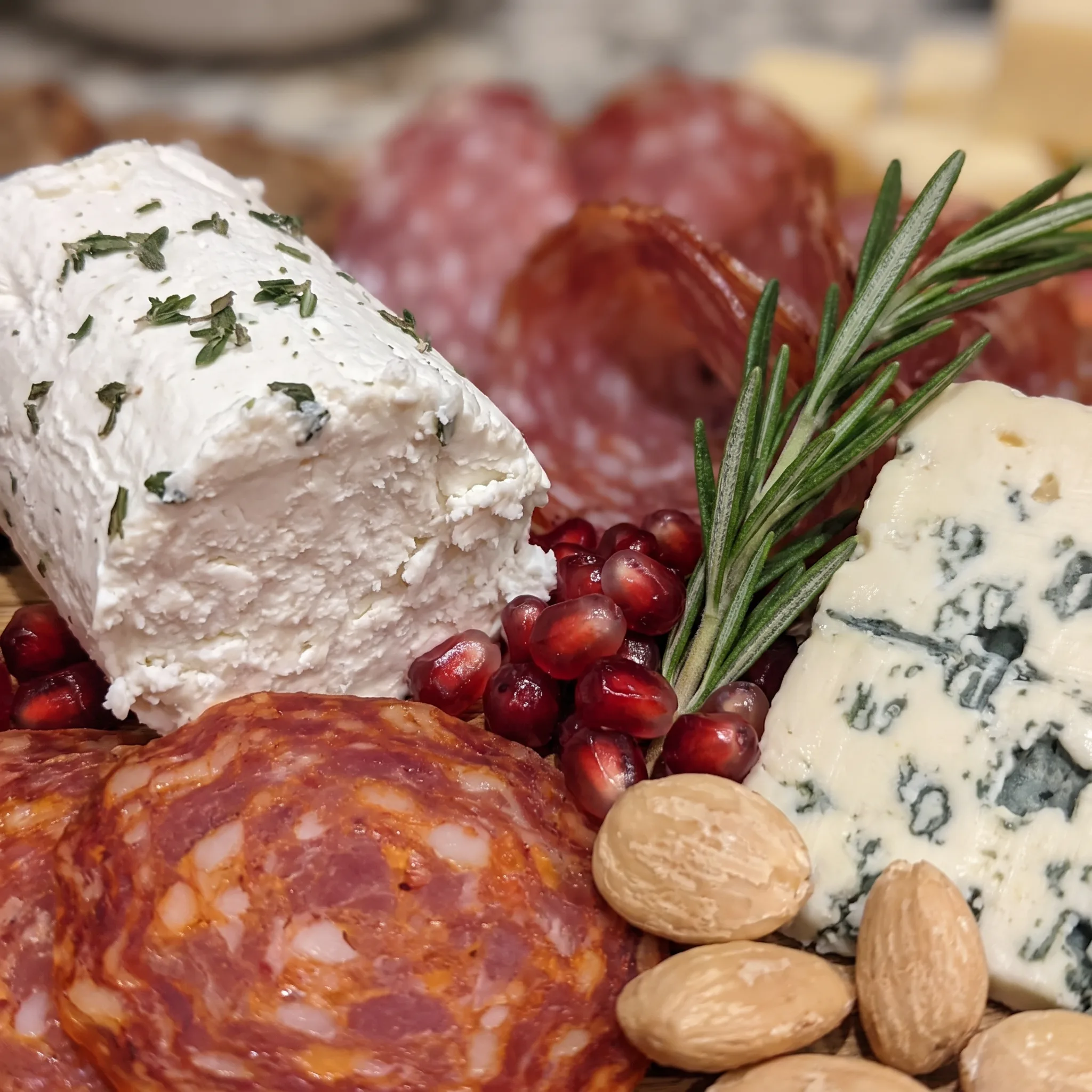
Chèvre: Buy a plain log, not a herbed or flavored one, so the thyme you scatter over it reads as its own thing.
Sharp Cheddar: Ask for a block you can slice thin yourself; pre-sliced deli Cheddar is cut too thick and cracks when bent.
Double cream Brie: Look for a wheel that gives slightly at the center when pressed, not one that’s firm all the way through or already bulging at the rind.
Blue cheese: Saint Agur is the mild pick here; anything creamier or more crumbly changes how the wedge sits on the board.
Prosciutto: Have it sliced paper thin and ask for it laid between sheets of paper, not stacked, so the slices pull apart without tearing.
Honeycomb: A small piece with the wax still intact, not jarred honey with comb fragments floating in it, since the comb is what gives you something to cut.
Reading the Board While It Comes Together
Judging whether the board is actually big enough
Everything on the list has to sit in one layer with visible space between piles. If the cheeses already crowd each other at the start, the meats and fruit will fight for the same square inches and you’ll end up stacking. A board that’s too small reads as a pile, not a spread.
Swap to a larger surface or a second board before you commit anything.
When the cheese wants to warm up and when it wants to stay cold
Brie and chèvre spread best when they’ve lost their fridge chill, so they give under a knife instead of tearing. Sharp Cheddar and Parmesan cut cleanest cold.
If the Brie slumps and runs, it’s gone past spreadable into soup, and the board looks messy within the hour. Pull the soft cheeses out first; leave the hard ones in until you’re ready to place them.
Folding the meats so they read as grabbable
Prosciutto should look like loose ribbons, not a flat deck of cards. Ruffle each slice into a wave and set the folds against each other so a hand can pinch one piece without dragging the whole pile. Salami and mortadella want the same treatment: shingled, not stacked.
Flat meat glues together and tears when someone pulls at it.
Leaving gaps instead of filling them
The instinct is to plug every empty patch with almonds or cranberries. Resist it. Bare board between the clusters is what tells a guest where one thing ends and the next begins.
Once the surface is covered edge to edge, nobody can pick up a single olive without knocking three things loose. Stop when the piles still have a little air around them.
Keeping the wet items off the cheese
Mustard and cornichons both leak. Set those two bowls down last, and keep them a hand’s width from the Brie and chèvre, which will soak up whatever runs.
If a pool forms under a bowl, slide a few nuts or a sprig of rosemary under it as a shim. Wet cheese rind is the fastest way for the board to look tired.
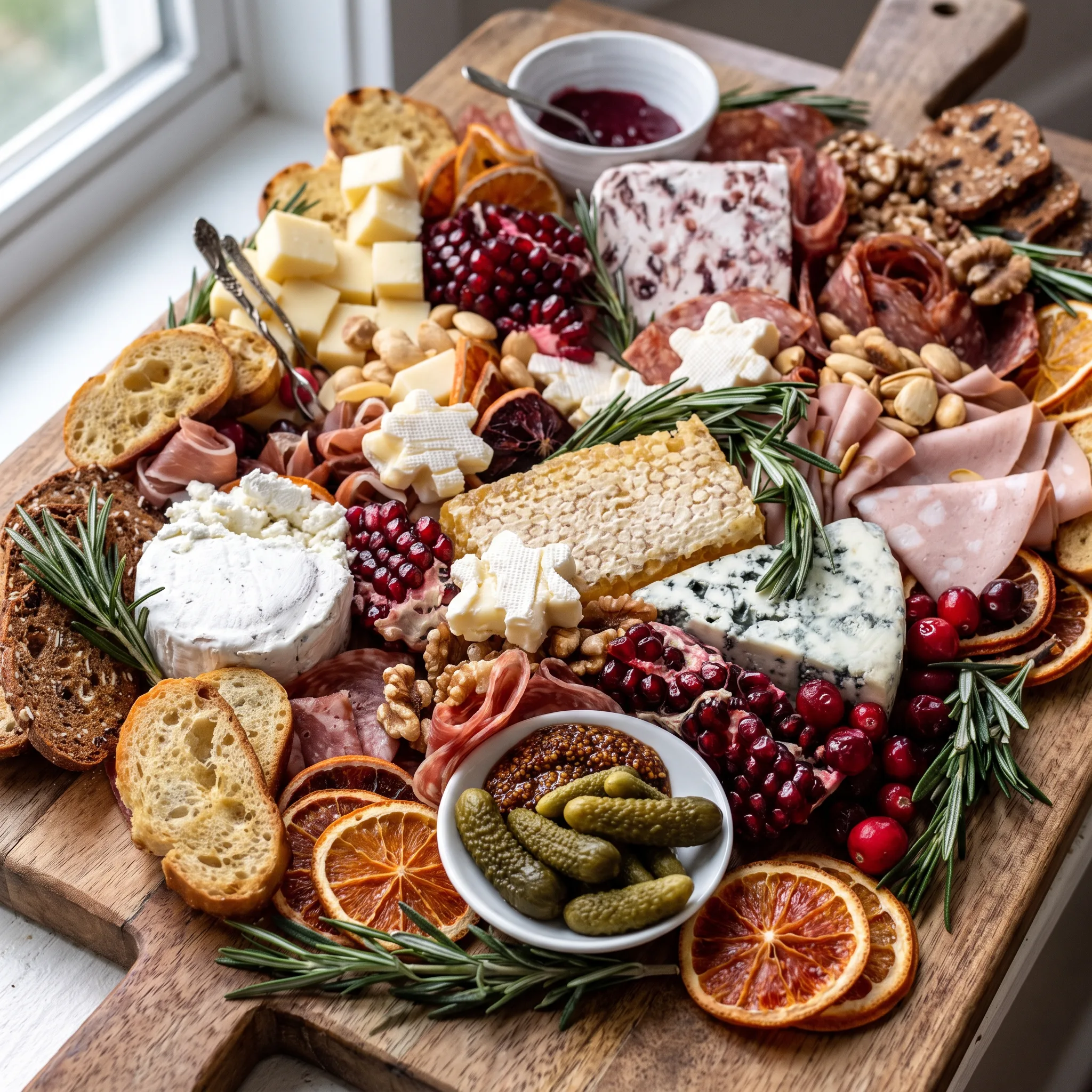
Festive Holiday Cheese Board with Chèvre and Cured Meats
Ingredients
Method
- On a large cheese board, place the chèvre, Cheddar, Brie, Parmesan, and blue cheese.
- Surround the cheese with the prosciutto, salami, and mortadella.
- Fill the board’s gaps using the almonds, walnuts, pomegranate, cranberries, and honeycomb.
- Transfer the mustard and cornichons into small bowls and set them on the board. Accompany with the baguette, crackers, and breadsticks. Finish by garnishing with rosemary sprigs and dried citrus.
Swaps That Keep the Board Balanced, Not Just Different
Chèvre: Another soft goat cheese, plain or with herbs. Start with the same 6 oz the recipe uses and adjust after tasting.
Texture stays spreadable, but flavor shifts: herbed versions double up on the thyme already scattered over the log, so the herb reads as background instead of a distinct note. A fresher, tangier goat cheese makes the honeycomb seem sweeter by contrast.
Blue cheese: A milder Gorgonzola dolce. Use the same 6 oz; no adjustment needed. The wedge will be creamier and less pungent, so it spreads instead of crumbling.
That softness can make the board look messier if it sits out, and the bold punch that resets your palate after rich Brie fades. You lose some of the sharp contrast that keeps bites interesting.
Prosciutto: For a gluten-free board, check that your cured meats and mustards are gluten-free; the meats themselves usually are, but some mustards contain wheat-based thickeners. No amount change. The board stays texturally the same, but you’ll need to read labels.
If you swap prosciutto for another dry-cured ham like Speck, the slices may be thicker and less delicate, so fold them more loosely to keep them grabbable.
Honeycomb: Leave it alone. Jarred honey won’t give you the same chew, and the wax comb is what makes the sweet element something to bite into. Honey would drizzle and seep into the cheese, making everything sticky.
The comb stays put and offers a distinct texture against salty blue cheese. Without it, the board loses a key sweet counterpoint to the cured meats.
Pomegranate: Leave it alone. Dried cranberries are already on the board for sweetness; pomegranate brings the fresh acidic burst that cuts through fat. Substituting more dried fruit would make the board sweeter and less bright.
The juicy seeds are what refresh your palate between bites of salami or mortadella. Without them, the richness builds up faster.
Tips
- Taste a sliver of the Brie and the chèvre before you build. At peak ripeness the Brie is soft through the middle and the chèvre is tangy and clean; if the Brie has an ammonia smell or the chèvre tastes flat and chalky, the contrast against the sharp Cheddar and blue will read as dull, and no amount of honeycomb fixes it.
- Set the Brie and chèvre out 30 to 60 minutes before assembly so they lose the fridge chill. Cold cheese holds its shape but releases almost no aroma, and the board depends on the soft cheeses tasting distinct from the firm ones. If the room is warm, cap it at 30 minutes; past that the Brie slumps and the wedge spreads across the board.
Storage, Make-Ahead, and the Serving Window
Serve this board within two hours of assembly. That’s the window where Brie and chèvre spread cleanly, meats stay supple, and nothing has sweated or dried at the edges. If you’re prepping ahead, cover and refrigerate components separately, not as a built board.
Leftovers keep in the fridge for two days, but expect the texture to shift: Brie turns runny, prosciutto stiffens, cut fruit weeps. Bring the board back by letting cold components sit 30 minutes before serving, then blot any pooled moisture with a paper towel. The garnishes go on last, right before the board hits the table.
Rosemary sprigs and dried citrus are visual, not structural, and they wilt or soften once refrigerated. Nothing here freezes well.
Soft cheeses separate, cured meats turn leathery, and pomegranate seeds burst when thawed. The finishing touch is the garnish, placed at the moment of serving, not before.
As you assemble the board, watch for cut faces of the soft cheeses turning matte or developing a slight skin; this means moisture is already leaving the surface. Once a Brie wedge looks chalky at the edges or a chèvre log feels firm rather than tacky, the texture has already degraded and cannot be fully reversed. The window to correct is before serving, when the cheese still looks glossy and feels slightly moist to the touch.
Frequently Asked Questions
Can I assemble this cheese board ahead of time?
Build it right before you serve it. The garnishes in particular, the rosemary sprigs and dried citrus, go on at the moment of serving because they wilt or soften once refrigerated. You can prep ahead by covering and refrigerating the components separately, not as a built board, then bringing cold items out 30 minutes before serving and blotting any pooled moisture with a paper towel.
Once it’s assembled, serve within two hours.
How do I keep the cheese from drying out on the board?
Keep the wet items away from the cheese, and don’t leave the board out longer than the two-hour serving window. Mustard and cornichons both leak, so set those bowls down last and keep them a hand’s width from the Brie and chèvre, which soak up whatever runs; slide a few nuts or a rosemary sprig under a bowl as a shim if a pool forms.
Cut surfaces of the Cheddar and Parmesan are the first to go leathery, so if you slice them thin, pile the slices against each other rather than spreading them flat. Soft cheeses give up their shape next: Brie slumps into soup and chèvre loses its log form once it’s been out too long.
What is the best way to serve this cheese board for a party?
Set it out whole and let people take from it, with each pile still showing bare board between clusters. Ten servings means the cheeses, three meats, and the small items need to sit in one layer, so use a surface large enough that nothing gets stacked.
Ruffled prosciutto and shingled salami read as grabbable, while a flat pile glues together and tears when someone pulls at it. Keep a small knife with the Brie and chèvre so guests can spread rather than hack at the wedges. Refill from the kitchen as piles thin, since a picked-over board stops inviting anyone in.
