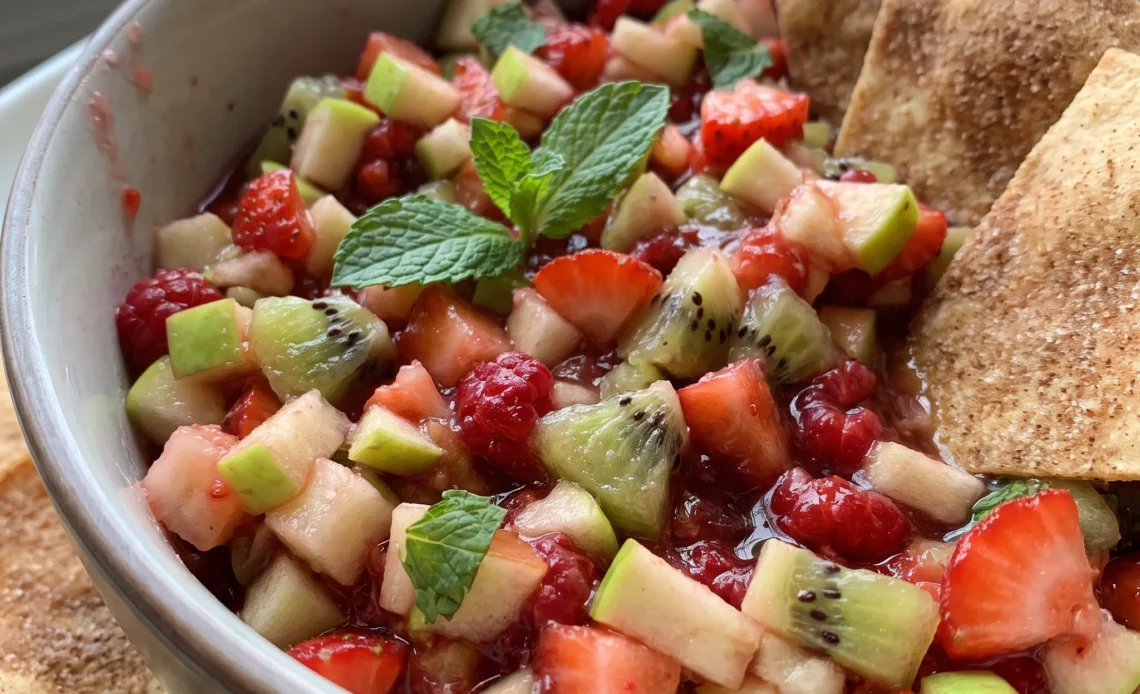
A chip dragged through fruit salsa should snap before it gives, and that snap is the whole trick here. The fruit side runs juicy by nature: strawberries and kiwis shed liquid within minutes of dicing, which is why draining before serving matters more than any ingredient tweak. Warm chips stacked straight from the tray go leathery from their own steam, so the wait for cooling is the margin where this snack is won or lost.
Sweetness lands twice, once from the cinnamon sugar baked onto the tortillas and again from brown sugar and preserves folded through the fruit, and the tart apple keeps both from turning cloying. This fruit salsa reads like dessert on a chip, though it eats like a dip, and that tension is exactly what disappears if you assemble it too early.
Keep the Two Parts Apart Until Serving
Crisp chips and juicy fruit cannot share a bowl for long. The tortilla chips need to cool completely on the baking sheet after they come out of the oven. Warm chips steam in a stack, and that trapped moisture turns them leathery.
Once they’re fully cool, they’ll stay crisp for hours in a loose pile or a paper bag, but never seal them in a plastic container while there’s any warmth left. The salsa, meanwhile, sits in its own airtight container in the refrigerator, where the fruit juices pool and the apples stay firm.
At the table, keep them separate; let each person spoon salsa onto a chip just before eating. If you combine them ahead, the chips go soft within minutes and the whole point of the contrast is lost. The salsa can be served straight from the fridge or left out for half an hour to take the chill off.
Either way, the chips stay crisp if they’re added at the last second. That texture gap is what makes the snack work.
Two Sweeteners, Two Jobs
Granulated sugar and brown sugar aren’t interchangeable here because they behave differently on the tortillas and in the fruit. A fine dusting of granulated sugar mixed with cinnamon clings to the sprayed tortilla wedges and bakes into a thin, crackly glaze.
Brown sugar would clump and burn in spots; its moisture content makes it unsuitable for that dry coating. In the salsa, brown sugar brings a soft, molasses-like depth that plain white sugar lacks, and it dissolves slowly into the fruit juices without thinning them. The preserves, meanwhile, add body and a concentrated berry flavor that fresh fruit alone can’t provide.
They also help bind the diced apples, kiwis, and strawberries so the salsa holds together on a chip. Between the cinnamon-sugar coating and the tartness of the fruit, you get a back-and-forth: sweet, sharp, sweet. If the salsa tastes flat, a pinch more brown sugar or a squeeze of lemon will bring it back into line.
Choose Apples That Hold Their Edge
Granny Smith apples are the right pick because they stay crunchy after dicing and they bring a clean tartness that cuts through the sweeter strawberries and kiwis. Softer apples would turn grainy and blend into the background. As soon as the apples are cut, they need a toss with lemon juice.
That acid slows the browning that turns diced apples an unappetizing brown within minutes. Two teaspoons of juice for two apples is enough to coat every piece without making the fruit taste like lemon. The result is a salsa where the apple pieces stay pale and distinct, and their crunch gives a welcome contrast to the softer berries and kiwis.
When you bite into a chip loaded with salsa, you get that snap from the apple, then the burst of softer fruit. Without the lemon, the color fades and the salsa looks tired before it even hits the table.
Raspberries Are Optional for a Reason
Raspberries are delicate, and once they’re stirred into the salsa, they collapse. Their cells break open, releasing juice that streaks the mixture with pink and red. That’s not a flaw; the recipe notes it because the change is expected.
A salsa with raspberries looks more jewel-toned and tastes more intensely berry-forward, but the texture turns looser, almost like a compote. Without them, the salsa stays chunkier, with each fruit piece intact and the apples and kiwis more prominent. Both versions work, but they eat differently.
If you want a cleaner, crisper bite, leave them out. If you don’t mind a softer, juicier salsa that stains the chips, fold them in gently just before serving. Either way, the flavor stays bright and the chips stay crisp as long as you keep the two separate until the last moment.
The choice is yours, and the recipe gives you room to decide based on what you’re after.
Pick Fruit That Holds Up on the Chip
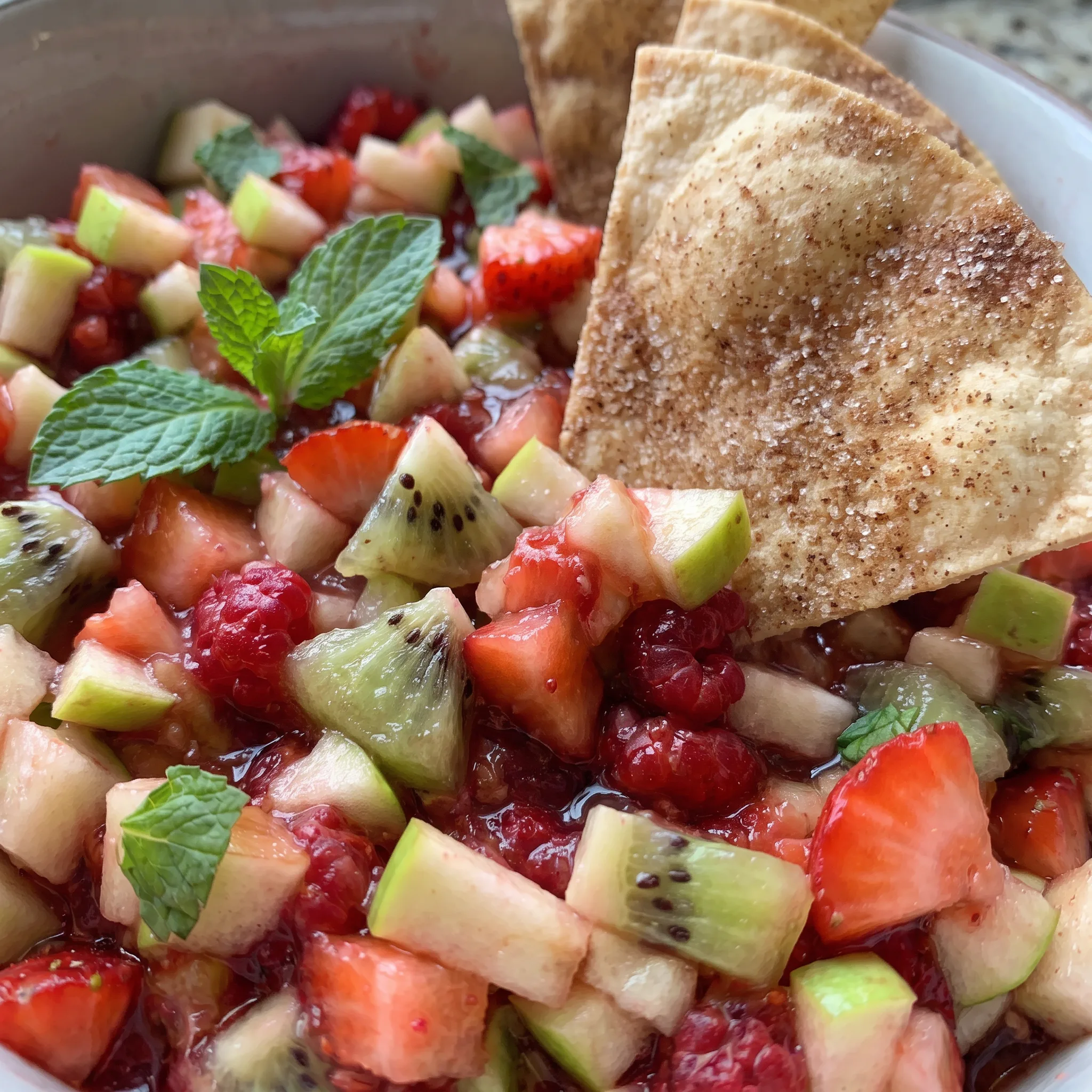
Granny Smith apples: Their firm flesh keeps a clean snap after dicing, unlike softer varieties that break down and taste grainy in the salsa.
lemon: You need 2 tsp of fresh juice to coat the diced apples, enough to slow browning without making every piece taste sour.
kiwis: Choose kiwis that give slightly to gentle pressure so they dice cleanly and stay distinct from the strawberries.
strawberries: Look for berries that are fully red with no pale shoulders, since underripe ones stay firm and taste watery next to the other fruit.
raspberries: The half pound is optional, and if you use them, expect the fragile berries to break apart and tint the salsa a deeper pink.
Baked cinnamon-sugar chips are crisp because their low moisture content creates a brittle starch matrix. When combined with the fruit salsa ahead of time, water from the fruit and its juices moves into the chips by capillary action and vapor diffusion, softening that matrix within minutes. This recipe avoids the problem by keeping the two components separate and assembling only at the moment of eating, which preserves the textural contrast between crisp chips and juicy salsa.
How to Read the Fruit and the Chips While You Work
Judging Whether the Apples Are Cut Small Enough
Aim for pieces no bigger than a kernel of corn. Oversized chunks make the salsa awkward to scoop and they won’t sit on a chip without rolling off. When you dice, feel the resistance: a Granny Smith should give a clean snap under the knife, not squish.
If the pieces look uneven, go back over the pile. The lemon juice coats better when the pieces are uniform, and the texture stays consistent from bite to bite.
Knowing When the Fruit Has Given Up Enough Juice
After you stir the strawberries and kiwis into the apples, let the bowl sit for a minute. The fruit will start to glisten as juices bead on the surface.
You want a spoonful that’s moist but not swimming. If liquid pools at the bottom before you’ve added the preserves, the salsa will be soupy on the chip. Drain off a spoonful or two, or add the preserves first to thicken what’s there.
The mixture should hold its shape when you scoop it.
Telling When the Chips Are Crisp, Not Just Colored
At 11 minutes, pull one wedge from the oven and let it cool for ten seconds. It should snap cleanly when you break it.
If it bends or feels leathery in the middle, give the tray another minute. The color can fool you: edges brown before the center dries out.
Overbaking past 12 minutes turns them bitter and hard. Underbaking leaves them chewy.
The snap is the only reliable signal, and it only shows after a brief cool.
Keeping the Cinnamon Sugar from Clumping on the Tortillas
When you dust the sprayed tortillas, use a light hand. A heavy coat turns pasty where the spray is thick, and those spots bake into sticky patches instead of a crackly glaze. You should see the tortilla’s surface through the sugar, not a solid blanket.
If clumps form, tap the tortilla over the bowl to shake off the excess. The coating should look even and thin, like frost on grass, not like a crust.
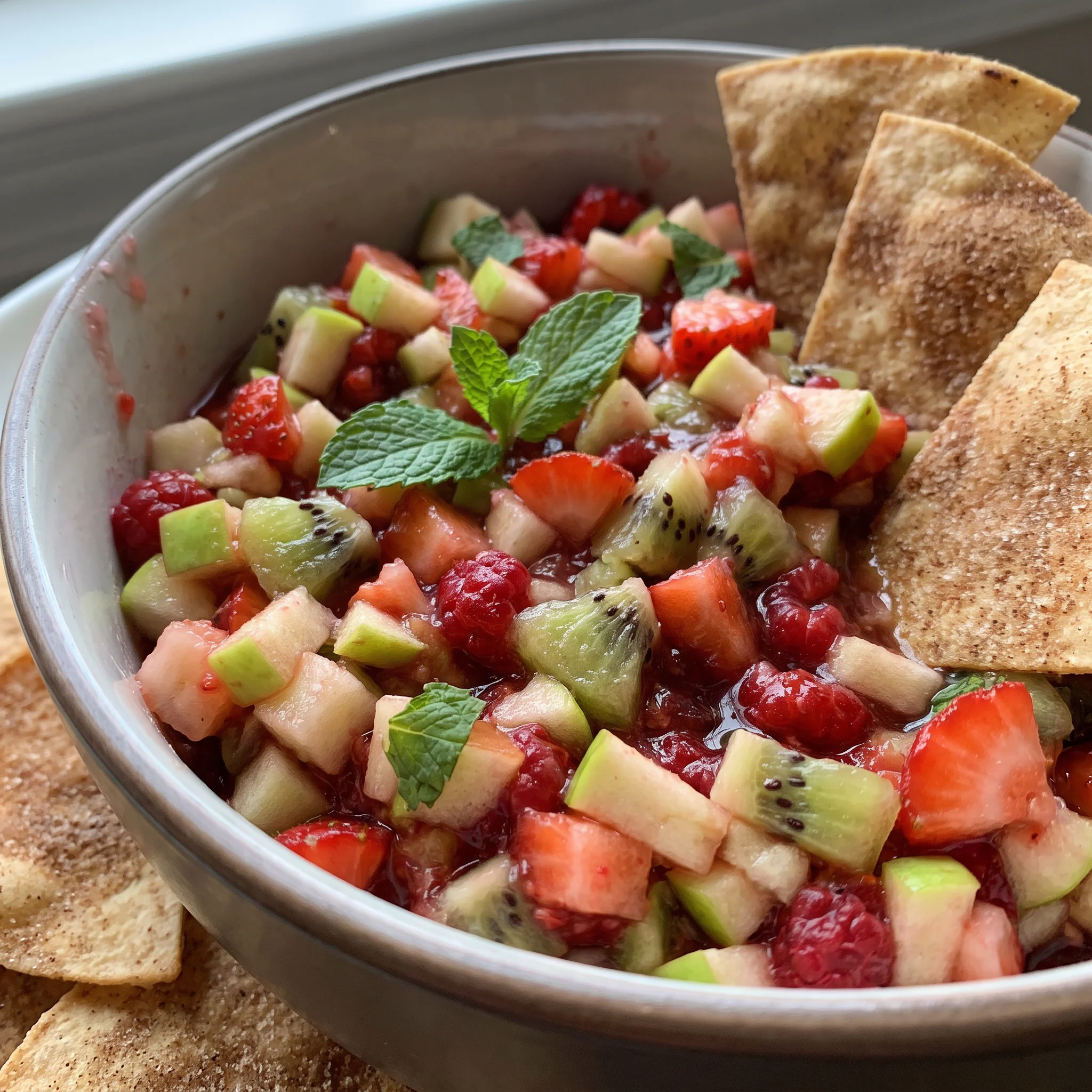
Fruit Salsa with Cinnamon Sugar Tortilla Chips
Ingredients
Method
- Combine the granulated sugar and cinnamon in a small bowl, stirring until mixed; set aside.
- Lightly coat both sides of 3 tortillas at a time with nonstick cooking spray, then generously dust each side with the cinnamon-sugar mixture. Stack the tortillas and slice into 12 wedges with a pizza cutter. Repeat with the remaining tortillas.
- Place the prepared chips in a single layer on an ungreased baking sheet and bake at 350°F (175°C) for 11–12 minutes, or until crisp.
- Peel and finely chop the apples. Squeeze 2 tsp lemon juice over the diced apples and toss to coat.
- Finely dice the strawberries and kiwis. Gently stir to combine all the fruit, keeping in mind that if using raspberries they will break up somewhat, which is fine.
- Serve the salsa at room temperature or chilled. Store in an airtight container in the refrigerator.
Storing the Chips and Salsa Separately
Keep the chips in an airtight container at room temperature and eat them within a day or two. They have no moisture left to lose, so the fridge is the enemy: cold air condenses on them and they go slack by the next morning. The salsa is the opposite.
It belongs in the refrigerator in a sealed container, where it holds for several days. Expect the liquid to rise as the days pass.
Strawberries and kiwis keep releasing juice, and by day three the salsa sits in a shallow pool. Drain it before serving.
Tip the container and pour off what collects, or lift the fruit out with a slotted spoon. Skipping that step soaks the chips on contact.
Eat leftovers cold or let a portion sit out half an hour to take the chill off. Add the final touch, a gentle fold of the salsa, right before it goes on the chips.
Serve within minutes of scooping. The chips never freeze well, but the salsa does, though it thaws soft and loose, better spooned over yogurt than onto a chip.
Where You Can Swap and Where You Can’t in This Fruit Salsa
Flour tortillas: Corn tortillas or whole-wheat flour tortillas. Corn tortillas bake into a thinner, more brittle chip that shatters easily and lacks the same buttery flavor of flour.
Whole-wheat tortillas have a nuttier taste and a slightly denser chew, so the chip won’t have that light, crisp snap. Both work, but expect a different texture. Start with the same 10 tortillas and adjust the bake time by a minute or so if needed.
Granulated sugar: Coarse sugar (like turbinado) or brown sugar. Coarse sugar stays grainy on the chips instead of dissolving into a smooth glaze, giving a crunchy, sandy coating.
Brown sugar clumps and burns in spots because of its moisture, so it’s not a good substitute here. If you use coarse sugar, keep the same 1/3 cup; just know the coating will be more textured.
Strawberry or raspberry preserves: Jam or fresh pureed fruit. Jam is often looser and sweeter, so the salsa may be runnier and taste sweeter.
Fresh pureed fruit adds more liquid and less sweetness, so the salsa will be juicier and less set. Start with the same 3 tablespoons and add more only if the salsa seems dry after mixing.
Raspberries: Frozen raspberries or omit entirely. Frozen raspberries will break down even more than fresh, making the salsa wetter and more uniformly pink.
Omit them and the salsa stays chunkier and less berry-forward, with the apples and kiwis more prominent. If using frozen, there’s no need to thaw; fold them in frozen and they’ll thaw in the salsa, but expect extra juice.
Tips
- Spray the tortillas on a plate or sheet of parchment, not over the bowl of cinnamon sugar. The aerosolized spray settles on everything nearby, and a dusting of it lands in the sugar bowl, where it makes the mixture damp and prone to clumping on the next tortilla.
- Stack only three coated tortillas at a time before cutting, as written, and cut the stack before the spray dries. Freshly sprayed tortillas grip each other, so the wedges hold their alignment under the blade; if the stack sits long enough for the coating to set, the layers slide apart mid-cut and you get ragged, uneven wedges.
Frequently Asked Questions
Can I make the cinnamon sugar tortilla chips ahead of time?
Yes, but keep them at room temperature in an airtight container and plan to eat them within a day or two. The article’s storage notes cover the fridge problem; the short version is that cold air condenses on the chips and they go slack by the next morning.
What you’re really buying with that window is the crackly glaze from the cinnamon sugar, which dulls after a couple of days even in a sealed container. If you want them at their crispest, bake them the same day you serve.
How do I keep the tortilla chips from getting soggy?
The most likely culprit is stacking or sealing the chips while they’re still warm, so let them cool completely on the baking sheet first. Once they’re cool, a loose pile or a paper bag works better than a tight plastic container, since any trapped warmth turns them leathery.
If your chips are already soft, a minute or two back on a baking sheet at 350°F will bring the snap back, though they won’t be quite as good as fresh. The salsa side of the equation is separate: drain any pooled liquid before serving, because that’s what soaks the chip on contact.
What can I do if my fruit salsa is too watery?
Drain off the excess liquid first, either by tipping the container and pouring it off or lifting the fruit out with a slotted spoon. The cause is usually the strawberries and kiwis giving up their juice as they sit, and the preserves can only bind so much. If it’s still loose after draining, a spoonful more preserves will thicken what’s there without changing the flavor much.
Serving with a slotted spoon at the table keeps the last of the juice in the bowl instead of on the chips.
How is this fruit salsa different from a traditional tomato salsa?
The backbone here is diced Granny Smith apples, kiwis, and strawberries rather than tomatoes, so the acidity is brighter and the sweetness comes from fruit rather than chilies and onion. Texture runs chunkier and juicier, with a snap from the apple that tomato salsa doesn’t have.
The preserves add a concentrated berry note and help bind the fruit so it sits on a chip instead of sliding off. It’s a different eating experience: sweet and tart rather than savory and hot.
Can I serve the fruit salsa warm?
Room temperature is the sweet spot, and the article’s storage section covers the timing for taking the chill off. Warm fruit loses the crisp snap of the apples and the salsa turns softer and looser, closer to a compote.
If you’ve had it in the fridge, let a portion sit out half an hour rather than heating it. Cold or room temperature both work; warm doesn’t do the fruit any favors.
