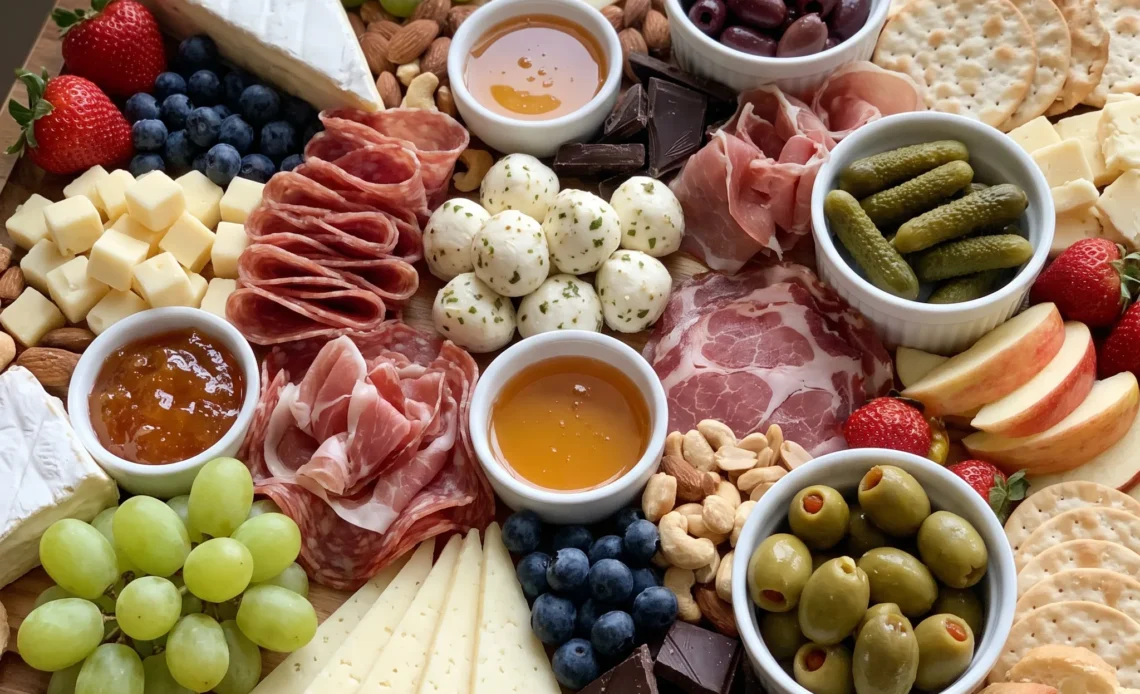
A charcuterie board isn’t dinner, and it isn’t a cheese plate with a garnish problem. It’s a spread that has to feed eight people, and the trick is that it does that in half an hour. The work is arrangement, not cooking, which is why the hard part sneaks up on you: soft cheese that won’t spread, crackers that go limp against a bowl of olives, apple slices that brown while you’re still folding prosciutto.
Everything is technically done the moment you set it down, and everything is quietly on a clock. Build it with that clock in mind and the board looks generous. Ignore it and you’re mopping brine off the table while guests work around you.
Anchor Your Cheeses First
A board works when guests can serve themselves without dismantling the arrangement. Start with the cheeses. The whole Brie and the triple cream take the central spots because they are the softest and need breathing room.
They also become the visual heart of the board. From there, give each firm cheese its own quadrant. Manchego in one corner, white cheddar in another, mozzarella in a third.
That separation prevents flavors from mingling and makes it clear where to reach. Leave gaps between the clusters. Those gaps become landing spots for folded meats, crackers, and fruit later.
You want a board that looks abundant but not packed. If everything touches, there is no room for guests to maneuver a knife or grab a slice without knocking something over. The cheese should be the first thing they see and the easiest thing to take.
When the board is done, a guest should be able to identify each cheese at a glance.
Temperature and Placement for Soft Cheeses
Brie needs to sit out before it hits the board. Cold Brie tears instead of spreading, and a torn wedge looks messy.
Let it come to room temperature on the counter while you prep everything else. The triple cream is sold in a larger container for a reason.
Leave it in that container to hold its shape and stay scoopable. If you turn it out, it slumps into a puddle.
Honey and fruit spread are not decoration. They belong next to the cheeses they complement.
Set the honey near the Brie and the fruit spread near the cheddar or Manchego. That way guests can drizzle and spread without crossing the board. A distant corner for condiments forces people to reach over other items, which leads to spills.
When the board is ready, the soft cheeses should give slightly when pressed and the honey should glide, not drip. That tells you everything is at the right temperature for serving.
Shape Matters for Grazing
Flat ingredients make a flat board. Folding salami, prosciutto, and coppa into ribbons or cones does more than look good. It creates height, so the eye travels across the board.
It also makes each piece easy to pick up. A flat slice of prosciutto sticks to itself and to the board.
A loose fold separates cleanly. Fruit needs the same attention.
Slice apples or pears thin, and portion grapes into small clusters. That way a guest can take a few grapes without pulling the whole bunch apart.
Leave the dark chocolate as a solid block and it becomes a chore to break. Irregular pieces invite people to grab a shard.
When you step back, the board should have a mix of textures and levels. Nothing should look uniform.
The folds and cuts should feel casual, not fussy. If a piece falls apart when you pick it up, it was too thin or too tightly packed.
Contain the Brine and Build Piles
Olives and pickles bring liquid. Without a bowl, that liquid spreads across the board and makes crackers soggy.
Use three separate small bowls for stuffed olives, Kalamata olives, and baby dill pickles. That keeps each flavor distinct and the brine contained.
Nuts and chocolate can go in small piles rather than scattered loosely. A pile invites a handful; a scatter looks like debris.
Place those piles near the soft cheeses so guests can pair a nut with a smear of Brie or a piece of chocolate with a slice of cheddar. Honey and fruit spread also belong in small serving dishes.
A drizzle directly on the board turns into a sticky trail. When you set the bowls, check that they sit flat and do not tip.
The board should look organized, not chaotic. If a bowl slides, move it to a flatter spot.
The goal is easy access without a mess.
Crackers and Bread Reach Every Guest
Crackers and baguette slices are the delivery system for everything else. If they are all in one corner, half the guests have to reach across the board. Arrange water crackers and artisan crackers in overlapping rows or fans.
That fills empty gaps and makes them easy to grab. Toasted baguette slices can go in a separate bowl or basket if the board is already full. But keep some bread on the board too, so people can pair it without moving.
Distribute crackers and bread around the perimeter, not just in the center. That way, no matter where someone stands, a cracker is within reach. The board should feel generous, not crowded.
If a cracker breaks when you pick it up, it was too thin or the spread was too thick. When the board is set, every guest should be able to build a bite without asking for anything to be passed.

What to Buy for a Board That Disappears Fast
Brie: Buy a whole wheel, not wedges, and leave it on the counter until it gives under your thumb.
Triple cream cheese: Choose the larger container so it stays scoopable instead of collapsing into a puddle.
Prosciutto: Get it sliced thin enough to fold into ribbons without tearing, but not so thin it clumps.
Stuffed olives: Buy them from an olive bar if you can, because the brine tastes cleaner than the canned stuff.
Grapes: Pick grapes that are plump and firmly attached to the stem, then cut them into small clusters.
Dark chocolate bar: Buy a bar you would eat on its own and break it into irregular shards instead of neat squares.
Reading the Board as You Build It
When the soft cheeses have sat out long enough
Press the Brie with a fingertip. Cold, it fights back and the rind cracks when you cut a wedge.
Room temperature, it gives and the wedge holds its shape instead of smearing. The triple cream tells you the same way: scoopable, not soupy. Check both before you commit them to the board, because once they slump into a warm spot there’s no pushing them back into shape.
If they’re still firm, walk away and finish the fruit.
Judging a fold that a guest can actually pick up
Pick up a folded slice of prosciutto the way a guest would, with two fingers. If it clings to itself and tears, the fold is too tight.
Loosen it into a ribbon with air in it. Salami coins should overlap like shingles, not stack flat, or they weld together.
Coppa behaves like prosciutto. The test is simple: does it come away clean with one piece, or do you drag the whole pile with you?
Where the brine decides the board’s fate
Set the olive and pickle bowls down and look at what’s within an inch of them. A cracker touching the rim will drink brine and go limp before anyone reaches it.
Leave a bare margin around each bowl. If a bowl rocks on the board, move it.
A tipped bowl of Kalamata olives floods everything downhill, and that’s a board you can’t recover, only mop.
The point where the board stops being generous and starts being crowded
Step back. If you can’t see board surface between the piles, you’ve overfilled it. Guests need a lane to set down a knife or maneuver a cracker.
Thin the nuts, spread the crackers further out, or move the baguette slices to a basket. An overfilled board doesn’t read as abundance, it reads as a hazard. Pull two or three items off and the whole thing breathes.
How the apple slices will look in ten minutes
Slice the apple or pear thin and watch the cut faces. They brown, and a brown slice on a display board reads as old.
If you’re building ahead of people arriving, hold the slices in a little acidulated water or leave the fruit whole until the last thing you do. The card says sliced for easy access, so slice it, but slice it last, after the cheeses and meats are placed.
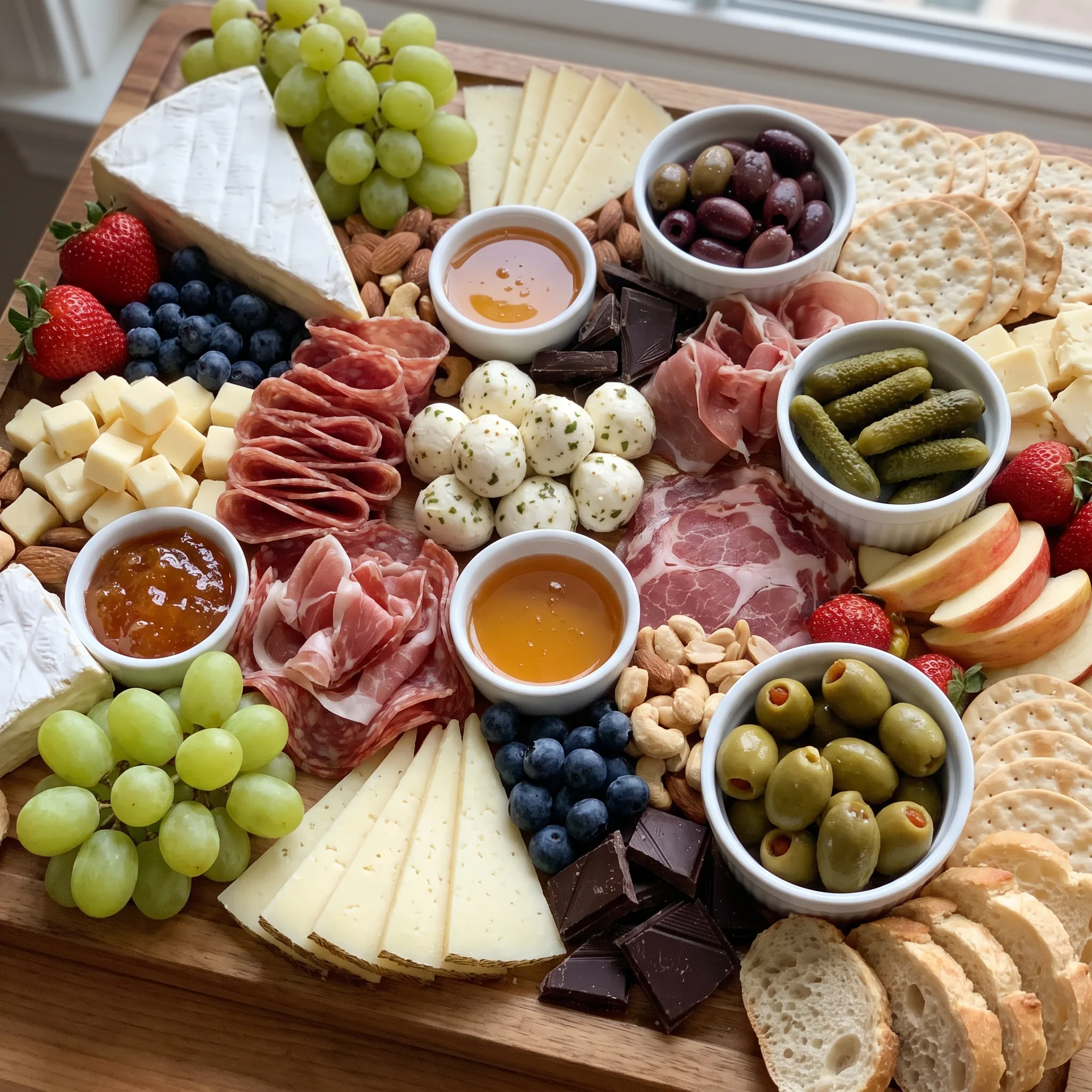
Loaded Charcuterie Board with Cured Meats and Cheese
Ingredients
Method
- Place cheeses around your board. For soft varieties, cut wedges; for firmer ones, slice them so guests can easily help themselves.
- Shape salami, prosciutto, and coppa into appealing forms to enhance both appearance and mouthfeel.
- Put olives and pickles in small bowls. Set honey and fruit spreads close to the cheeses they pair well with.
- Wash and slice apples, portion grapes, and arrange all fresh fruit attractively across the board.
- Group nuts and chocolate in small piles, nestling them beside soft cheeses to create tasty combinations.
- Arrange crackers and baguette slices thoughtfully, filling empty spots or placing them in a separate bowl alongside.
Storage and the Two-Hour Window
This board is at its best within the first two hours it sits out, and the soft cheeses set the clock. Brie and triple cream soften past spreadable once they’ve been out that long, and the rind on the Brie starts to slump. Sliced apple and pear brown within minutes of cutting, so slice them last, right before guests arrive, and let the cheese come up to room temperature while you do it.
After two hours, refrigerate what’s left. Pull the soft cheeses first and wrap them tight; they keep two to three days before the texture turns grainy. Hard cheeses, cured meats, and olives hold a week.
Discard cut fruit and any crackers that touched brine. Nuts and chocolate keep fine, but store them away from the cheese so they stay crisp.
To serve leftovers, let the cheese sit out fifteen minutes and rebuild on a smaller board rather than adding to the old one.
Swaps That Keep the Board Photogenic: What to Trade and What to Leave Alone
Triple cream cheese: A double-cream Brie or a soft goat cheese log. Double-cream Brie holds a wedge better but lacks the same ooze.
Soft goat cheese brings tang and stays scoopable, but it won’t spread as silkily. Both change the texture guests expect when they scoop.
Start with the same 7 oz (200 g) the recipe uses, then adjust after you see how it behaves at room temperature.
Dried coppa: Soppressata or capicola. Soppressata is leaner and firmer, so it slices into coins that shingle without tearing. Capicola brings more fat and a peppery edge, and it folds almost like coppa.
Neither has the same dry, winey depth, but both stand up on a board. 5 oz (100 g), sliced thin enough to fold.
Fresh figs or strawberries: Dried figs or apricots. Dried fruit won’t bleed juice onto the board and keeps for days, but it’s chewier and sweeter. Fresh figs are fragile and perishable; strawberries release liquid that can make crackers soggy.
If you swap, use the same 7 oz (200 g) and cut dried figs into quarters so they don’t look like lumps. The board loses some of its fresh pop, but gains shelf life.
Brie: Camembert. Camembert is essentially the same cheese with a slightly earthier flavor.
It softens the same way but may be a touch runnier at room temperature. Keep the whole wheel and let it sit out until it gives under your thumb. No amount change needed; it’s a one-to-one swap for the same 1 whole wheel.
Tips
- Check the Brie before it goes anywhere near the board by pressing the top of the wheel with your thumb. A ripe wheel gives the way a ripe avocado does, with a little resistance at the rind and softness underneath. If the whole wheel feels firm, it needs more counter time. If the rind is already bulging and the inside feels liquid under a thin skin, it is past the point where a wedge will hold, and you should serve it in its own dish with a spreader instead of cutting it into the layout.
- With 8 servings and 3.5 oz (100 g) each of salami, prosciutto, and coppa, the folded meats will dry out at the edges if they go on early. Fold them onto the board last, right after the crackers, so the cut faces stay glossy through the first hour. If you build the board ahead, cover just the meat clusters with a damp paper towel, then pull it off before guests arrive.
The single mistake most cooks make is pulling the Brie straight from the refrigerator and placing it on the board. Cold fat in the cheese is solidified, so the paste is stiff and will crack or tear when cut, and it cannot be spread on crackers or bread. The fix is to let the whole Brie sit at room temperature until the interior yields gently to pressure, which allows the fat to soften and the paste to become fluid enough to scoop or spread.

Frequently Asked Questions
Can I build this charcuterie board ahead of time?
You can set out the cheeses, meats, olives, and pickles up to a few hours before, but hold the fruit and bread. The Brie and triple cream need to sit at room temperature anyway, so they’re the easy part to start with. Slice the apple or pear last, right before guests arrive, because the cut faces brown and a brown slice on a display board reads as old.
If you’re building hours ahead, leave the apple whole until the final pass. The board is at its best within the first two hours it sits out, so time your build so the soft cheeses aren’t past their prime when people show up.
How do I keep the board from looking messy when guests start serving themselves?
Leave a bare margin around each bowl and don’t let crackers touch the rims. A cracker that touches brine goes limp before anyone reaches it, and a tipped bowl of Kalamata olives floods everything downhill. Build in clear lanes so guests have a spot to set down a knife or maneuver a cracker without knocking into the next pile.
If you can’t see board surface between the clusters, you’ve overfilled it, and an overfilled board reads as a hazard rather than abundance. Pull two or three items off and the whole thing breathes.
What’s the best way to serve Brie on a charcuterie board?
Set out a whole wheel and let it come to room temperature before it goes on the board. Press it with a fingertip: cold, it fights back and the rind cracks when you cut a wedge.
At room temperature it gives, and the wedge holds its shape instead of smearing. Place it in a central spot with breathing room, since it becomes the visual heart of the board.
The honey belongs right next to it so guests can drizzle without reaching across other items.
How many people does this board actually serve?
Eight, per the card. 5 ounces each of several cheeses and meats, plus 7 ounces of grapes and 7 ounces of strawberries or figs.
In practice, if this is the only thing on the table, a hungry crowd will clean it faster than eight people picking at it as an appetizer. If you’re serving it as the main event rather than a starter, plan on it feeding closer to six. The wide variety of items means people graze rather than load a plate, which stretches it further than the numbers suggest.
How is this charcuterie board different from a classic one?
The scale and the variety. Five cheeses, three cured meats, three briny items, three fresh fruits, plus honey, fruit spread, nuts, dark chocolate, and two kinds of crackers. A classic board might carry two cheeses and one meat.
Here you’re building a board that has to be arranged in quadrants and clusters, not just laid out. That’s why the soft cheeses get the center and the firm ones get their own corners.
The extra items also mean more bowls and more margins, so the board needs to be larger than you’d think.
