
Butternut squash quinoa bake lives or dies on what happens before it ever reaches the oven. A skillet full of squash, kale, quinoa, and Gruyère sounds like a forgiving weeknight move, and mostly it is, but the difference between a bake that slices clean and one that pools water on the plate comes down to moisture you can’t see yet. The squash needs to soften through without collapsing.
The quinoa has to go in already cooked and drained, or the grains keep drinking and the whole dish turns heavy. Get those two things right and the rest is assembly: a savory filling under melted cheese and crushed croutons that brown into a lid you can actually cut through. Serves six, and it reheats better than most.
Cook the Quinoa First, Then Drain It
Quinoa goes into the baking dish already cooked, not raw. If you skip that and add dry quinoa with the broth, the grains will soak up liquid during the bake and leave the whole casserole wet and heavy.
The broth gets absorbed on the stovetop, where you can see exactly how much is left. Any pool of liquid at the bottom of the pot needs to go down the sink.
Drain it off before the grains go into the skillet. That way the quinoa soaks up the pesto, almond milk, and cheese without leaking water back out. What you’re after is separate, fluffy grains that stay that way once they’re mixed with everything else.
Wet grains clump and steam instead of baking, and the topping never gets a chance to crisp.
Give the Squash a Head Start
Butternut squash cubes take longer to soften than quinoa does. If they go into the oven raw, they’ll still be firm when the quinoa is done, and the whole dish ends up with uneven texture. Cooking them in the skillet with the onions and garlic lets them get tender first.
The lid traps steam, so the squash softens without browning or drying out. You want pieces that give way when you press a fork into them, no resistance in the center.
By the time they hit the baking dish, they’re already cooked through, so the final 15 minutes in the oven only needs to melt the cheese and warm everything together. That’s how the squash and quinoa finish at the same time instead of one turning to paste while the other stays hard.
Two Layers of Cheese, One Crunchy Top
Gruyère does two jobs here. One cup gets stirred into the filling, where it melts into the quinoa and squash and gives every scoop a savory pull. The remaining half cup goes on top, scattered over the surface before the croutons.
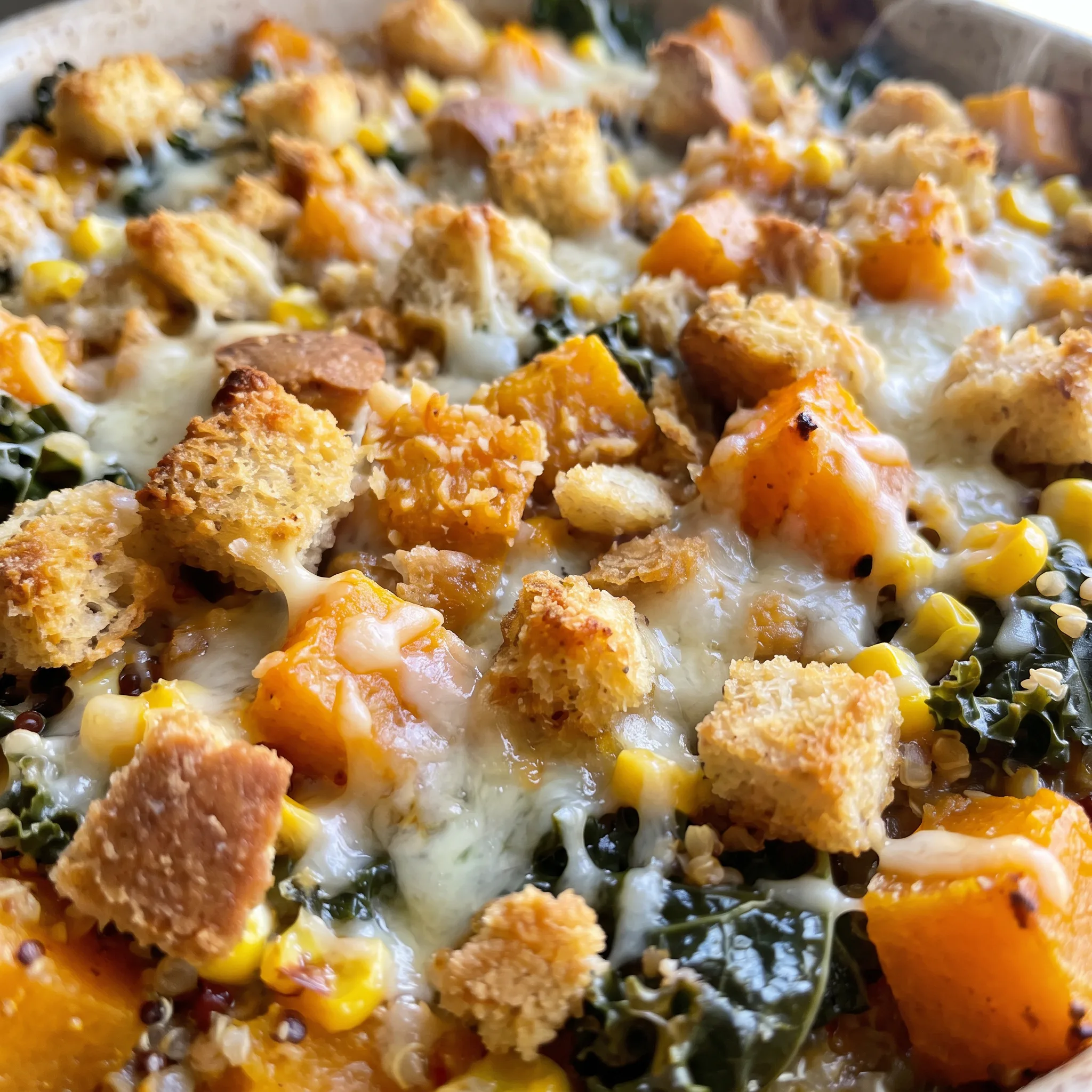
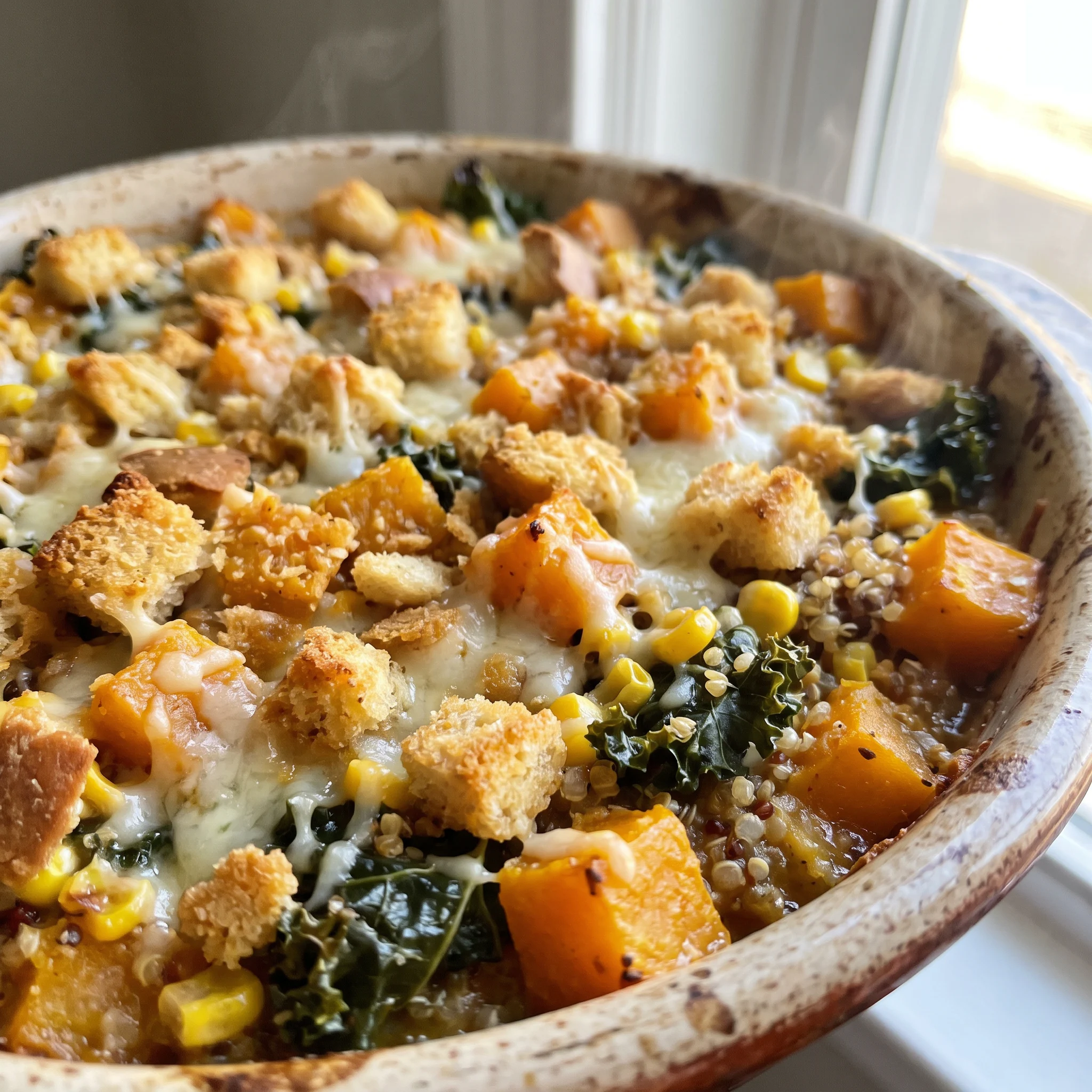
Those crushed croutons sit on the cheese and soak up just enough fat to turn golden in the oven. What you get is a soft, creamy middle and a rough, crisp lid. The cheese underneath the croutons melts and binds them together, so the topping doesn’t scatter when you cut into it.
You’re looking for a top that’s browned at the edges and bubbling around the sides, with the crouton pieces clearly darker than when they went in.
Wait Five Minutes Before You Serve
That five minutes after the bake comes out of the oven isn’t dead time. The filling is still very hot and loose right away.
Resting gives the cheese a chance to firm up slightly and the quinoa to settle, so the first scoop holds together instead of running across the plate. If you dig in immediately, you’ll get a watery puddle and the layers won’t have set.
The total time from start to table is 50 minutes, and those five are part of it. Use them to set out plates or pour drinks.
When you do serve, a spoon should come away with a clean edge, not a stream of liquid. The bake is ready when it looks set at the edges and slightly firm in the center.
What to Buy and How to Prep It Before It Hits the Skillet
Butternut squash: Buy the pre-cut 1/2-inch cubes if you can, since uniform pieces cook evenly and oversized chunks stay hard.
Kale: Strip the stems and chop the leaves, because thick stems stay chewy after a short bake.
Gruyère: Shred it yourself off the block, since the pre-shredded kind is coated and melts into a grainy film.
Sun-dried tomato pesto: The oil-packed jarred kind carries enough richness to season the whole filling, so taste it before you commit.
Croutons: Crush them into uneven pieces, since a mix of sizes gives you both crunchy bits and smaller toasted crumbs.
Almond milk: Unsweetened, plain, because a sweetened or vanilla version will read through the pesto and cheese.
Quinoa cooked in vegetable broth must be fully cooked and drained before it is combined with the other ingredients, because any unabsorbed broth will leak out during the bake and turn the filling watery. The same principle applies to the butternut squash: it is precooked in the skillet until fork-tender so that its cell walls have already softened and released their moisture before the dish goes into the oven, rather than weeping liquid into the casserole as it bakes. When excess liquid is present, the cheese melts into a sauce instead of forming a stretchy layer, and the crushed croutons absorb steam from below and turn soft rather than crisp.
Judging the Bake: When to Stop, When to Rest, and When to Adjust
Knowing when the squash is tender enough to stop
After about 10 minutes covered, test a piece with a fork. You want it to slide in with almost no resistance. If there’s a firm center, give it a few more minutes.
Undercooked squash will stay hard in the bake, throwing off the texture. Overcooking makes it fall apart and water down the filling.
Aim for fork-tender but not collapsing.
Getting the filling’s consistency right before it goes in the oven
Once everything is mixed in the skillet, the filling should be thick and spoonable, not soupy. If you see pools of liquid, you likely didn’t drain the quinoa enough or the vegetables released too much water. A wet filling means a soggy bake.
If it’s too wet, cook it down for a minute or two over medium heat, stirring, until it tightens. Then transfer to the baking dish.
Reading the top for doneness: color and bubbling
At 15 minutes, the cheese should be fully melted and the croutons darkened. Look for bubbling around the edges and a top that’s browned in spots. If the croutons are still pale, give it a few more minutes, but watch closely: they can go from golden to burnt fast.
The filling should look set, not jiggly, when you nudge the dish.
Why the five-minute rest matters for the first scoop
Right out of the oven, the filling is loose and the cheese is molten. Wait five minutes. During that time, the cheese firms up just enough and the quinoa settles, so a spoonful holds its shape instead of running.
If you serve immediately, you’ll get a watery mess on the plate. After resting, the edges should look set and the center slightly firm.
Butternut Squash Quinoa Bake with Kale and Gruyère
Ingredients
Method
- Set oven to 375°F (190°C) and position a rack in the center.
- Prepare the quinoa with the vegetable broth as directed on the package; if any liquid remains, drain it off.
- In a deep-sided skillet, warm the olive oil over medium-low heat. Add the onion and garlic and cook for about 5 minutes, until the onion becomes translucent.
- Add the butternut squash, cover, and cook for about 10 minutes, stirring occasionally, until fork-tender.
- Stir in the corn, kale, sun-dried tomato pesto, salt, cooked quinoa, 1 cup of the cheese, and the almond milk; adjust the seasoning with salt and pepper. Transfer to a baking dish, top with the remaining cheese and the croutons, and bake for 15 minutes, until the cheese is melted.
- Take out of the oven and let rest for about 5 minutes before serving.
Swaps That Hold: What to Change and What to Leave Alone in This Bake
Gruyère cheese: For dairy-free, use a good melting vegan cheese in the same total amount: 1 cup stirred in and 1/2 cup on top. For a different flavor, try smoked Gouda or sharp white Cheddar, shredded off the block. Gruyère brings a nutty, savory note and melts without turning greasy.
A vegan cheese will melt, but many stay firm or release oil when baked, so the top may not bind the croutons as tightly. Gouda or Cheddar will melt well; smoked Gouda adds a smoky edge, while Cheddar sharpens the whole dish. Shred any block cheese yourself, since pre-shredded kinds are coated and bake up grainy.
Almond milk: Any plain, unsweetened plant milk works: oat, soy, or cashew. If you use dairy, whole milk is fine.
Start with the same 1/4 cup the recipe calls for. Almond milk adds moisture without much flavor, so the pesto and cheese lead. Oat milk is slightly creamier and may thicken the filling a touch more.
Soy milk behaves similarly. Sweetened or vanilla versions will read through and clash with the savory ingredients.
If you swap in a thicker milk, you might need a splash more to keep the filling spoonable, but start with 1/4 cup and adjust after mixing.
Sun-dried tomato pesto: Use the same amount of another thick, savory condiment: regular basil pesto, olive tapenade, or a spoonful of tomato paste mixed with a little olive oil. If you have sun-dried tomatoes packed in oil, chop them fine and use about 1/3 cup. Sun-dried tomato pesto gives a concentrated, tangy depth that seasons the whole bake.
Basil pesto swaps in easily but brings a fresher, herbal note. Olive tapenade adds a briny punch that can dominate, so taste before mixing.
Tomato paste with oil is thicker and less acidic; you may want a pinch more salt. Chopped sun-dried tomatoes won’t distribute as evenly, so you’ll get pockets of intense flavor rather than a uniform background.
Kale: Chopped spinach or Swiss chard, same 2 cups. If using spinach, no need to strip stems; for chard, remove the thick stems.
Kale holds its shape and a bit of chew after the short bake, adding texture. Spinach wilts down much more and releases water, so the filling might be slightly wetter; if it looks soupy before baking, cook it down for a minute.
Chard is sturdier than spinach but softer than kale, and its stems can be fibrous if not removed. Either way, you’ll lose the slight bitterness kale brings, so taste and adjust salt.
Storage and Serving: Eat It Hot, Refresh the Top
Serve this bake within about 20 minutes of that five-minute rest. Past that, the topping stops being crisp and the cheese tightens. Leftovers keep in the fridge for three days in a sealed container.
The croutons will soften by day two; that’s expected, not a failure. Reheat in a 375°F oven, uncovered, for 10 to 12 minutes, until the cheese loosens and the top re-crisps.
A microwave heats unevenly and leaves the croutons limp, so skip it. Freeze individual portions for up to two months, but know the topping won’t recover its crunch.
Thaw overnight in the fridge, then reheat in the oven. If the topping matters to you, scatter fresh crushed croutons over the top after reheating. The filling itself freezes and reheats well because the quinoa and squash hold their structure.
Eat leftovers within three days for the best texture.
Tips
- Pat the chopped kale dry and blot the corn kernels with a towel before they go into the skillet. Kale leaves hold water from washing, and canned or frozen corn carries its own liquid; that water has nowhere to go once the quinoa is cooked and drained, so it pools at the bottom of the baking dish and loosens the filling. Dry greens and corn go in and stay in the mix, not the pan.
- If you use frozen corn, spread it on a plate and let it sit at room temperature for about 10 minutes, then pat it dry, rather than adding it straight from the freezer. The ice that coats frozen kernels melts in the hot skillet and adds roughly a couple tablespoons of water to a filling that only holds 1/4 cup of almond milk for moisture. Thawed and dried corn keeps the filling thick enough to set during the 15-minute bake.

Frequently Asked Questions
Can I assemble this butternut squash quinoa bake ahead of time and bake it later?
You can get the filling fully mixed in the skillet and parked in the fridge, but hold off on the croutons until the bake goes in. The quinoa and squash hold up fine overnight, and the pesto and cheese actually settle into the grains. The problem is the crushed croutons: they sit on top and pull moisture from the filling, so by the next day they’re soft and won’t crisp.
Scatter them over the cheese right before the dish goes into the oven. If the filling went in cold, give it a few extra minutes so the middle heats through and the cheese bubbles at the edges.
Why did my quinoa bake turn out watery?
Nine times out of ten, the quinoa went in with liquid still clinging to it. The grains need to be drained well after cooking, since any pool at the bottom of the pot ends up in the baking dish.
The second check is the vegetables: kale and squash both let off water, and if the filling looked soupy in the skillet, it only gets wetter in the oven. Cook it down for a minute or two over medium heat, stirring, until it tightens before you transfer it. A filling that’s thick and spoonable going in comes out set, not puddled.
How is this different from a classic quinoa casserole?
A classic casserole usually leans on a creamy sauce or canned soup to bind everything, and the quinoa often goes in raw with the liquid. Here the quinoa is cooked and drained first, then folded with sun-dried tomato pesto, almond milk, and Gruyère, so the seasoning comes from the pesto rather than a cream base. The squash gets a head start in the skillet too, which keeps it from finishing hard while the quinoa turns soft.
And the topping is crushed croutons over a second layer of cheese, which gives you a rough, browned lid instead of a uniform breadcrumb crust.
