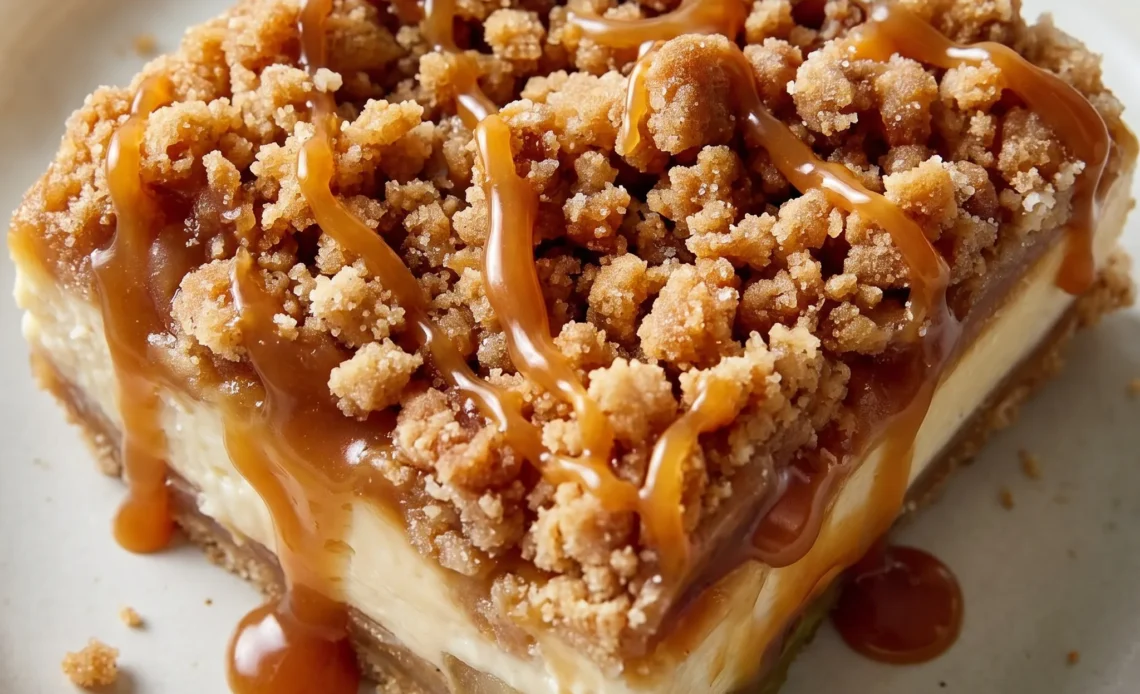
Caramel apple cheesecake bars aren’t a slice of cheesecake with fruit piled on. They’re a 9×13 pan built to be cut into squares, and the whole recipe is engineered around that: a pressed, par-baked crust, apples stirred through the custard, streusel broken into pieces on top, and a salted caramel that goes on after the bars chill.
The tricky part is the filling, which bakes at two temperatures instead of in a water bath, and the doneness call is a jiggle in the center, not a clean toothpick. Get that wrong and you’ll know at the cut. Room-temperature cream cheese matters more here than in most bakes, since cold lumps never beat smooth.
Layers That Hold Together
A cheesecake bar lives or dies by its structure. The crust has to be firm enough to carry the filling and apples without going soft.
A crumbly base that’s pressed firmly and baked until lightly browned gives you that support. The apples get stirred into the filling right before it goes into the pan.
That keeps them suspended instead of sinking to the bottom. The streusel goes on top in broken pieces, not a solid sheet. Those pieces create crisp pockets against the creamy filling.
Caramel comes last, after baking and chilling. Drizzle it then and it stays glossy on the surface. Add it earlier and it soaks in, leaving you with a soggy top.
Each layer has a job, and the order you build them in is what makes the bars slice cleanly. When you cut a square and it stands up on the plate, that’s the structure doing its work.
A Two-Stage Bake Works Quietly
Most cheesecake recipes call for a water bath to keep the custard gentle. These bars skip that hassle by using two oven temperatures.
The first stretch at 350°F gives the crust and streusel a head start, and the filling gets a slight lift. Then the heat drops to 300°F for the long stretch. That lower temperature lets the custard cook slowly, so the eggs don’t curdle and the top doesn’t crack.
The center will still wobble when you pull the pan out. That jiggle is what you want. It sets up as the bars cool on the counter and then firm completely in the fridge.
The edges will look set while the middle moves. That’s the signal that you’ve nailed the two-stage approach.
No water bath, no wrapping foil, just a gentle finish that mimics the same environment. The result is a creamy center with no cracks and no dry edges.
Apples Bring Moisture and Balance
Granny Smith apples earn their place here for two reasons. Their tartness cuts through the sweet filling, and their firm flesh holds up in the oven instead of turning to sauce.
Chop them finely so they disperse evenly. Larger chunks can leave pockets of undercooked fruit. Tossing the apples with sugar and spices starts drawing out juice right away.
That liquid has to go somewhere. If the apples sit too long, they release enough to thin the filling and make the bars weep. Stir them into the cheesecake batter just before you pour it over the crust.
That way they’re coated and suspended, not sitting in a pool of their own juice. You want each bite to get a piece of apple that’s tender but still has a little resistance.
When you taste a bar, the fruit should register as a bright note, not a soggy surprise.
Caramel That Clings, Not Pools
The caramel drizzle is the final touch, and its consistency matters as much as its flavor. Cook it until the sugar dissolves and it thickens just enough to coat a spoon. Too thin and it runs off the bars and pools on the plate.
Too thick and it won’t drizzle at all. Pull the pot off the heat before you add the vanilla. That keeps the vanilla flavor bright instead of cooking it off.
Let the caramel cool to room temperature. If it’s hot, it will melt the chilled cheesecake and turn the topping into a puddle. Drizzle it after the bars have chilled completely.
That way the caramel stays on top as a distinct ribbon, not soaked into the layers. When you bite into a bar, you should get a clean hit of buttery caramel that contrasts with the cool, creamy filling.
That’s the finish.

Five Ingredients That Decide How These Bars Turn Out
Salted butter: Softened means it dents under a finger but still holds its shape, because butter past that point makes both the crust and streusel greasy.
Quick cooking oats: These are cut fine, not rolled, so they disappear into the streusel instead of staying chewy and coarse on top.
Granny Smith apples: Firm and tart off the tree, they hold their shape through the bake where softer varieties collapse into the filling.
Full-fat cream cheese: Bricks, not spread, and genuinely room soft, since cold lumps never smooth out and low-fat types bake up loose.
Heavy cream: Room temp keeps it from seizing when it hits the hot sugar, which is what leaves you with a grainy caramel.
A cheesecake filling can be baked either at a constant moderate temperature, which cooks the custard slowly but leaves the crust and streusel pale and soft, or with an initial blast of high heat followed by a long, gentle bake. The high heat first sets the outer edge and gives the top structure, while the lower temperature lets the egg proteins coagulate gradually without over‑tightening, so the center stays creamy and the surface remains smooth. This recipe uses the two‑stage approach because the crust and streusel need early browning, but the custard cannot survive a full bake at that higher heat.
Reading the Signs at Four Points Where These Bars Can Go Wrong
Judging the crust’s par-bake color
That first 10 to 15 minute bake sets the crust’s texture, and the window is narrow. Pull it when the surface is light brown all over and feels dry to the touch, not shiny or pale.
Underbaked, the crust stays soft and the filling’s moisture turns it pasty. Overbaked, it turns hard and tastes toasted, and the bars crack when cut. If you catch it a shade too dark, cool it completely before adding filling.
The filling’s weight will press down and can split a brittle crust, so handle gently.
The streusel’s chill and clump stage
After mixing, the streusel should hold together when squeezed but break into pea-sized clumps when you rub it. If it’s warm and greasy, chilling firms the butter so it stays in pieces on top. Skip that rest and the streusel bakes into a flat, tough sheet instead of crisp pockets.
If yours turns sandy and won’t clump, a teaspoon of cold water brings it back. Break it up as you sprinkle; solid chunks won’t crisp through.
The filling’s jiggle at the end of the second bake
At 300°F, the center should wobble like set gelatin when you nudge the pan, and the edges should look dry and slightly puffed. A liquid swirl in the middle means more time, but check every 5 minutes past 45, because eggs go from creamy to grainy fast.
If the top browns before the center sets, tent foil over it. The jiggle is your doneness signal, not the clock.
Caramel color and the vanilla timing
The caramel is ready when it coats the back of a spoon and a line drawn through it holds for a second, usually around 8 minutes. Too pale and it tastes flat and sweet; too dark and it turns bitter.
Pull the pot off the heat before stirring in the vanilla; the residual heat is enough to bloom it without cooking off the aroma. If it thickens past drizzling as it cools, a splash of warm cream loosens it.
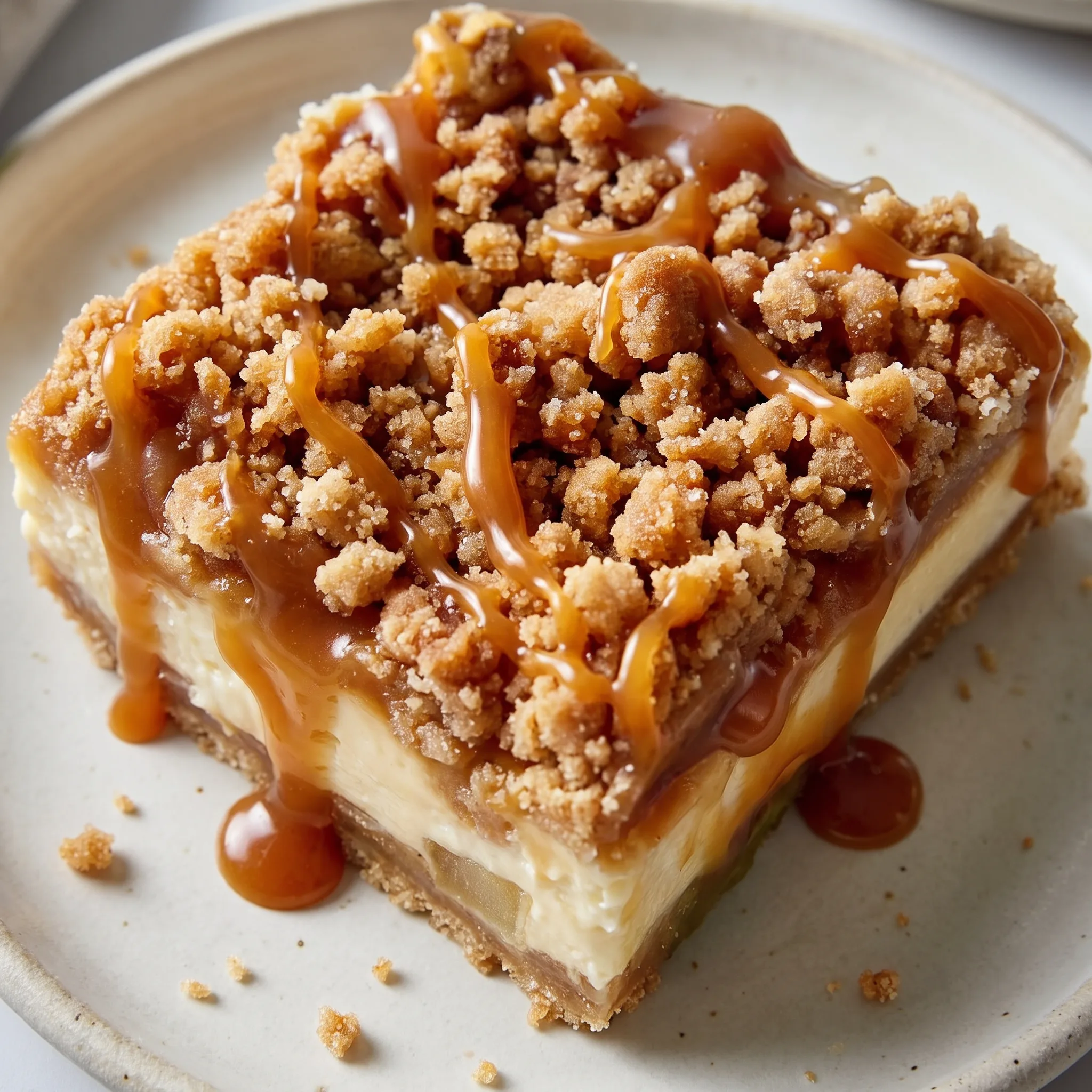
Caramel Apple Cheesecake Bars with Streusel
Ingredients
Method
- Set oven to 350°F (175°C) and fit a 9×13-inch baking pan with parchment paper.
- Combine flour and brown sugar in a medium bowl. Using a pastry blender, work in butter until crumbly. Firmly press into the pan and bake for 10-15 minutes until lightly browned, then cool.
- While the crust bakes, use a fork to mix brown sugar, flour, oats, butter, and cinnamon in the same bowl. Cover and chill.
- In another bowl, toss apples, sugar, cinnamon, and nutmeg until apples are evenly coated. Set aside.
- In a large bowl, beat cream cheese and sugar until smooth. Scrape bowl and beat again. With mixer on low, add eggs and yolks one at a time, then mix in sour cream and vanilla.
- Spread cheesecake filling over warm crust. Stir apples, then spoon evenly over cheesecake. Break up streusel and sprinkle over apples.
- Bake for 20 minutes, then lower heat to 300°F (150°C) and bake for 40-45 minutes, until edges are set and center jiggles slightly. Cool completely on counter, then cover and refrigerate for 5 hours or overnight.
- In a medium pot over medium-low heat, combine butter, brown sugar, and heavy cream. Stir and bring to a simmer, cooking until sugar dissolves and caramel thickens, about 8 minutes.
- Remove from heat and stir in vanilla. Transfer to a heatproof container and cool.
- To serve, cut cheesecake into squares and drizzle with caramel. Serve and enjoy!
Swaps That Save the Set (and One That Sinks It)
Full-fat cream cheese: Low-fat or whipped cream cheese, same weight. Whipped cream cheese is aerated and low-fat has more water, so the custard bakes up loose and the center never firms to that clean slice. If you use either, expect a softer set and plan to chill longer, but the bars will still weep at the cut.
Salted butter in the crust and streusel: Unsalted butter plus 1/4 teaspoon fine salt per 1/2 cup (113 g) butter. The salt brings back the savory edge that balances the brown sugar and apples. Without it, the crust and streusel taste flat and sweeter.
Add the salt to the dry ingredients before working in the butter so it distributes evenly.
Heavy cream in the caramel: Half-and-half or whole milk, same volume. Both have less fat, so the caramel finishes thinner and less glossy.
It’ll still taste sweet and buttery, but it may not coat a spoon the same way. Cook it a minute or two longer to thicken, and know that it can turn grainy if it gets too hot.
All-purpose flour in the crust and streusel: A 1-to-1 gluten-free flour blend. The crust and streusel come out a touch more sandy and don’t brown quite as deeply, but they still hold together if you press firmly.
The streusel clumps may be more delicate, so chill it well before sprinkling. Check the blend for xanthan gum; without it, the crust can crumble at the edges.
Storage, Chill Time, and the Serving Window
These bars need the full 300 minutes in the fridge before you cut them, and that’s not just for safety. The custard firms as it chills, so a bar sliced warm slumps on the plate. Serve them cold or just barely cool.
Left at room temperature more than about an hour, the filling softens and the streusel starts pulling moisture from the apples. Keep leftovers covered in the pan or in an airtight container in the fridge, where they hold about 4 days. Past that, the streusel goes from crisp to chewy and the crust softens against the filling.
Freeze only the bars themselves, well wrapped, up to 2 months, and skip the caramel on anything you freeze. Thaw overnight in the fridge.
The caramel is a finishing touch: cook it, cool it to room temperature, and drizzle it on just before serving. It stays glossy for that day.
Drizzle ahead and it slowly sinks into the streusel and dulls.
Tips
- Take the cream cheese out of the fridge at least 2 hours before you start, and set the eggs and yolks in a bowl of warm tap water for 10 minutes while you make the crust. Cold cream cheese stays in lumps no matter how long you beat it, and beating longer to chase those lumps whips air into the batter, which puffs the bars in the oven and then deflates them into a cracked, sunken top. Room-temp eggs also blend into the cream cheese without seizing, so the filling goes smooth in a minute or two of mixing instead of five.
Frequently Asked Questions
Can I make these caramel apple cheesecake bars ahead of time?
Yes, and they’re better that way. The bars hold about 4 days covered in the fridge, so a day or two ahead is well within range. Hold the caramel back and drizzle it just before serving, since it stays glossy for that day and sinks if it sits.
If you want to go longer, freeze the bars alone up to 2 months, skip the caramel on anything frozen, and thaw overnight in the fridge.
Why did my cheesecake bars crack on top?
Most likely the filling baked past the jiggle stage. At 300°F the center should wobble like set gelatin when you nudge the pan, with edges dry and slightly puffed; a liquid swirl in the middle means more time, but check every 5 minutes past 45 because eggs go grainy fast. A second cause is a crust baked so dark it turned brittle, which splits under the filling’s weight.
If the top browns early, tent foil over it rather than pulling the pan.
How do these differ from a classic cheesecake?
They’re built as bars in a 9×13 pan and cut into 16 squares, with a pressed crust and streusel instead of a springform and a smooth top. The bake runs at two temperatures rather than in a water bath, which is what keeps the custard gentle without foil wrapping.
Apples are stirred through the filling and streusel sits in broken pieces on top, so each square carries fruit, crunch, and cream at once. Caramel goes on after chilling, as a ribbon rather than a baked-in element.
