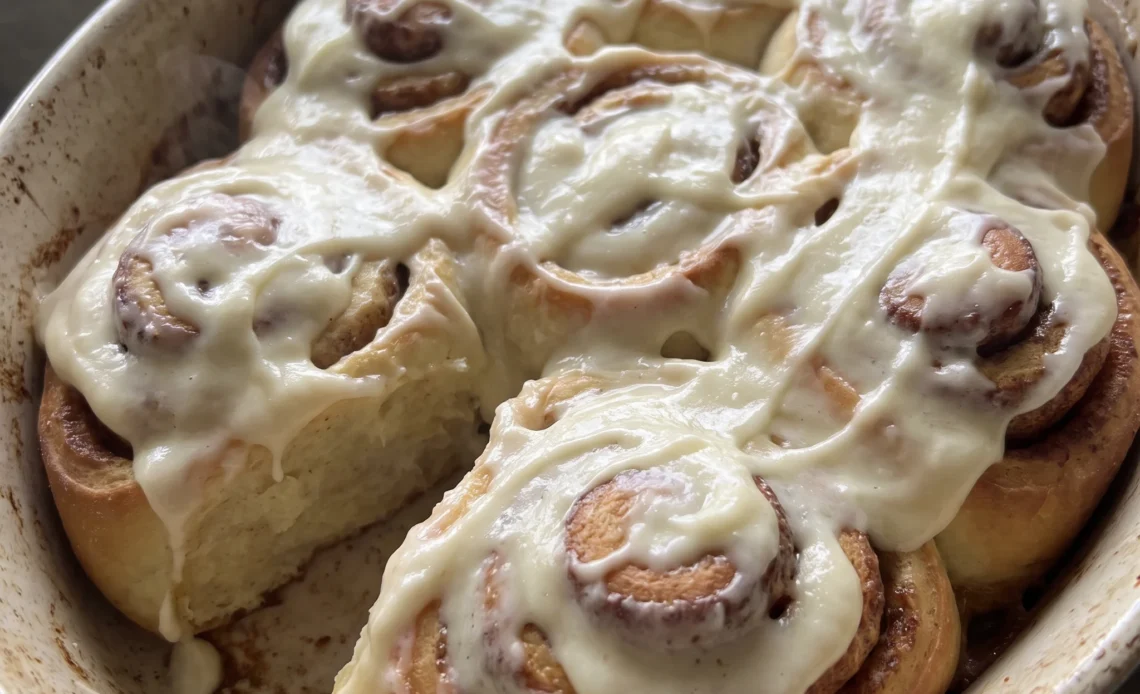
Cinnamon rolls reward patience more than technique, and the margin for error sits in a few places that catch cooks off guard. The milk has to be just warm enough to wake the yeast without killing it, and the rise is judged by feel, not by watching a clock. Get those right and nine spirals come out of the pan puffy, with cinnamon-sugar pooled in the center and frosting that softens the moment it hits the warm dough.
The heavy cream poured between the rolls before baking is what turns the bottoms custardy instead of dry, and it’s the step most people skip. Rolls this soft don’t keep well, so plan to eat them the day they’re baked.
Rapid-Rise Yeast and Milk Temperature
Rapid-rise yeast is milled finer than active dry and packed with enough ascorbic acid to skip the proofing step where you wake the yeast in warm water first. You scatter it dry over the wet ingredients, wait a couple minutes, then add flour and let the mixer do the work. That shortcut buys back time, but it puts all the pressure on one number: 110°F.
Warm the milk to that mark and the yeast wakes up hungry. Go past it and you cook the yeast before it ever gets going, which shows up later as a dough that rises like a brick.
The 90-minute total rise, one hour in the bowl and 30 to 45 minutes after shaping, only happens if the yeast is alive and the milk was right. Miss the temperature and you’re waiting on a dough that won’t move.
Hit it and the dough doubles on schedule, puffy and ready to roll.
Heavy Cream for Gooey Bottoms
Pour a little heavy cream into the gaps between the shaped rolls before they go in the oven. It sounds like a gimmick, but it changes the whole bottom of the roll.
The cream sinks past the dough and pools on the buttered dish, where it slowly thickens around the spirals as they bake. What you get is a soft, custardy base that tastes almost like bread pudding, but in a good way. Without it, the bottoms bake firm and dry, more like a standard sweet roll.
With it, the rolls stay tender all the way through and the cinnamon-sugar filling stays molten instead of soaking in and disappearing. This is the one step that separates a really gooey cinnamon roll from a good one. Skip it if you want a cleaner, more structured roll.
Add it if you want the kind that slumps on the plate.
Frosting on Warm Rolls
Cream cheese frosting for cinnamon rolls is not the same as cake frosting. It’s looser, tangier, and built to be spread while the rolls are still warm. The butter and cream cheese give it a slight tartness that cuts through the brown sugar filling, and the powdered sugar sweetens it just enough without turning it into a paste.
If you wait until the rolls are completely cool, the frosting sits on top in a thick layer that never really settles into the swirls. Spread it after ten minutes of cooling and it softens on contact, thinning just enough to run into the crevices and pool in the center of each spiral. That’s what you want: frosting in every bite, not just on the surface.
The warmth does the work for you. By the time you pull one out of the pan, the frosting has already found its way down.
Rolling from the 18-Inch Side
Roll the dough into a 12×18-inch rectangle and then roll it up from the long side. That gives you a log about 18 inches long, which cuts into 9 rolls instead of 6. More rolls means more edges, and edges are where the cinnamon-sugar gets caramelized and slightly crisp.
Each roll ends up smaller, so the ratio of frosting to dough swings in favor of the frosting. You get a higher proportion of filling and topping per bite. They also bake faster than larger rolls, which keeps the centers soft and prevents the outsides from drying out before the middle is done.
Nine rolls fit neatly in a 9×13-inch pan with just a little space between them, so they rise up rather than out. That’s the yield this recipe is built around, and it’s the one that gives you the best balance of gooey center and golden top.
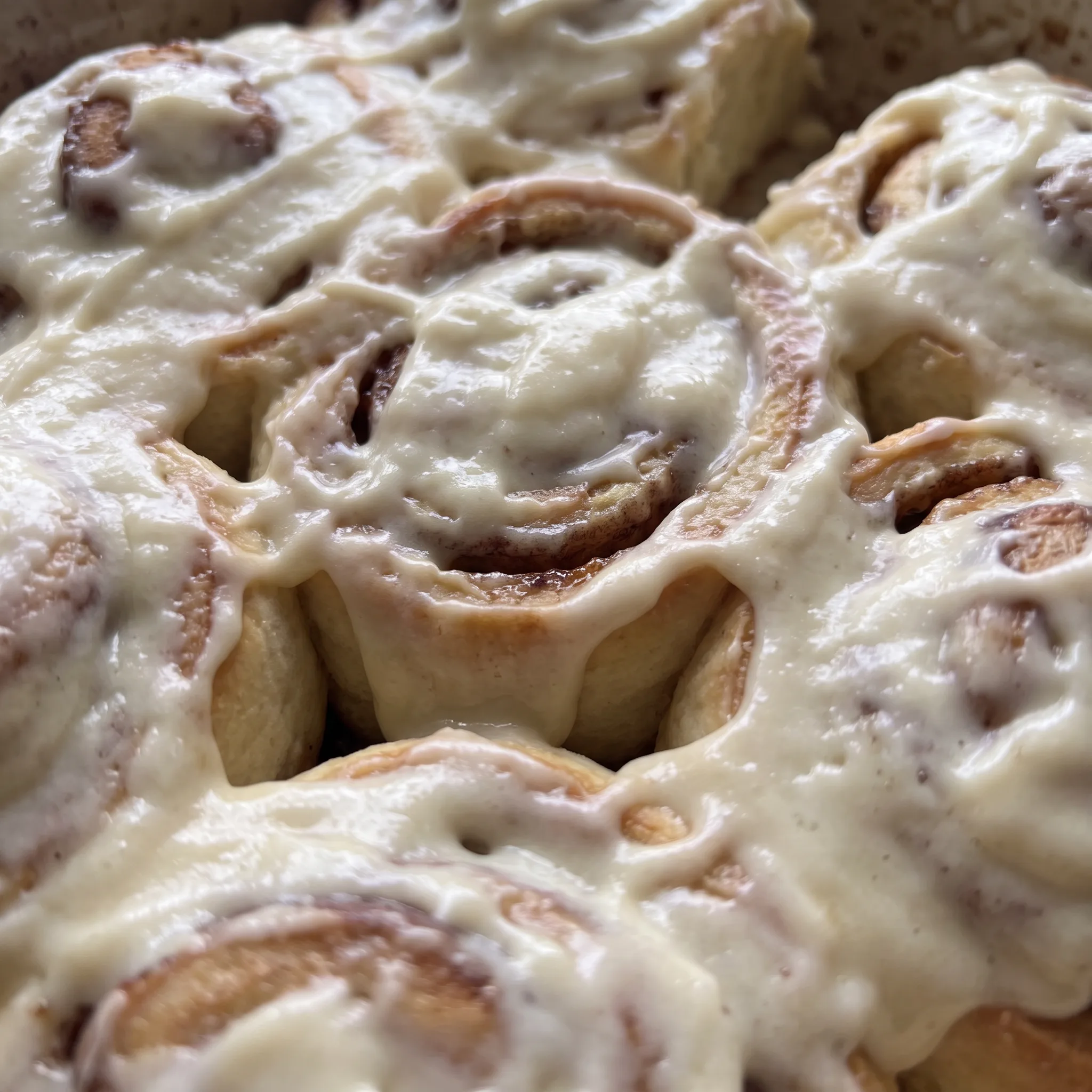
The Ingredients That Make or Break a Cinnamon Roll
Bread flour: Bread flour’s higher protein gives the dough enough structure to hold its shape around all that butter and sugar.
Rapid-rise instant yeast: Two packets of rapid-rise, not active dry, means you skip proofing and rely on milk at exactly 110°F.
Heavy cream: The optional 1/3 cup of heavy cream is what turns the bottoms custardy instead of firm and dry.
Brown sugar: Use 3/4 cup packed brown sugar, not granulated, for a filling that stays soft and slightly caramelized.
Cream cheese: Full-fat cream cheese at room temperature beats smooth; cold cream cheese leaves lumps you’ll never get out.
The most common mistake with this dough is heating the milk too far past 110°F (45°C), because it is tempting to think warmer liquid will speed up the rise. In reality, temperatures above that threshold kill the yeast outright, so the dough never doubles and the rolls bake dense and flat. The recipe uses rapid-rise yeast specifically for a fast, reliable rise, but that only works if the milk is at the correct temperature when the yeast is scattered over it.
How to Judge the Dough, the Rise, and the Bake
Reading the milk temperature without a thermometer
110°F is the line. Stick a clean finger in the milk: it should feel warm like a bath you’d sink into, not hot enough to make you pull back. If it’s steaming or you can’t hold your finger there for a second, it’s over and the yeast will die.
Let it cool, then scatter the yeast. If the surface foams a little after 2 to 3 minutes, you’re good. No foam means the milk was too hot or the yeast is old.
Start over.
When the dough has actually doubled
Don’t clock it. Look for the dough to fill the bowl and dome slightly, with a soft, puffy look.
Poke it: the indent should stay, not spring back. If it springs back, it needs more time. If it collapses or smells sour, it’s over-risen and will bake up dense.
In a cool kitchen, the 1-hour rise can stretch to 90 minutes. Judge by the poke, not the timer.
Knowing when the shaped rolls are puffy enough
After 30 to 45 minutes, the rolls should look swollen and press against each other, with the gaps nearly closed. Touch one gently: it should feel airy and leave a faint indent. If they’re still tight and the gaps are wide, they’ll bake up small and tough.
Give them more time. If they’ve ballooned and look fragile, bake them now. Over-proofed rolls deflate in the oven.
Judging the bake by color and feel, not just the clock
At 28 to 32 minutes, the tops should be golden brown and the centers should feel set when you press one. If they’re browning too fast but the centers still feel doughy, tent with foil and give them a few more minutes.
If the tops are pale and the centers spring back, they’re done. Underbaked rolls taste raw in the middle; overbaked ones dry out. Pull them when the color is even and the center is firm.
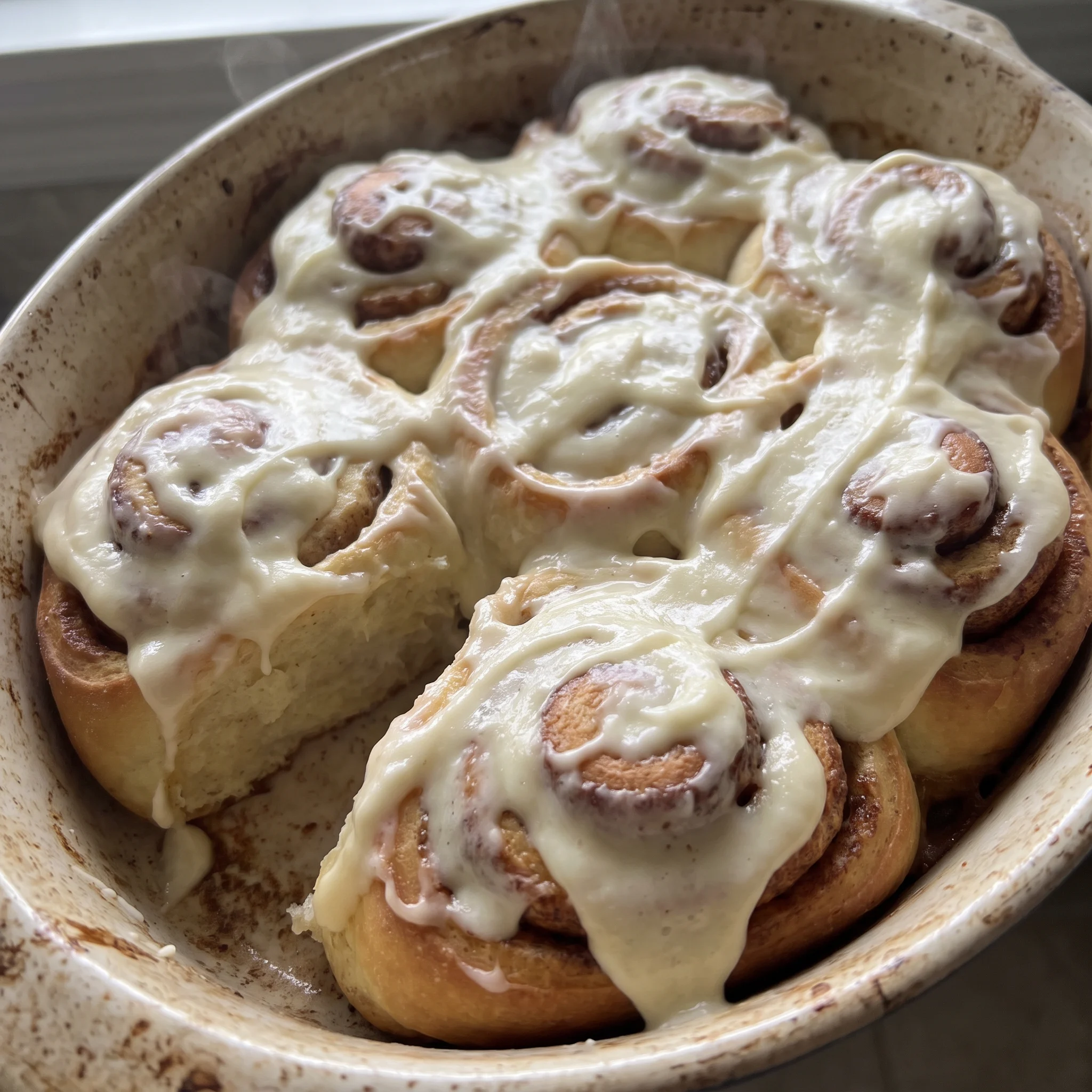
Soft Fluffy Cinnamon Rolls with Cream Cheese Frosting
Ingredients
Method
- Heat the milk to approximately 110°F (45°C); exceeding this temperature may destroy the yeast.
- Melt the butter and allow it to cool somewhat.
- In a mixing bowl, whisk the egg, granulated sugar, vanilla, heated milk, and melted butter together.
- Scatter the yeast over the top and leave for 2–3 minutes.
- Incorporate the flour and salt. Using a dough hook, mix on speed 2 for 5–8 minutes until a ball forms.
- Seal the bowl tightly with plastic wrap and a towel. Allow the dough to rise until doubled, roughly 1 hour.
- Butter a 9×13-inch baking dish.
- In a bowl, combine the brown sugar and cinnamon.
- Lightly flour a work surface. Roll the dough into a 12×18-inch rectangle.
- Evenly spread the softened butter over the dough.
- Scatter the cinnamon-sugar mixture on top.
- Roll tightly from the 18-inch side for 9 smaller rolls, or from the 12-inch side for 6 larger rolls.
- Cut evenly and place in the buttered dish.
- Cover with plastic wrap and a towel. Let rise 30–45 minutes until very puffy.
- Preheat oven to 350°F (175°C).
- Optional: pour heavy cream between the rolls for extra gooey texture.
- Bake 28–32 minutes, until tops are golden brown.
- While rolls cool for 10 minutes, beat the butter, cream cheese, vanilla, powdered sugar, and milk until smooth.
- Spread over warm rolls and enjoy.
Storing, Reheating, and Serving Cinnamon Rolls
Eat these the day they’re baked. That’s the window: cooled ten minutes, frosted, then gone within a few hours. The frosting goes on those warm rolls and nowhere else, so if you’re making them ahead, hold it back, refrigerate it separately, and bring it to room temperature before spreading it on rewarmed rolls.
Leftovers keep covered at room temperature overnight, but the frosting softens and weeps, so refrigerate anything past that. Cold firms the dough and solidifies the butter in the filling, which is why a chilled roll eats dense and dry straight from the container.
Airtight at room temperature, they’re worth eating for a day or two; in the fridge, three or four. Reheat single rolls at 300°F until the centers give when pressed, eight to ten minutes, tented with foil if the tops darken.
The frosting softens without breaking because the gentle heat warms it through rather than blasting the cream cheese. Microwave works, ten to fifteen seconds, but the dough toughens at the edges.
Cold rolls aren’t worth serving. Warm them. The frosting that pooled between the spirals on day one will have set; reheating loosens it again.
Tips
- Judge the first rise by the dough’s temperature, not the clock. Stick an instant-read thermometer into the center of the dough right after mixing: if it reads near 78°F to 80°F, the 1-hour rise will land close to schedule. If it reads 70°F or below, the dough is cold and the rise will run long, so move the bowl somewhere warmer or expect closer to 90 minutes. A humid kitchen pushes the other way, and the dough can double in 45 minutes, so start checking at the 40-minute mark instead of waiting for the full hour.
- Use the poke test on the shaped rolls as your cue to preheat, not the timer. Press one roll gently with a flour-dusted finger: a faint indent that fills back slowly means they are ready and the oven should already be at 350°F. If the indent stays deep and the dough feels slack, they have gone past the mark and will collapse in the oven, so bake them immediately. If the dough springs back fast, they need more time. This matters here because the 30 to 45 minute second rise is the window where a warm kitchen can push a batch from puffy to over-proofed in ten minutes.
Swap the Dairy and You Change the Dough, Not Just the Flavor
Milk (1 2/3 cups, heated to 110°F): Oat milk or another unsweetened plant milk, warmed to the same 110°F before it touches the yeast. The dough hydrates the same and the rise moves on schedule, since you’re still feeding the yeast a warm liquid. What you lose is richness.
Cow’s milk brings fat and milk sugars that keep the crumb tender and push browning along, so expect a slightly leaner roll and a paler top at 28 minutes. Almond milk works too but drinks thinner and the dough can feel a touch slack under the mixer. Don’t reach for anything labeled sweetened or vanilla; that sugar rides along into a dough that’s already got 1/3 cup in it.
Butter in the dough and filling (5 tbsp melted in the dough, 5 tbsp soft for the filling): A block-style plant butter that lists a high fat percentage, not a tub spread or margarine. Block plant butter melts and spreads like the real thing, so the filling stays glossy instead of weeping oil into the swirls.
Tub spreads carry more water, and that water turns the cinnamon-sugar into a wet paste that soaks into the dough and disappears by the time it bakes. Same 5 tablespoons each place.
The dough may feel slightly less elastic when you roll it out, so give it a gentler hand and don’t force the rectangle.
Cream cheese in the frosting (8 oz): Plant-based cream cheese, or a thick Greek-style coconut yogurt if you can’t find one that tastes clean. This is the swap most likely to disappoint, because frosting is the first thing anyone tastes. Plant cream cheese varies wildly by brand; some beat smooth and some stay grainy no matter how long the mixer runs.
Coconut yogurt gets you tang and spreadability but thins fast on warm rolls, so the frosting pools instead of clinging to the spirals. Keep the same 8 ounces either way. If the frosting looks loose, beat in powdered sugar a spoonful at a time until it holds a soft peak.
Heavy cream poured between the rolls (1/3 cup, optional): Full-fat coconut milk, the kind in the can, whisked smooth first. It sinks into the gaps and thickens around the bases the same way, and the coconut reads as faintly sweet rather than obvious once the cinnamon and brown sugar hit it.
Light coconut milk or a thin nut milk won’t do the job; they’re mostly water and the bottoms bake firm like you skipped the step. If you want the custardy base, use the can.
If you’d rather keep the flavor neutral, leave the cream out entirely and accept a firmer roll.
Frequently Asked Questions
Can I make these cinnamon rolls ahead of time and bake them later?
You can assemble them up to the point of the second rise, then cover and refrigerate overnight. The next day, let them sit at room temperature until they look puffy and press against each other, then bake as directed. If you want to bake them right after shaping, you can also freeze the unbaked rolls, but thaw them completely before the second rise.
Either way, hold the frosting back and refrigerate it separately; bring it to room temperature before spreading on rewarmed rolls.
Why did my cinnamon rolls turn out dry or tough?
Most often, the dough was over-floured or over-kneaded, which makes a stiff, tight crumb. Stick to the 4 3/4 cups and stop mixing as soon as the dough forms a ball and clears the bowl. Another cause is overbaking: pull them when the tops are golden and the centers feel set, not rock hard.
Finally, skipping the heavy cream between the rolls leaves the bottoms firm and dry, so if you want that custardy base, pour it in before baking.
How are these different from Cinnabon cinnamon rolls?
Cinnabon rolls are larger and heavier on frosting, with a gooier, more rich texture. This recipe makes nine smaller rolls packed into a 9×13 pan, so you get more edges and a higher frosting-to-dough ratio per bite. The optional heavy cream poured between the rolls creates a custardy bottom that’s similar to Cinnabon’s, but you control the sweetness and can dial back the frosting if you prefer.
The dough itself is enriched with butter, egg, and milk, giving a tender crumb that’s a bit lighter than the mall version.
