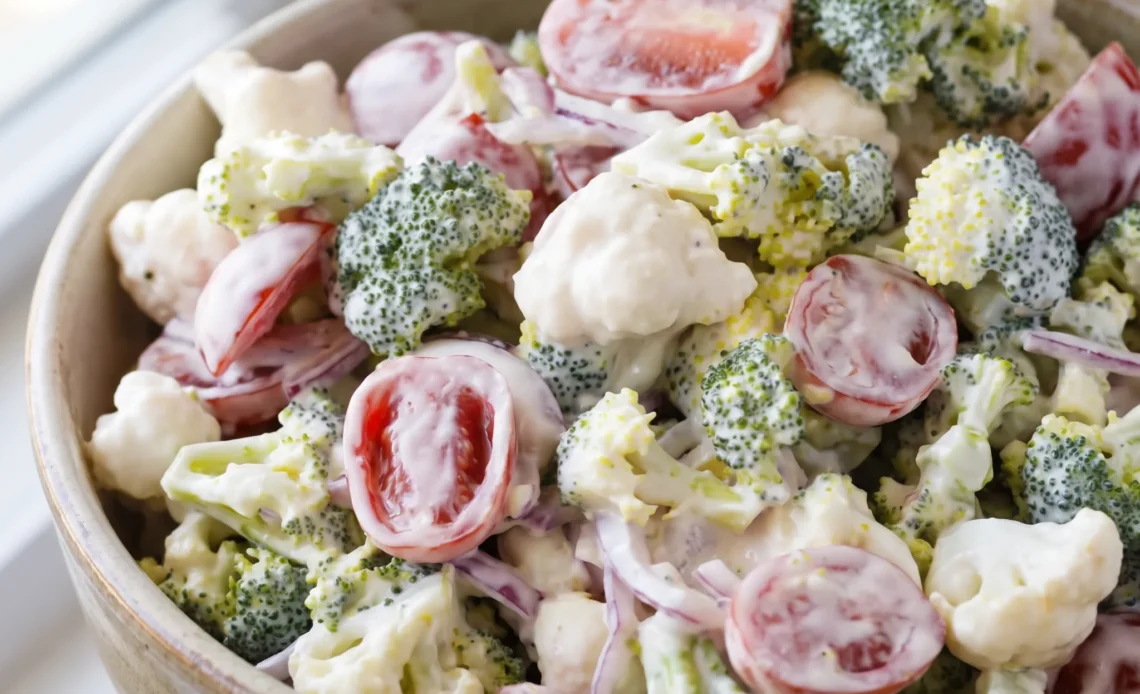
Raw broccoli and cauliflower hold their crunch under a thick dressing for a day. Cook them and the bowl turns watery by the next afternoon, which is why this one stays uncooked. The hard part is the dressing: mayonnaise and sour cream are heavy enough that sugar hides in them, and a grainy bite shows up later.
Full-fat dairy matters here, since the thin versions never coat the florets evenly. Cherry tomatoes and red onion give the red, the crucifers give the green, and the pale dressing keeps both bright. Build this broccoli cauliflower salad for a holiday table and the leftovers hold up cold the next day, though the texture fades after that.
When the dressing is tossed with the vegetables and left to sit, salt naturally present in the broccoli, cauliflower, and tomatoes pulls water out of the plant cells through osmosis. That extra water dilutes the mayonnaise and sour cream, thinning the dressing and causing it to slide off the vegetables instead of clinging. Without a stable emulsion, the fat and water separate, leaving a puddle at the bottom of the bowl and a salad that tastes sharp rather than cohesive.
Sugar, Fat, and the Bite of Raw Alliums
A spoonful of that dressing on its own tastes sweet, almost like dessert. Spread across a bowl of raw broccoli and cauliflower, that sweetness does different work.
It rounds off the sharp hit of sliced red onion, which otherwise lingers and burns at the back of the throat. The same sugar softens the faint bitterness that raw crucifers carry, a green, cabbagey edge that some eaters notice more than others. Fat does the rest.
Mayonnaise and sour cream are thick enough to coat every surface, and where they land, the harsh notes get muted. You still taste onion and broccoli, just without the sting. Whisk the dressing until it’s completely smooth before it goes anywhere near the vegetables.
A stray lump of sour cream or undissolved sugar means one bite gets a pocket of pure tang while the next tastes flat. The goal is the same flavor in every forkful.
Why Raw Florets Hold Up
Cooked broccoli collapses under a creamy dressing. Water leaks out, the florets go limp, and the whole bowl turns into a soggy, sad thing by the second day. Raw florets don’t do that.
They’re firm and dense, and they stay that way even after sitting in mayonnaise and sour cream. That firmness gives the salad its structure. Cherry tomatoes bring a burst of juice when you bite down, and the thin-sliced red onion adds a clean crunch, but the broccoli and cauliflower are what you chew.
Cut the florets into bite-sized pieces, roughly the same size, so each one gets an even coat of dressing and fits on a fork without a fight. A giant floret with a bare stem tastes like nothing but raw vegetable.
A small one drowns. Uniform pieces keep the ratio right. The salad should feel crisp and snappy from the first bite to the last.
An Hour in the Cold
Straight out of the bowl, this salad tastes sharp. The onion is loud, the broccoli is grassy, and the dressing sits on top rather than soaking in.
An hour in the fridge changes all of that. The cold firms up the dressing just enough that it clings to the florets instead of sliding off, and it gives the sugar and salt time to pull a little moisture from the vegetables. That moisture thins the dressing slightly, which sounds like a problem but isn’t.
It means the coating reaches into the tight spaces of the cauliflower and broccoli instead of sitting in a thick cap on the outside. The onion mellows, the raw edge softens, and the whole thing starts to taste like one salad rather than a pile of separate ingredients. Serve it immediately and you get a decent vegetable dish.
Wait the hour and you get something people go back for.
Red and Green, No Dye Required
Christmas colors on a table usually come from food coloring, maraschino cherries, or a dusting of something red and sugary. This salad gets them honestly.
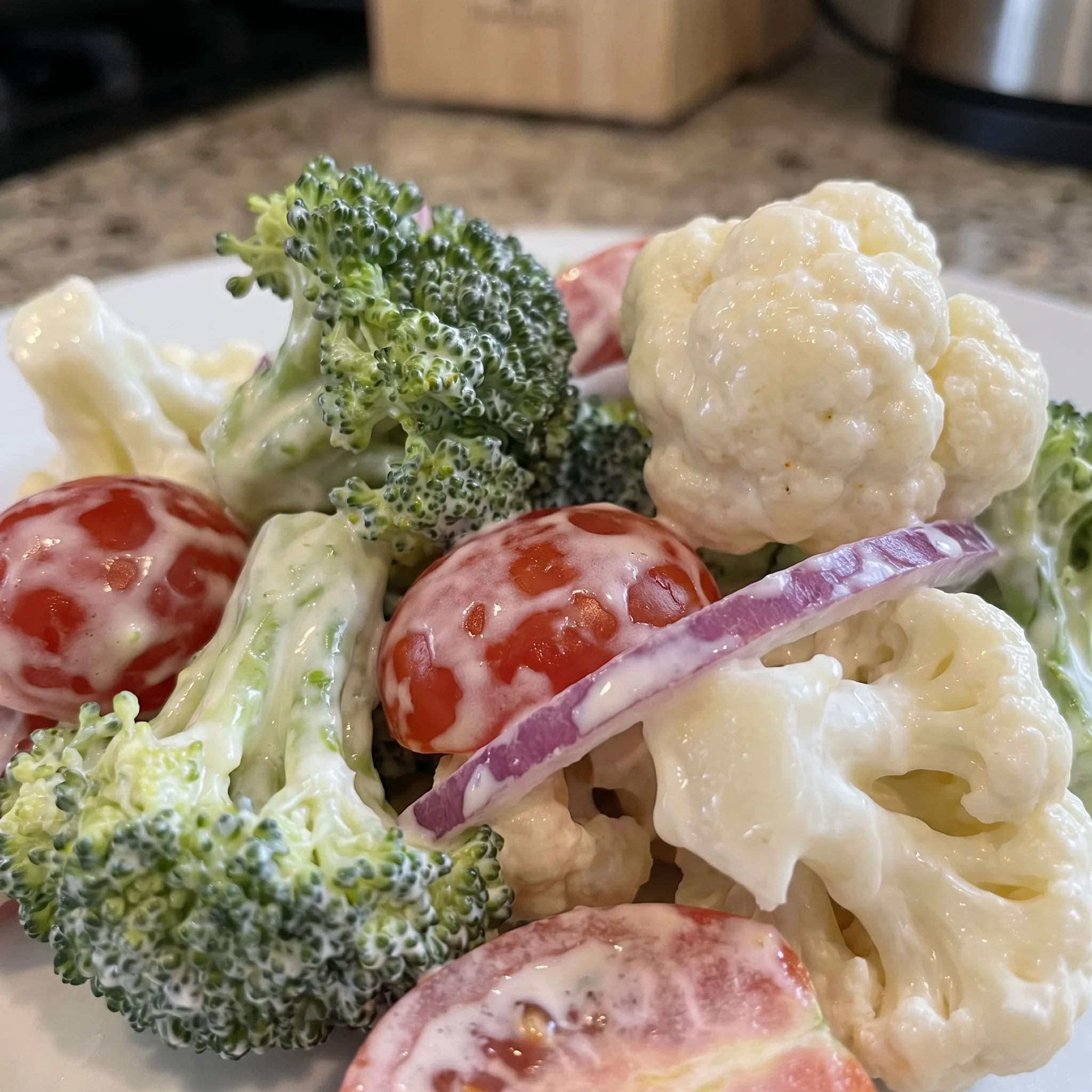
Cherry tomatoes, halved, show their cut faces like little red ornaments scattered through the bowl. Thin half-moons of red onion add a deeper, purplish red that breaks up the green.
Broccoli brings the dark green, and cauliflower brings the white, so the base already looks like a snowy wreath with green branches. The dressing is the trick.
Mayonnaise and sour cream are pale and neutral, so they don’t muddy the reds or dull the greens. They make the colors sit up.
A vinaigrette would darken everything and turn the cauliflower translucent. This creamy coat keeps each piece distinct, so you see exactly what you’re eating.
The bowl looks festive before anyone picks up a serving spoon.
What to Buy and How to Prep for This Creamy Christmas Salad
broccoli: Buy heads with tight, dark green florets and no yellowing, since yellowing means older broccoli with a stronger cabbagey bite.
cauliflower: Choose heads that feel heavy for their size with no brown spots, as light heads have loose, less sweet florets.
red onion: Pick a firm onion with shiny, unbruised skin, as soft spots mean the interior will taste harsh and sulfurous.
cherry tomatoes: Select tomatoes that are deeply colored and firm, since pale or soft ones bring little juice and a mealy texture.
mayonnaise: Use full-fat mayonnaise, as reduced-fat versions are thinner and won’t coat the florets as evenly.
sour cream: Buy full-fat sour cream, because low-fat types have a gummy texture that never whisks into a smooth dressing.
How to Read the Bowl Before It Chills
Whisking the dressing past smooth
Mayonnaise and sour cream are both thick, and sugar dissolves slowly in that much fat. When you think it’s smooth, drag the whisk across the bottom.
If you feel grit or see tiny white flecks, keep going. Undissolved sugar tastes like sand in an otherwise creamy bite, and it won’t break down in the fridge.
The dressing should ribbon off the whisk, not plop.
Sizing the florets for a single bite
Pick up a floret. If it’s bigger than a walnut, it’s too big.
The stem end will be bare of dressing, and the crown will hold too much. Cut until every piece is roughly the same size, small enough to eat in one go.
Uneven pieces mean some bites are all dressing and others are raw vegetable. This is the difference between a salad that eats well and one that doesn’t.
Tossing until every piece is coated
After you drizzle and toss, look for dry patches. Broccoli and cauliflower have tight spaces that dressing won’t reach unless you turn them over.
Use your hands or two spoons, lifting from the bottom. If a piece still looks matte, it missed the dressing.
Those dry bits taste flat and raw. The bowl should look uniformly glossy, with no puddles at the bottom.
Judging the onion’s edge before chilling
Taste a sliver of the raw onion. If it’s so sharp it makes your eyes water, the hour in the fridge will mellow it, but only so much.
For a milder salad, soak the slices in cold water for ten minutes and pat dry before adding. That rinses away some of the bite. If you skip this, the onion can dominate, especially on the second day.
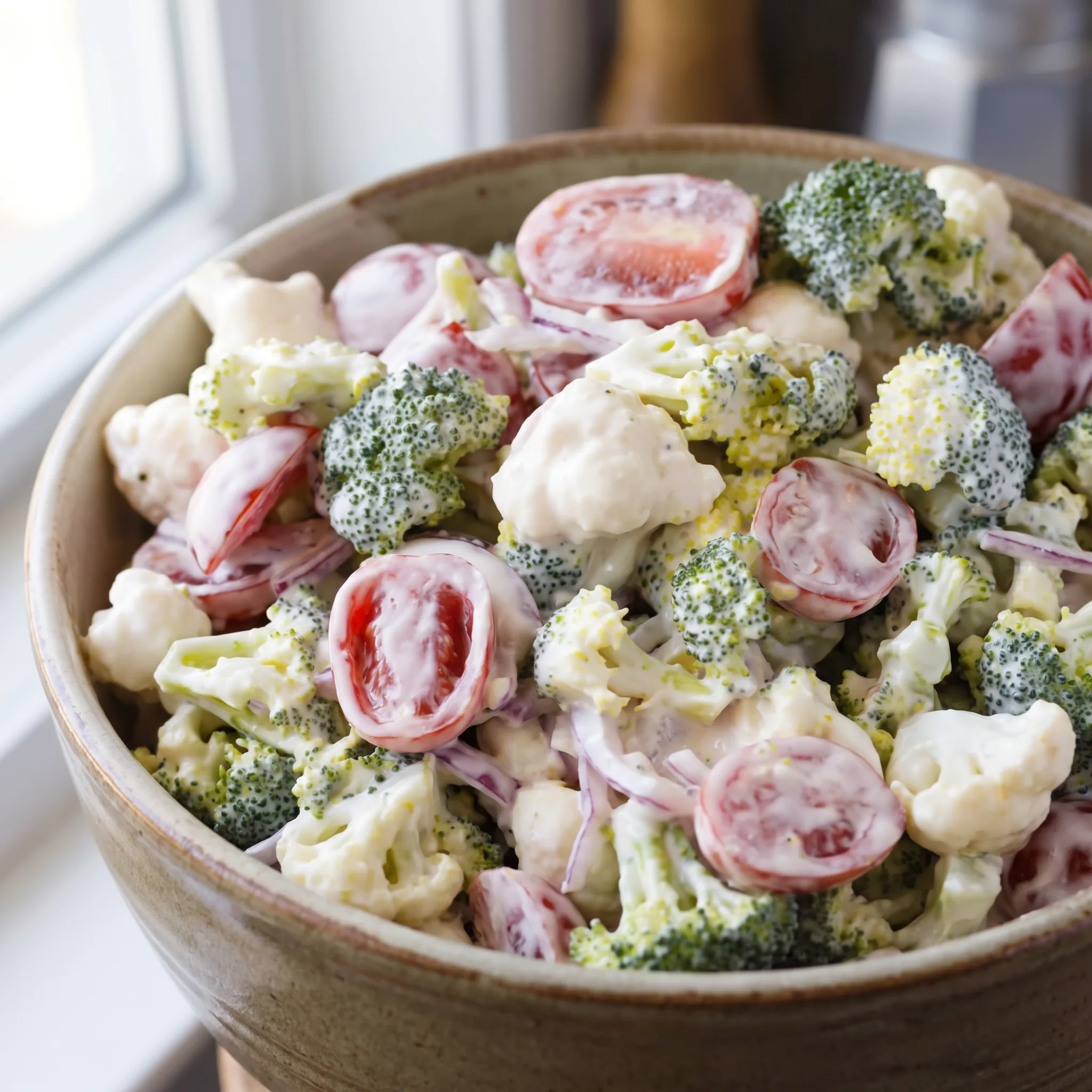
Creamy Broccoli Cauliflower Salad with Cherry Tomatoes
Ingredients
Method
- Place the broccoli, cauliflower, red onion, and cherry tomatoes into a salad bowl.
- In another bowl, combine the mayonnaise, sour cream, and sugar, whisking until smooth.
- Drizzle the dressing over the vegetables and toss until evenly coated.
- Chill for 1 hour prior to serving.
Keeping It Cold and Eating It Soon
This salad peaks within 24 hours. The hour of chilling is the minimum, not the goal.
By the next day the dressing has pulled water from the tomatoes and the cut faces of the onion, thinning the coat and softening the florets from snappy to bendy. That shift is gradual, not sudden. At 24 hours it still tastes bright.
By 48 the broccoli has lost its snap, the tomatoes slump, and the bottom of the bowl holds a thin pink pool. Eat it inside that first day for the texture the recipe is built on.
Store it covered in the fridge in the bowl you tossed it in. Before each serving, stir from the bottom, since the dressing settles and the released liquid pools. A stir re-coats everything and buys back some gloss.
Don’t freeze it. Mayonnaise and sour cream break when thawed, and raw florets go limp and waterlogged. There’s no component here worth freezing on its own.
No finishing touch goes on at the end. Everything is already in the bowl from the toss, so serve it straight from the fridge, cold and stirred.
What Swaps Keep This Salad Creamy and What Kills the Crunch
Mayonnaise: Greek yogurt or a lighter mayo blend, replaced in equal measure. Greek yogurt brings a tang that sour cream already has, so the dressing tastes brighter and less rich. It also thins the coating, and that means the dressing slides off the florets instead of clinging.
The bowl will look wetter at the bottom after an hour in the fridge. If you go this route, use full-fat Greek yogurt and expect a sharper, lighter salad.
A lighter mayo blend behaves much the same way: it coats, but the coating is thinner, so you lose some of the richness that rounds off the raw onion. Start with the same amount the recipe uses and adjust after tasting the dressed salad.
Sour cream: More mayonnaise, or plain whole-milk yogurt, in the same amount. Sour cream adds a clean tang and a little body. If you replace it with mayonnaise, the dressing gets heavier and less bright, and the salad tastes flatter.
Plain yogurt works, but it’s looser than sour cream, so the dressing won’t hold onto the vegetables as well. You’ll notice more liquid pooling after chilling.
If you use yogurt, strain it for 10 minutes first to thicken it. Either way, whisk and taste before dressing the salad. Adjust with a squeeze of lemon if it tastes dull.
Sugar: Honey, or reduce the amount, or leave it out. Sugar here tames the raw onion and the bitterness of the crucifers. Honey does the same job but brings its own flavor, so the dressing tastes slightly floral.
Use a little less honey than sugar because it’s sweeter and adds moisture. If you cut the sugar entirely, the salad will taste sharper and more vegetal. Some people like that; others find the onion too loud.
Start with half the sugar the recipe calls for, taste the dressing, and add more if needed. The card gives 1 tablespoon (12 g), so half is 1½ teaspoons.
Broccoli and cauliflower: None. Leave them raw. The crunch of raw florets is what makes this salad work.
Cook them and they release water, turn limp, and the dressing turns into a thin puddle. The salad won’t hold for more than a few hours. If you want a cooked version, you’re making a different dish.
Keep the florets raw and cut them into bite-sized pieces. That’s the only way to get the texture this salad is built on.
Tips
- Taste the dressing by itself before it touches the vegetables, and make it sweeter and tangier than you want the finished salad to be. The raw broccoli, cauliflower, onion, and tomatoes bring their own water and bitterness to the bowl, so the dressing you taste now will read weaker once everything is tossed. If it tastes right on the spoon, the salad will taste flat.
- If you halve the cherry tomatoes ahead of time and let them sit cut-side down on a paper towel for a few minutes, they shed some juice before going into the bowl. That juice would otherwise thin the mayonnaise and sour cream coating and pool at the bottom during the hour of chilling. Patting the cut faces dry keeps the dressing thick enough to cling to the florets.
Frequently Asked Questions
Can I make this broccoli cauliflower salad the night before?
Yes, but understand what you’re trading. The salad peaks within 24 hours, so a night in the fridge puts it right at that window. The hour of chilling is the minimum; overnight, the dressing pulls water from the tomatoes and onion, thinning the coat and softening the florets from snappy to bendy.
By the next day it still tastes bright, though the bottom of the bowl will hold a thin pink pool. Stir from the bottom before serving to re-coat everything.
Why did my creamy broccoli salad get watery?
Most likely the florets weren’t fully dry after washing, or the tomatoes released juice as they sat. Both add liquid that the mayonnaise and sour cream can’t absorb, so it pools at the bottom. A secondary check: if you used a lighter mayo or yogurt, the coating is thinner to begin with, and water shows up faster.
The dressing should ribbon off the whisk, not plop, so it clings rather than slides.
How is this different from classic broccoli salad with bacon and cheese?
This one skips the bacon and cheddar entirely and leans on a sweet-tangy dressing of mayonnaise, sour cream, and sugar. Cauliflower joins the broccoli, adding white florets that keep their crunch and don’t muddy the reds of the tomatoes and onion. Without bacon’s smokiness or cheese’s salt, the raw onion and crucifers come through more clearly, which is why the sugar and the hour of chilling matter.
The result is a lighter, crunchier bowl that lets the vegetables speak.
