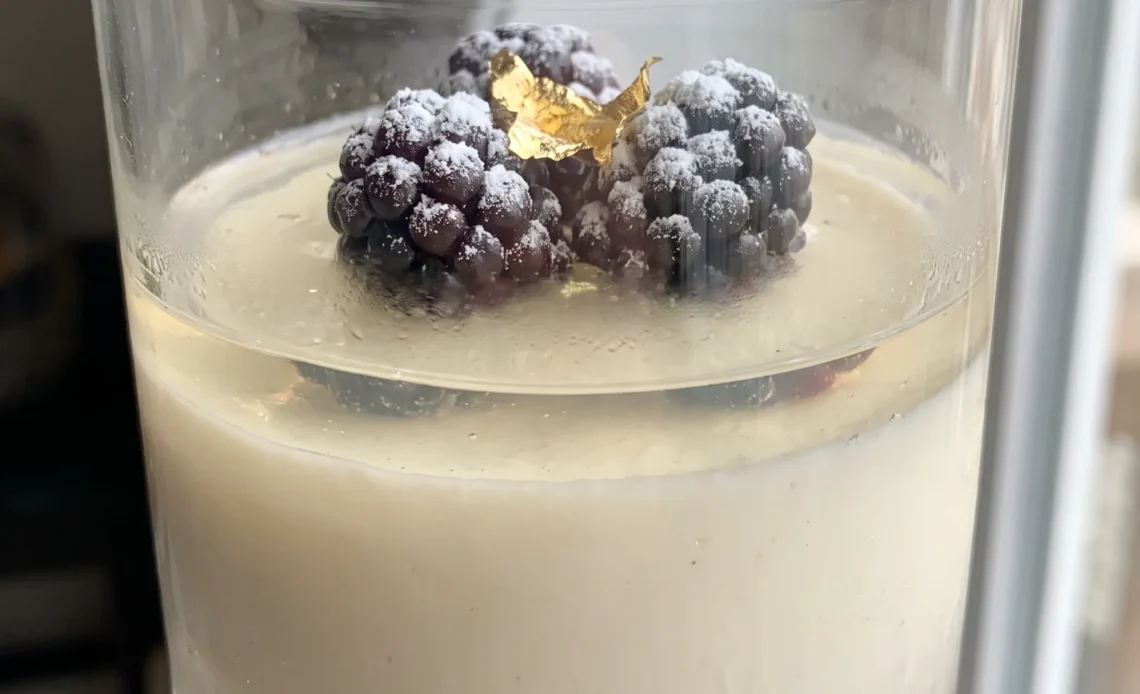
Scatter gelatin over the dairy too fast and you get hard specks that never dissolve, suspended in what should be a clean white base. That’s the kind of thing you don’t notice until a guest tilts a glass and sees grain. Sparkling wine panna cotta lives or dies on the bloom, and the wine jelly is even less forgiving than the cream.
Acidity and alcohol make a set harder to reach, so the wine layer needs a firmer hand than the dairy one. Get both right and you’re rewarded with three distinct bands in a single flute: creamy white, clear sparkling jelly, and berries bleeding their color down on top. It’s the kind of dessert that makes people stop mid-sentence.
The berries go on at the very end, or they stain everything below them.
Why the Jelly Needs More Gelatin
Sparkling wine is a tricky liquid to set. Its acidity and the alcohol from fermentation both interfere with gelatin’s ability to form a solid gel. That’s why the jelly layer calls for 2 teaspoons of gelatin for just 2 cups of wine, while the panna cotta base uses the same amount for about 3 cups of dairy.
Without that extra gelatin, the jelly would stay liquid, no matter how long you chill it. You’d end up with a panna cotta layer topped by a puddle of wine, and the two would never form distinct layers.
The higher ratio gives the jelly enough structure to set firm but still tender. When you tilt the glass, the jelly should hold its shape with a slight wobble. That’s your cue that it’s ready to serve.
Set the Base Before You Pour
The panna cotta base has to be fully set before the champagne jelly goes anywhere near it. If you pour the jelly over a liquid base, the two will mix and you’ll lose the clean separation.
Let the base chill until it’s firm to the touch and doesn’t jiggle when you nudge the glass. Then, when you pour the jelly, it sits on top and sets as its own layer.
That two-step chilling gives you a clear visual line between the creamy base and the sparkling top. It also means the jelly won’t weep into the panna cotta, so each spoonful has the texture you intended. The result is a dessert that looks as good as it tastes.
Choosing Your Glassware
Shot glasses and tall flutes each offer a different way to enjoy this dessert. Shot glasses give you small, intense portions where the three layers are visible but compact.
They’re easy to pass around at a party and encourage just a few bites. Tall flute glasses, on the other hand, let you build the full three-layer effect with berries and a splash of champagne.
The shape of the glass also affects how you add those final touches. In a flute, you can layer berries and wine for a dessert cocktail look, while shot glasses are better for a simpler garnish.
Both work, but the experience changes with the vessel you pick.
Add Berries at the Last Minute
Fresh berries are a finishing touch, but they can also be a problem if you add them too early. Their juices start to leak as soon as they sit, and that liquid will bleed into the champagne jelly, discoloring it and blurring the neat layers you worked to create. For the shot glass option, a light coating of icing sugar helps seal in some of that moisture, but it’s not a fix.
In the flute option, you place the berries on top and pour champagne over just before serving, which keeps the layers intact for the moment. The best approach is to garnish right before you hand the glasses to your guests.
That way, the dessert looks as crisp and clean as when you first assembled it.
What to Buy and Watch in the Glass and the Bottle
**Half-and-half:** The dairy base sets the body, so use a fresh carton and skip anything ultra-pasteurized if you have the choice.
**Heavy cream:** Buy a carton with a high enough fat content that it coats a spoon, since thinner cream gives a softer set.
**Unflavored gelatin:** Plain powdered gelatin, not the flavored dessert mix, and check the date because old gelatin sets weakly.
**Sparkling wine:** A dry Prosecco or Champagne works best; sweet or heavily fruited bottles taste syrupy once the jelly sets.
**Vanilla extract:** Real vanilla, not imitation, since the dairy is mild and any off note shows through in the finished spoonful.
Judging Panna Cotta and Sparkling Wine Layers by Feel and Sight
Reading the Bloom: When Gelatin Is Ready to Use
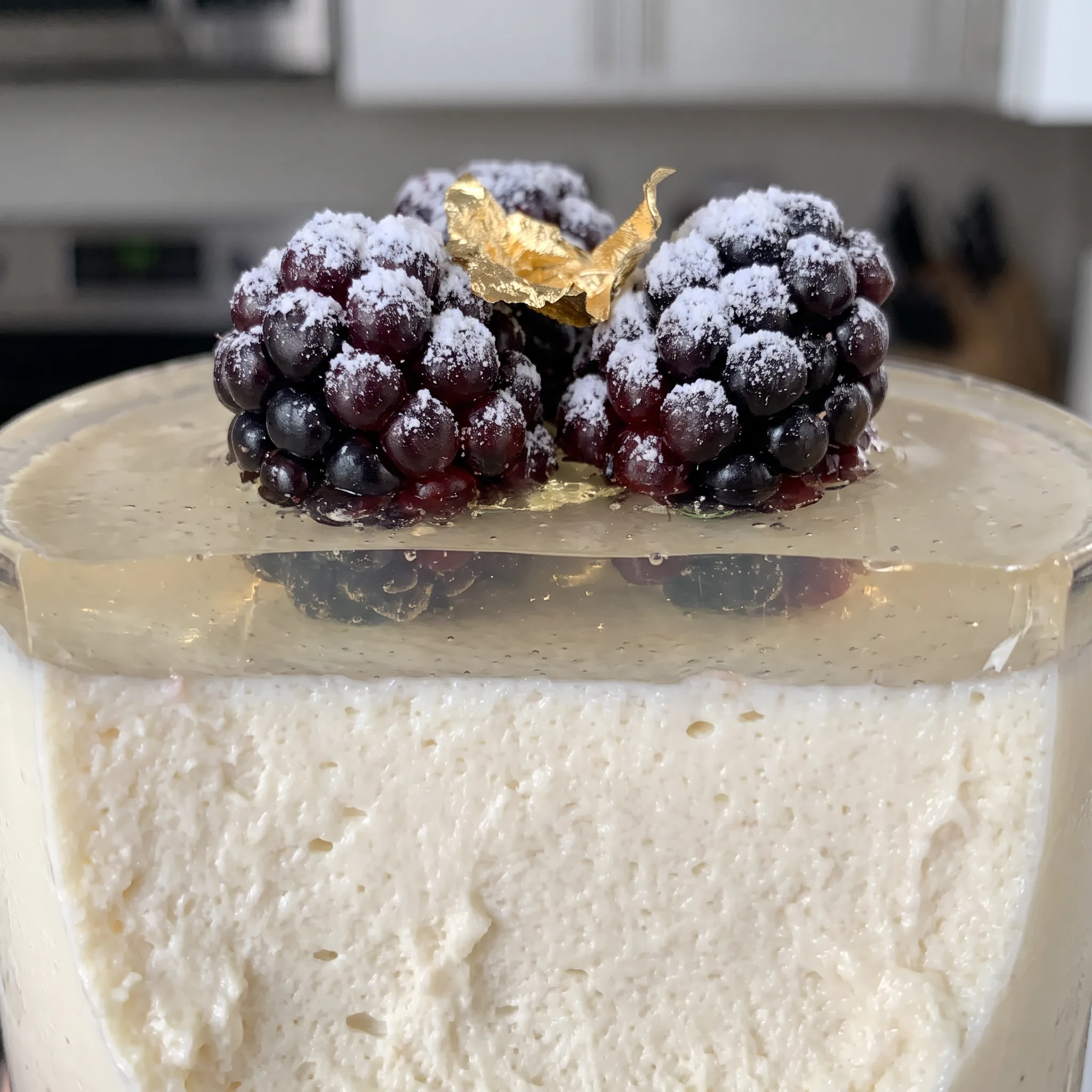
Gelatin needs to absorb liquid before it can set anything. Scatter it evenly over the half-and-half and let it sit.
The grains will darken, swell, and look like wet sand. If you see dry patches after a minute, stir them in.
Bloomed gelatin should feel soft and pliable, not gritty. If it clumps, the liquid was too cold or you dumped it in one spot; spread it out and give it another minute. This step is done when no dry granules remain and the mixture looks uniform.
Heating Without Boiling: The Point Where Gelatin Weakens
Keep the dairy mixture below a simmer. Steam should rise, but no bubbles should break the surface.
Boiling breaks down gelatin’s setting power, and you won’t see the damage until hours later when the panna cotta stays liquid. If you catch it just as bubbles start, pull the pan off the heat immediately and stir.
The mixture should feel hot to the touch but not scalding. Sugar dissolves best in this range, so stir until the liquid looks clear, not cloudy.
Cooling to Room Temperature: Why You Wait Before Pouring
After the gelatin goes in, let the mixture cool to room temperature before dividing it into glasses. Pouring hot liquid into glass risks cracking, and the heat also keeps the gelatin from starting to set. Stir occasionally to release heat evenly.
The mixture is ready when the bottom of the pan feels neutral against your wrist, not warm. If you rush this, the panna cotta may set unevenly or separate.
A gentle stir before filling each glass keeps the mixture from settling.
Judging the Set: When the Base Is Firm Enough for Jelly
The panna cotta must be fully set before the champagne jelly goes on top. Nudge the glass: a set base won’t ripple; it will hold with a slight give, like firm custard.
If it still sloshes, chill longer. Pouring jelly over a liquid base mixes the layers and ruins the separation. The base should also be cold throughout, not just at the edges, so the jelly sets on contact and doesn’t melt the surface.
Pouring the Jelly: When It’s Cool Enough to Layer
The champagne mixture must be at room temperature before it touches the set panna cotta. Warm jelly will melt the base and blur the line between layers. Touch the outside of the pan: it should feel cool, not warm.
Stir gently before pouring each glass, since the gelatin can settle. If you see the base softening as you pour, stop and let the jelly cool further.
A clean pour leaves the panna cotta undisturbed and the jelly on top.
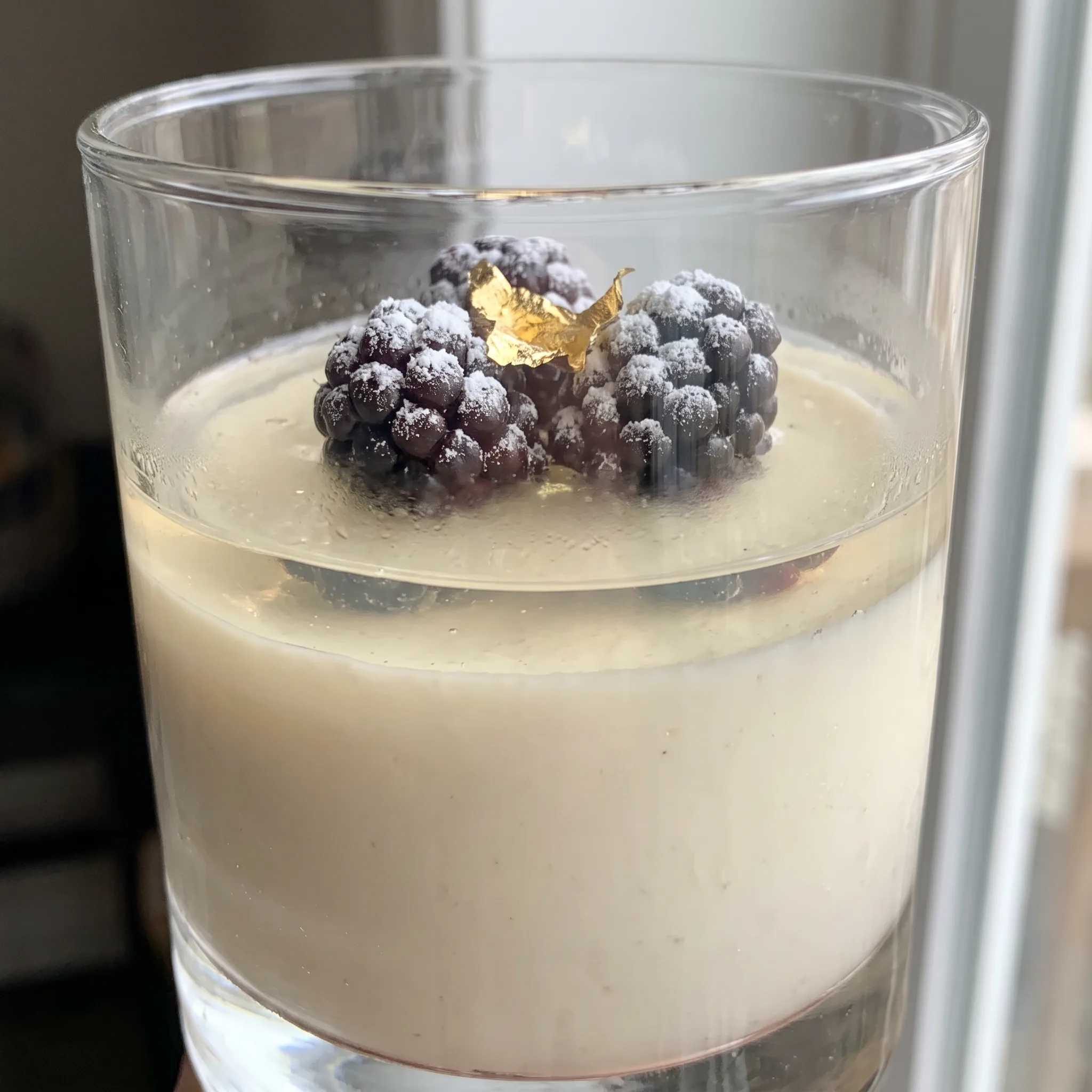
Sparkling Wine Panna Cotta with Champagne Jelly
Ingredients
Method
- In a small cup, ideally one with more surface area, measure 2 tbsp of the half-and-half. Scatter the gelatin uniformly on top and allow it to bloom.
- In a saucepan set over low heat, mix together the leftover half-and-half, sugar, and salt; avoid boiling. Should boiling start, take it off the heat right away. Keep a close eye on it, because it can boil over in no time.
- Keep stirring until the sugar has completely dissolved.
- Pour in the cream and stir until the mixture is uniform.
- Introduce the bloomed gelatin by whisking it in. Avoid boiling.
- Take the pan off the heat.
- Stir in the vanilla extract.
- Continue stirring gently until the mixture reaches room temperature.
- Distribute the mixture into shot glasses or tall flute glasses. Give the mixture a gentle stir before filling each new glass to keep it from separating.
- Refrigerate in an airtight container until set, roughly 2–4 hours, before adding the champagne jelly on top.
- In a cup, measure 2 tbsp of sparkling wine and scatter the gelatin on top to bloom.
- In a small pan, mix the sugar and Prosecco and warm over low heat.
- After the sugar has dissolved, whisk in the bloomed gelatin. Avoid boiling.
- When the mixture reaches room temperature, pour it over the set panna cotta. Stir gently before pouring into each glass.
- 2 IN ONE DESSERT OPTION: After the jelly has set, just before serving, carefully place some berries of your choice on top. Fill the remainder of the glass with champagne. Swirl the glass to release the juices from the berries. The flute glass will now show three distinct layers of color.
- SHOT GLASS OPTION: Just before serving, lightly coat clean and dried berries of your choice with icing sugar. Place them on the jelly and add gold leaf if desired. Avoid placing berries too far ahead, as their juices may leak out and discolor the jelly.
Notes
Storage and Serving: Timing the Layers and the Final Pour
The set panna cotta and jelly hold in an airtight container in the fridge for up to two days, but texture slides after the first. By day two the jelly may release a little liquid and the base firms up past custard. That’s why I’d eat these within 24 hours for the cleanest layers.
Freezing doesn’t work here: the dairy base separates and the jelly weeps on thaw, so keep them cold, never frozen.
Add berries and champagne only right before serving. The flute option needs its champagne poured at the moment you hand it over, and the sugared berries for shot glasses go on last. Any earlier and juice bleeds into the jelly, discoloring it.
Serve straight from the fridge, within 15 minutes of topping, while the layers are still distinct.
What You Can Swap in This Panna Cotta and What to Leave Alone
Half-and-half: If you can’t find half-and-half, mix equal parts whole milk and light cream. The recipe uses 1 1/4 cups, so use 5/8 cup (10 tablespoons) of each.
This matches the fat and water content closely, so the set and richness stay the same. The panna cotta will be a touch less rich than with commercial half-and-half, but the difference is minor.
The texture remains creamy and the base still sets firm enough for the jelly layer.
Heavy cream: Don’t swap heavy cream for milk or half-and-half. It’s 1 3/4 cups and provides the fat that gives the panna cotta its body.
Using a lower-fat liquid will leave you with a soft, spoonable dessert that won’t hold a clean line against the jelly. The panna cotta may not set firmly enough to support the champagne jelly, and the layers could bleed together.
If you must reduce fat, expect a looser set and serve in small glasses to minimize the visual impact.
Sparkling wine (Champagne or Prosecco): A dry sparkling wine works best. Avoid sweet or fruit-forward bottles, as their sugar and flavor will make the jelly taste syrupy. Non-alcoholic sparkling wine can be used, but the jelly may set slightly softer because the lack of alcohol changes the gel’s strength.
With a dry wine, the jelly stays crisp and lets the vanilla in the base come through. A sweet wine overwhelms the delicate dairy, and non-alcoholic versions may need a little extra chill time to firm up.
Unflavored gelatin: There’s no direct substitute for powdered gelatin in this recipe. Agar agar sets at a different temperature and gives a brittle texture, while leaf gelatin would require a different bloom and measurement. Stick with powdered unflavored gelatin, and check the date on the box.
Using old gelatin or a different gelling agent can leave you with a liquid base or jelly that never sets. If you’re unsure about your gelatin’s potency, bloom it in the liquid as directed; if it doesn’t swell and soften, start with a fresh box.
Tips
- Rub a pinch of the bloomed gelatin to the touch before it goes into the pan. It should feel like wet sand with no hard specks; any dry core means those grains will never dissolve and will show up as gritty streaks suspended in the panna cotta and jelly. If you find them, scatter the gelatin back over the liquid and wait another minute rather than adding it as is.
Sparkling wine’s acidity and alcohol disrupt gelatin’s protein network, so the jelly needs a higher gelatin concentration per volume than the dairy base to set firmly. Even with that adjustment, the jelly must be poured over a fully set panna cotta base; otherwise the warm liquid disturbs the creamy layer and the two merge instead of forming distinct strata.
Frequently Asked Questions
Can I make sparkling wine panna cotta ahead of time?
Yes, but the window is short. The set panna cotta and jelly hold in an airtight container in the fridge for up to two days, but texture slides after the first. By day two the jelly may release liquid and the base firms past custard.
For the cleanest layers, eat these within 24 hours, and never freeze them.
Why is my champagne jelly not setting?
The most common cause is that the wine was warm when you whisked in the gelatin, or the mixture boiled. Heat breaks down gelatin’s setting power, so you won’t see the damage until hours later.
Another check: use fresh powdered gelatin and let it bloom until no dry granules remain. If the jelly still won’t set, you may have used too little gelatin or a sweet wine.
How is this different from classic panna cotta?
Classic panna cotta is a single layer of set cream, often unmolded onto a plate. This version stays in the glass and adds a sparkling wine jelly on top, which gives you two distinct textures and a clean line between them.
The base is also lighter, using half-and-half alongside heavy cream, so it sets softer than a traditional all-cream panna cotta. That softer base is why the jelly needs to be fully set before you pour it.
