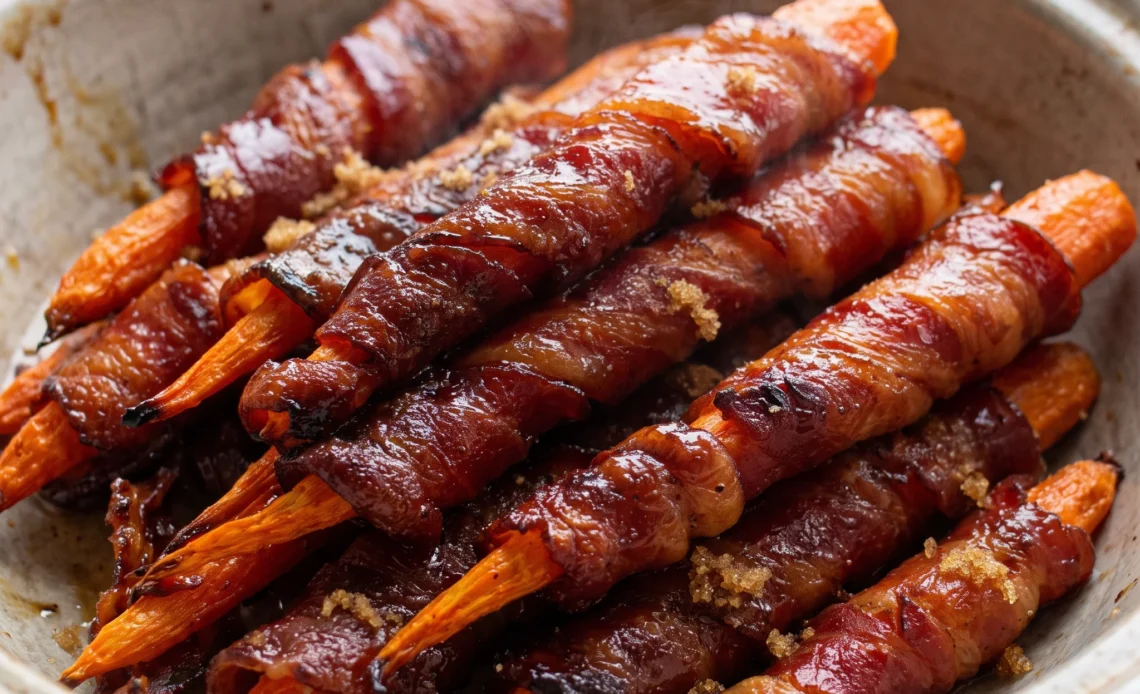
Maple bacon carrots earn their place on a holiday table because of what happens at the collision point: salty bacon shattering against a carrot that gives, then the maple coming in behind it. Three ingredients, and the whole thing can still go sideways on you. The window between bacon that’s rendered and bacon that’s caught is narrow, and sugar closes it fast.
What separates a tray of these that works from one that doesn’t is mostly about the surface the carrots roast on and the moment the syrup goes on. Get those right and the contrast holds. Get them wrong and you’re looking at flabby strips sitting in fat, with a glaze that tastes like scorched coffee.
Bacon releases a significant amount of fat as it roasts, and carrots release moisture. If the carrots rest directly on a baking sheet, they sit in this liquid, so the bacon steams rather than fries and the carrots cook unevenly. A wire rack improves the carrots, letting the fat drip away and hot air circulate around each piece, which produces crisp bacon and tender carrots.
Use a Wire Rack for Crisp Bacon
As the bacon-wrapped carrots roast, they throw off a surprising amount of liquid. Bacon fat renders, and carrots release their own moisture, which would otherwise pool around them on a flat pan. A wire rack lifts each piece above that liquid, so the fat drips away instead of collecting.
Hot air can then move around the carrots on all sides, cooking the bacon evenly and letting the carrots firm up rather than turning soft and waterlogged. Without that elevation, the carrots sit in the rendered fat and steam, and the bacon never crisps.
You end up with pale, soggy strips and carrots that cook unevenly. With the rack, the bacon shrinks and tightens around the carrot, turning deeply browned and crisp, while the carrots underneath become tender and sweet. The result is a clean, dry surface on both the bacon and the carrot, ready for the glaze.
Coil Bacon Snugly Without Overlap
A snug coil of bacon around each carrot keeps everything in place as it roasts. Bacon shrinks significantly in the heat, so if it is not wrapped tightly, it will loosen and slide off. Overlapping strips create thick sections that cook more slowly than the thin edges, leading to burnt spots and undercooked patches.
Starting at the thicker end of the carrot gives the coil a natural anchor, since that end is wider and holds the first turn securely. As you wrap toward the tip, keep the bacon flat against the carrot without letting any part cross over itself.
The goal is a single, even layer that covers the carrot from end to end. When it roasts, the bacon contracts uniformly, staying wrapped and cooking at the same rate. Each bite then has a balance of crisp bacon and tender carrot, with no dense, chewy pockets or dry, overcooked bits.
Wait to Brush the Maple Syrup
Maple syrup is mostly sugar, and sugar burns fast at high heat. If you brush it on before the carrots go into the oven, those sugars will carbonize long before the bacon is crisp.
The result is a bitter, burnt crust and a sticky mess on the rack and pan. Instead, the syrup goes on only after the initial roast. By then, the bacon has rendered most of its fat and the carrots have softened.
The surface is hot, so the syrup thins and spreads easily, clinging to the bacon and carrot. As the carrots continue to roast, the syrup gently caramelizes, turning glossy and deep amber without scorching.
The final minutes are just enough to set the glaze and intensify its flavor. You get a sticky, sweet coating that complements the salty bacon, with no burnt edge. The syrup stays where it should, on the carrots, not burned onto the pan.
Two Roasts, Two Textures
The first roast does the heavy lifting: it renders the bacon fat, crisps the bacon, and cooks the carrots through. The high, dry heat pulls moisture from the surface, so the bacon turns brittle and the carrots become tender with a slight resistance at the center. Only after that do you brush on the maple syrup and return the pan to the oven.
This second roast sets the glaze, thickening the syrup into a sticky shell that clings to the bacon. Because the bacon is already crisp, the syrup cannot interfere with that texture; it just adds a sweet, glossy finish.
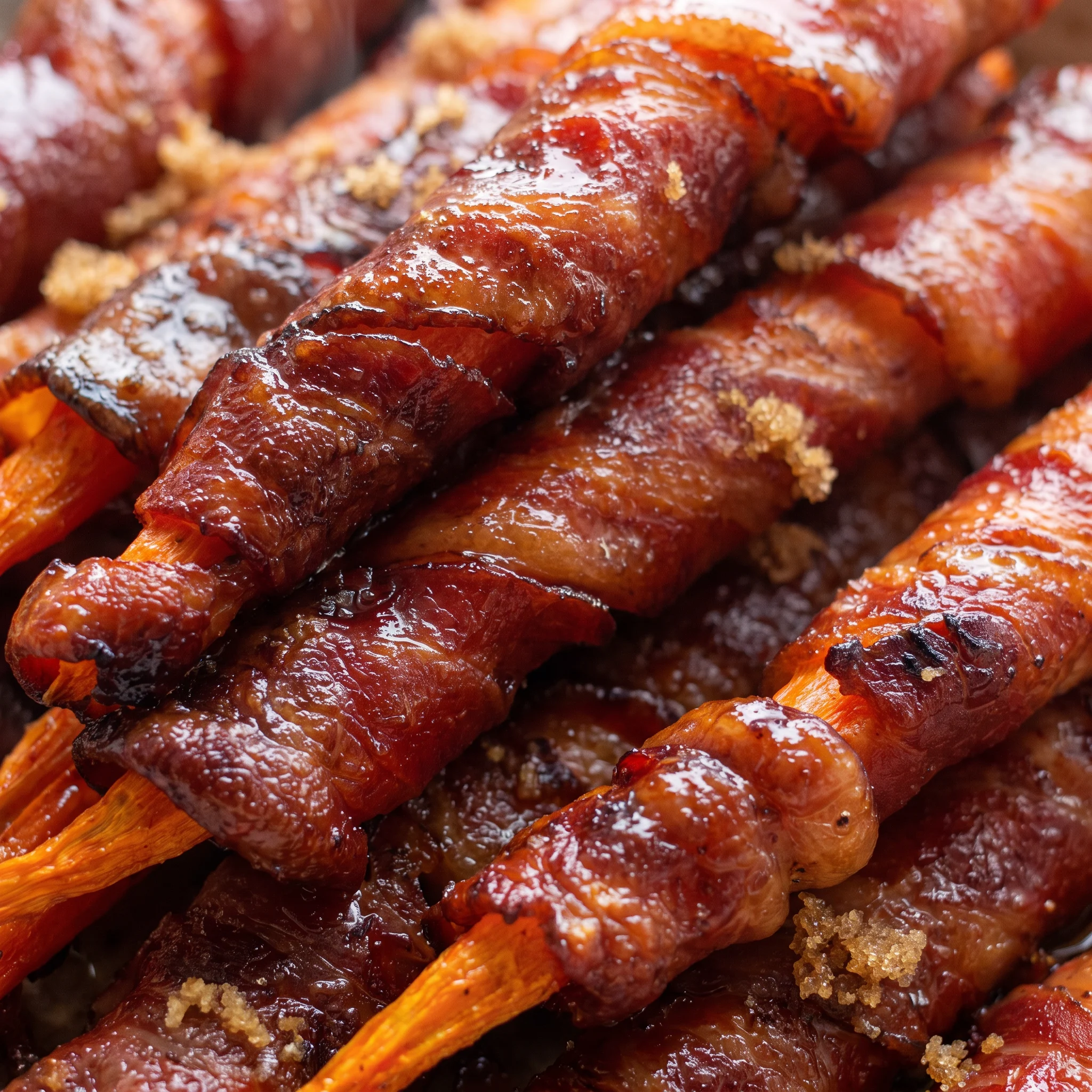
The two phases keep the components distinct: the bacon stays crunchy, the carrots stay soft, and the maple flavor stays bright instead of turning bitter. When you pull them out, the glaze should look shiny and set, not runny. The bacon should shatter when you bite it, and the carrots should give way with a gentle chew.
Pick Carrots That Hold Their Shape and Bacon That Wraps Clean
Carrots: Choose carrots with a diameter under ½ inch so they cook through in the same time as the bacon.
Bacon: Thin-sliced bacon is essential because thick-cut slices stay chewy while the carrots overcook.
Maple syrup: Use pure maple syrup, not pancake syrup, which has additives that burn faster under high heat.
Knowing When Each Stage Is Done, Not Just When the Timer Goes
Judging the first roast: bacon crispness against carrot resistance
At 25 minutes, bacon should look shrunken and deeply browned, but the real test is the carrot. Pierce the thickest part with a paring knife: it should slide in with slight resistance, not drop through. If the bacon is browning but the carrot is still hard, the carrot is too thick; return the pan for 5 minutes, then check again.
If the bacon is already dark but the carrot is firm, the bacon is at risk of burning, so pull the pan and proceed to glazing; the second roast will finish the carrot. The reverse, a tender carrot with flabby bacon, means the bacon was too thick or the oven ran low; a few extra minutes will crisp it, but watch closely.
Coiling tension: tight enough to hold, loose enough to cook
A snug coil stays put as the bacon shrinks; a loose one slides off and leaves bare carrot. Wrap so the bacon touches the carrot along its length, but do not stretch it taut. If you can slide a finger under the bacon, it is too loose.
If the carrot bends under the pressure, it is too tight. Overlap creates thick spots that stay chewy while thin edges burn, so keep each turn flush against the previous one without crossing. Fix a loose wrap by rewinding it; fix an overlap by unwinding that section and re-laying it flat.
When to brush the syrup: the surface must be hot and the bacon set
The syrup goes on only after the first roast, when the bacon is crisp and the carrots are tender. If you brush too early, the sugar burns before the bacon renders.
Test by touching the bacon: it should feel firm and dry, not slick with fat. The carrots should be soft at the tip but still offer a bit of resistance at the core. If they are not there yet, roast another 5 minutes before glazing.
Brushing onto a cooler surface leaves the syrup thick and uneven; it will not spread or cling properly, and the final glaze will be patchy.
Reading the final glaze: set, shiny, not runny or scorched
After 8 to 10 minutes at 400°F, the syrup should look glossy and thickened, coating the bacon without dripping. If it still runs off the carrots, give it 2 more minutes.
If it darkens to the color of coffee, you have gone too far; the sugar is bitter. The bacon should shatter when bitten, and the carrots should yield with a gentle chew. A pale, liquid glaze means the syrup has not caramelized; a blackened one means it burned.
Both are salvageable only by adjusting the next batch, not this one.
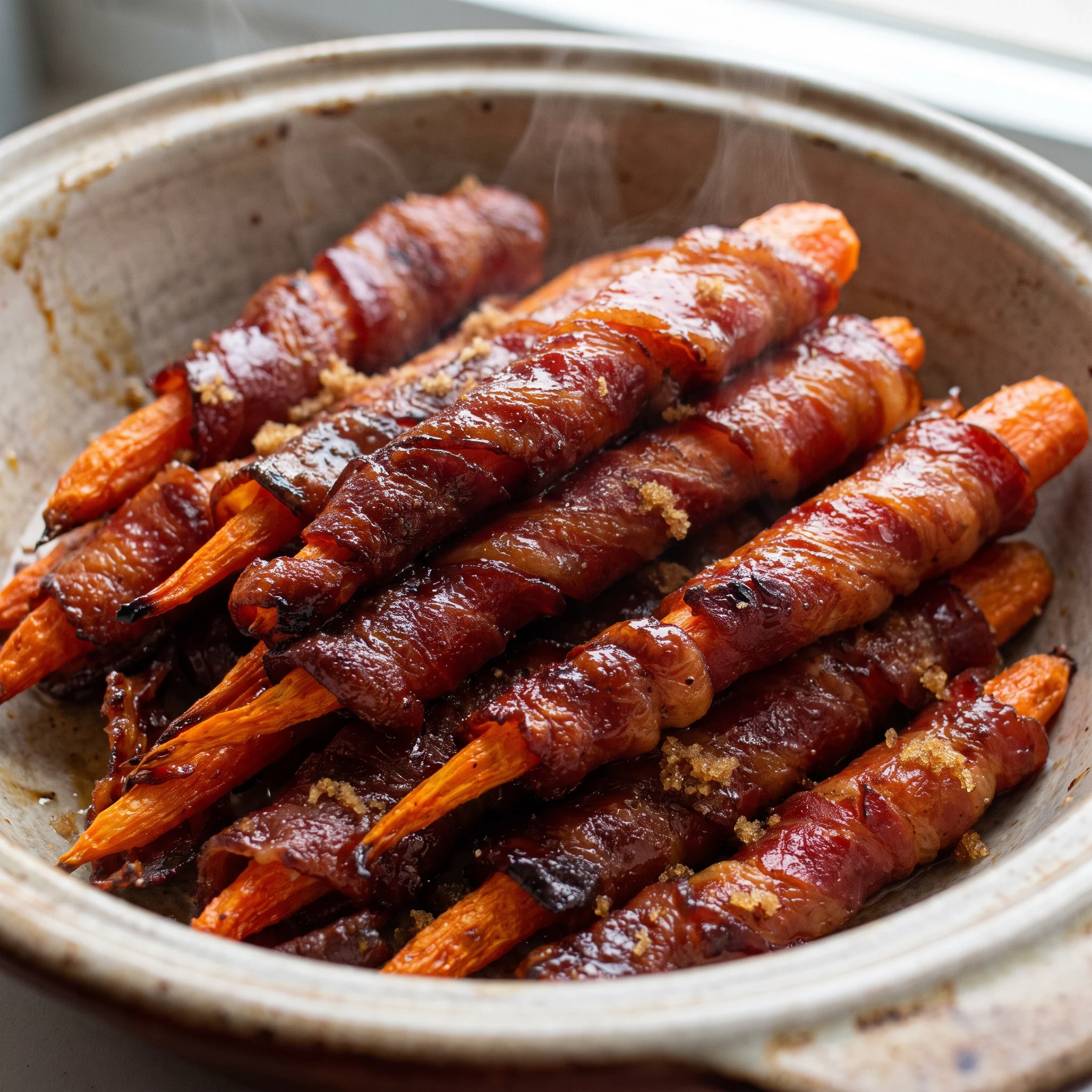
Maple Bacon-Wrapped Roasted Carrots
Ingredients
Method
- Set oven temperature to 400°F (205°C).
- Take one bacon slice and coil it snugly around a carrot, beginning at the thicker end; do not let the bacon strips overlap.
- Place the bacon-wrapped carrots onto a wire rack positioned above a baking sheet.
- Roast for 25 minutes, or until the bacon reaches a crisp texture and the carrots become tender.
- Take out of the oven and brush maple syrup over every side with care.
- Continue baking for another 8–10 minutes.
- Plate and serve.
Storage and Serving Maple Bacon Carrots
These are at their best within 30 minutes of the second roast. The bacon shatters, the glaze is still tacky rather than sticky, and the carrots hold a slight chew. Past an hour on the counter, the bacon softens as it pulls moisture from the carrots.
Refrigerate leftovers in a shallow container with the lid ajar until they stop steaming, then seal. The bacon goes flabby and the maple glaze sets into a tacky film within a day, and by day three the carrots taste waterlogged next to the bacon.
Reheat on a wire rack over a sheet pan at 375°F for 8 to 10 minutes; a skillet works for small batches, but a microwave leaves the bacon rubbery and the glaze runny. Do not freeze: the carrots weep on thaw and the bacon never recovers its snap.
For a party, roast in batches and hold the glazed carrots in a 200°F oven no more than 20 minutes before serving.
Swapping Carrots, Bacon, or Maple: What Actually Works
Carrots: Use thicker carrot batons (about 1 inch thick) or whole baby carrots, but expect them to need more time in the oven. The bacon will crisp before the carrots are tender, so you’ll have to pull the pan early or risk burnt bacon.
Thicker carrots also won’t coil as neatly with a single bacon slice; you may need to cut them into sticks that are still under ½ inch for even cooking. If you go thicker, par-roast the carrots for 10 minutes before wrapping.
Bacon: Turkey bacon for a leaner option, but it won’t crisp the same way. Turkey bacon releases less fat, so the carrots won’t get that rich, salty coating. It also cooks faster and can dry out, so check at 20 minutes.
The texture will be chewier, not shatter-crisp. If you use turkey bacon, brush with a little oil to help it brown.
Maple syrup: Honey, but it’s sweeter and browns faster. Honey has a higher sugar concentration, so it can scorch in the final roast. Reduce the second bake to 5 to 7 minutes and watch closely.
The glaze will be stickier and less mapley; add a pinch of salt to balance.
Bacon: Thin-cut bacon is essential, but if you only have thick-cut, don’t use it. Thick-cut bacon won’t wrap tightly and will stay chewy while the carrots overcook.
It also releases more fat, which can make the carrots greasy. Stick with thin-sliced for the best results.
Tips
- Pat the peeled carrots completely dry with a kitchen towel before you coil the bacon, because any water left on the surface turns to steam in the 400°F oven and that steam keeps the bacon from crisping against the carrot. Carrots hold a lot of water after peeling and rinsing, and the moisture has nowhere to go once the bacon is wrapped around it, so it cooks the bacon from the inside while the outside browns. A dry carrot lets the bacon render and shrink directly against it, which is what produces the shatter-crisp texture.
Frequently Asked Questions
Can I make these maple bacon carrots ahead of time?
Not for texture you’d want to serve guests. The bacon shatters and the glaze stays tacky only within about 30 minutes of the second roast; past an hour on the counter the bacon starts pulling moisture from the carrots and softens. If you’re feeding a crowd, roast in batches and hold the glazed carrots in a 200°F oven no more than 20 minutes before serving.
That window is the real constraint, not the prep. Reheating later works, but it’s a different dish: crisp bacon becomes chewy, and the maple sets into a tacky film.
Why did my bacon-wrapped carrots turn out soggy?
The most likely cause is that the carrots sat in their own rendered fat and steam instead of dripping free, which happens when they’re not improved above the pan. The other check is the bacon itself: thick-cut slices stay chewy while the carrots overcook, so you end up with flabby strips and soft carrots at the same time.
Carrot thickness matters too. Anything at or over ½ inch won’t cook through in the same window as the bacon, so the bacon darkens and the carrot stays firm, and if you keep going to fix the carrot, the bacon gives up its crispness. Snug coiling without overlap also keeps the bacon in contact with the hot carrot surface, which helps it crisp evenly.
How do I keep the bacon from unraveling during roasting?
Wrap so the bacon touches the carrot along its length without stretching it taut. If you can slide a finger under the strip, it’s too loose, and bacon shrinks hard in the oven, so a loose coil slides off and leaves bare carrot.
If the carrot bends under the pressure, you’ve gone too tight, and the coil will pinch and split as it cooks. Start your first turn at the thicker end, where the carrot is widest and gives the coil a natural anchor.
Keep each turn flush against the previous one without crossing over, since overlap creates thick spots that stay chewy while the thin edges burn.
What’s the difference between this recipe and classic glazed carrots?
Classic glazed carrots are carrots cooked in a buttery syrup until the liquid reduces to a coating, with nothing wrapped around them. Here the bacon does the work of seasoning and texture, and the maple goes on only after the first roast, so the sugar caramelizes onto an already-crisp surface instead of simmering into a pan sauce.
That order matters: the bacon renders its fat and crisps first, then the glaze sets in a second, shorter roast, which keeps the maple bright and the bacon crunchy. You end up with two distinct textures in one bite, shattering bacon against a tender carrot, rather than one uniform glazed piece.
