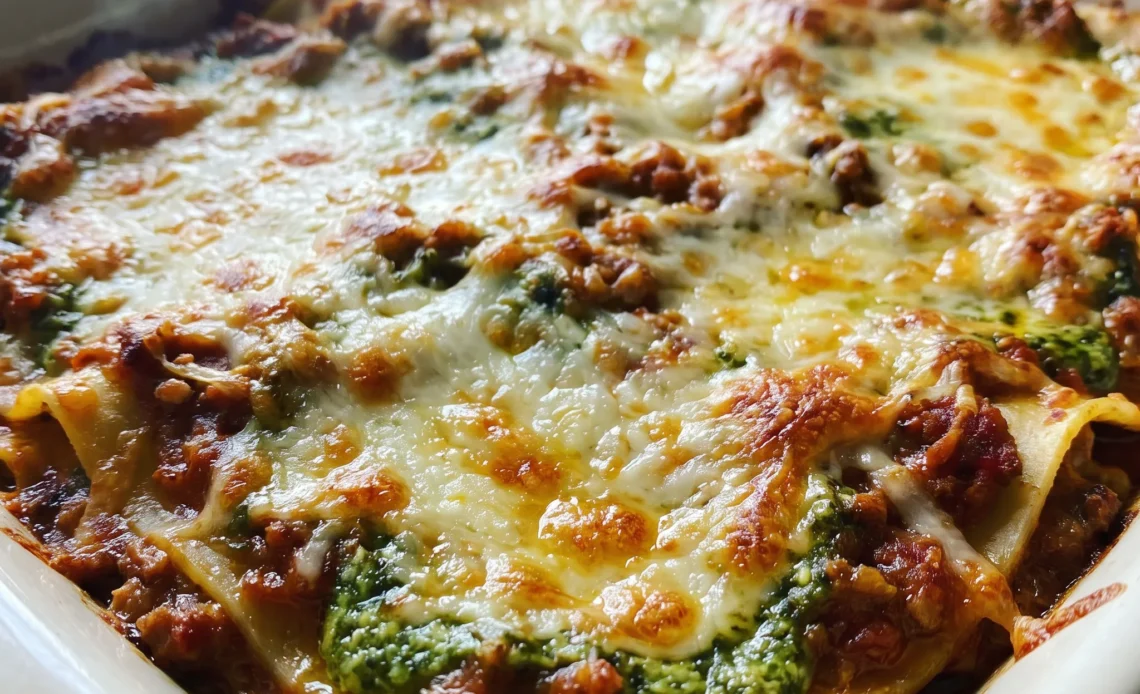
Christmas Eve lasagna bolognese asks for a full day of simmering and building, then a long, cold night in the refrigerator, and the cold is what actually makes it work. No-boil noodles soften by drawing moisture out of the bolognese and the pesto ricotta, and that doesn’t happen on a countertop. Go in too soon and the center sheets stay stiff while the edges already slump.
The hours also firm the ricotta and set the fat in the meat sauce, so the layers hold when you cut. It’s the rare make-ahead project where waiting genuinely improves the result, not just your schedule. Build the pan the day before and Christmas Eve belongs to you.
A Long Chill Sets the Structure
No-boil lasagna noodles need more than a quick dunk in sauce. They soften by pulling moisture from the bolognese and ricotta, and that takes time. Twelve hours in the refrigerator gives them enough contact to turn fully tender.
Pull the pan out early and you’ll find chalky, stiff sheets in the middle. Cold also firms the ricotta and solidifies the fats in the meat sauce, so the layers hold their shape when you slice.
Skip the rest and the whole thing collapses into a soupy pile on the plate. Those hours in the cold also let the garlic, basil, and long-simmered meat settle into each other.
I once rushed a similar pan and ended up with a puddle instead of a slice. The reward is a clean cut and a lasagna that tastes like it was made days ahead.
Building Depth in the Sauce
A quick meat sauce tastes thin next to this bolognese. The difference comes from cooking in stages.
First, the soffritto of carrot, celery, and onion gets deeply browned, which brings out a sweet, caramelized flavor that raw vegetables never give. Next, the pestata of pancetta and garlic renders down, adding a savory, aromatic base. Then everything simmers for a long time with wine, tomatoes, and herbs.
That slow cooking concentrates the flavors and tenderizes the meat until it’s soft and rich. A finish of cream and parmesan rounds off the acidity and adds a silky texture.
The result is a sauce that tastes layered and complete, not flat. Each stage builds on the last, and that depth is what makes the lasagna special.
Pesto Ricotta Changes Everything
Traditional lasagna often uses plain ricotta, but here a jar of basil pesto gets stirred in. That pesto brings a fresh, garlicky basil note that cuts through the heavy bolognese and mozzarella.
Without it, the lasagna can taste one-dimensionally savory. The ricotta mixture needs to be well combined but not overmixed. Stir too hard and it turns runny, which throws off the texture.
The eggs in the mix act as a binder, helping the layers set during baking. This ricotta layer adds creaminess and keeps every bite from feeling flat. You want the pesto evenly distributed, but you still see streaks of green.
When you taste the finished lasagna, that bright herb flavor should come through just enough to balance the richness.
Order Matters for Every Slice
How you stack the components decides whether each piece is balanced or uneven. Start with a thin layer of bolognese on the bottom.
That slick coating keeps the noodles from sticking and burning as the lasagna bakes. Then alternate bolognese and ricotta so every bite gets both meat and creamy cheese. Spread the cheeses evenly over each layer, or you’ll end up with dry patches and clumps.
The final layer of cheese on top browns into a golden, crispy crust. Get the order right and you won’t find a slice that’s all pasta or all sauce. The layers should look neat and level before baking.
That structure pays off when you cut into it: each square holds together with the same mix of flavors from edge to center.

The Ingredients That Carry This Lasagna
Pancetta: Ask for it in one piece and chop it yourself; pre-diced cubes are often too lean and won’t render properly.
Red wine: A medium-bodied Chianti or similar dry red works best; avoid anything sweet or heavily oaked, which will taste jarring.
Crushed tomatoes: Buy a 28-ounce can of good-quality crushed tomatoes; cheap brands can taste metallic and thin.
No-boil lasagna noodles: Use the exact 13.2-ounce box called for; other sizes or brands may need different liquid ratios.
Whole-milk ricotta: Whole-milk ricotta gives the creamiest texture; part-skim works but will be slightly drier.
Reading the Pan at Four Points Where It Can Go Wrong
When the soffritto is browned enough
The vegetables start pale and wet, then go quiet, then start to catch. You want them deeply browned but not burnt, 15 to 20 minutes. Taste a bit: it should be sweet and concentrated, not raw or acrid.
If the edges darken too fast, drop the heat. Push them to the sides when they’re done so the meat can hit the hot center.
How the bolognese thickens over 90 minutes
It should plop off a spoon, not run. The fat will have separated slightly and the meat will look glossy. If it’s watery, keep simmering; if it’s stiff and dry, add a splash of broth or water.
Stir the bottom often so nothing sticks. The cream and parmesan at the end loosen it just enough, so stop a touch thicker than you want.
The pesto ricotta texture
You want a soft, scoopable mixture with visible green streaks, not a uniform paste. Overmix and it turns runny, which makes the layers slide. The eggs need to be fully incorporated but stop as soon as you see no bare white.
If it’s too loose, chill it; the cold will firm it up before assembly.
When the cheese is browned and the pasta is tender
In the last 10 minutes without foil, watch the top: it should bubble and turn golden, not dark brown. If it’s browning too fast, tent it loosely with foil. The noodles are done when a knife slides through the center with no resistance.
If they’re still firm, give it 5 more minutes, but check every few so the top doesn’t burn.

Lasagna Bolognese with Basil Pesto Ricotta
Ingredients
Method
- Soffritto: Put the roughly chopped carrot, celery and onion into a food processor bowl. Pulse only until the mixture becomes finely broken down. Do not purée; you should still see small bits of carrot, celery and onion. Move to a medium bowl and set aside.
- Pestata: Put the pancetta and garlic into the bowl of the same food processor used for the soffritto (no need to wash it!). Pulse only until the mixture becomes finely broken down. Set aside.
- Cook the pestata: Pour the olive oil into a heavy-bottomed pot (at least 4-quart capacity) over medium heat. Once hot, carefully add the pestata mixture from Step 1 and cook, stirring occasionally, until the pancetta renders and the garlic is fragrant, 4-5 minutes.
- Brown the soffritto: Add the soffritto mixture from Step 1 to the pot with the pestata. Season with 1 teaspoon kosher salt, and stir to combine. Cook, stirring occasionally, until deeply browned and fragrant, 15-20 minutes. If the veggies begin to brown too quickly, reduce the heat to medium-low or low. Once browned, push the pestata and soffritto mixture to the outer edges of the pot.
- Brown the meat: Generously season the beef and pork with 1 teaspoon kosher salt each. Add the meat to the center of the pot with the soffritto and pestata mixture. Do not touch the meat for 2-3 minutes, allowing it to brown deeply. Turn the meat over and brown the second side for 2-3 minutes. Once browned on both sides, use a wooden spoon to break the meat apart into fine crumbles. Stir to combine with the soffritto mixture. Cook, stirring occasionally, until browned completely, 8-10 minutes. Add the tomato paste, stirring to coat the meat and soffritto mixture. Cook for 2-3 minutes to brown.
- Deglaze: Increasing the heat to medium-high, pour the red wine into the pot. Stir constantly, using a wooden spoon to scrape up any browned bits that may have formed at the bottom of the pot. Cook for 4-5 minutes, until the wine is almost completely absorbed into the meat mixture.
- Aromatics: Tie the herbs together using kitchen twine (or finely chop if you do not have twine), then add to the pot with the bay leaves and parmesan rind, if using. Add the crushed tomatoes and broth or water, stirring to combine.
- Simmer: Reduce the heat to medium-low and simmer, stirring occasionally, for 90 minutes. If the bolognese begins to reduce too much (losing too much of its liquid too quickly), feel free to add in a splash more broth/water, reduce the heat further, and/or cover the pot.
- Finish the bolognese: Stir in the heavy cream and grated parmesan. Taste and season with additional kosher salt and ground black pepper, as desired. Remove from the heat and set aside, or store in an airtight container in the refrigerator for up to 5 days.
- Mix the basil pesto ricotta: Meanwhile, as the bolognese sauce simmers, prepare the basil pesto ricotta. Add all listed ingredients to a medium mixing bowl, seasoning with ½ teaspoon each kosher salt and ground black pepper, or to taste. Stir until combined. Set aside, or store in an airtight container in the refrigerator for up to 3 days.
- Assemble the lasagna: Spray a large piece of foil with nonstick cooking spray and set aside. Spray a 9×13 baking pan with nonstick cooking spray (see Recipe Notes, below). Ladle about 1 cup of the bolognese sauce into the baking dish, spreading it out to evenly coat the bottom. This prevents the pasta from sticking to the bottom of the dish as the lasagna bakes. Build your lasagna layer by layer:
- Layer 2: Arrange a second layer of lasagna. Top with ½ of the prepared basil pesto ricotta, spreading into an even layer. Sprinkle some the mozzarella and Italian cheeses over top, using about ¼ of the cheese.
- Layer 3 and 4: Repeat Layers 1 and 2, creating 4 alternating layers of bolognese and ricotta. Finish with one last generous sprinkling of cheese, using any remaining mozzarella and Italian cheese.
- Rest: Top with the prepared foil. Transfer to the refrigerator to rest for at least 12 hours before baking.
- Bake the lasagna: Preheat the oven to 375 degrees F, ensuring an oven rack is positioned in the center of the oven. Remove the lasagna from the refrigerator, and set the baking dish on a large rimmed baking sheet. Transfer to the oven and bake the lasagna for 60 minutes, carefully removing the foil from the baking dish in the last 10 minutes of baking to brown the top. If desired, turn the broiler on in the last 5 minutes to give the cheesy top an especially golden brown and crispy finish.
- Rest, slice, and serve: Carefully remove the lasagna from the oven. Set aside to rest for 10-15 minutes before slicing into 12-15 squares and serving. Enjoy!
What You Can Swap Without Ruining the Bake
Pancetta: Bacon, or omit for a pork-free version. Bacon brings a smokier, saltier note that will edge the bolognese away from the classic delicate pork flavor.
If you omit it, you lose the pestata’s savory depth; add an extra tablespoon of olive oil and a pinch more salt when cooking the garlic to compensate. Either way, the sauce will still simmer down to a rich, meaty base, but the aroma and finish will shift.
Whole-milk ricotta: Part-skim ricotta. The mixture will be a touch drier and less creamy, so the layers may not set as smoothly.
You can stir in a tablespoon or two of heavy cream or whole milk to loosen it back to a scoopable texture. The pesto and eggs still bind everything, but the final lasagna will taste slightly leaner.
No-boil lasagna noodles: Gluten-free no-boil lasagna sheets. Gluten-free sheets often need more liquid and a longer rest to soften fully.
Keep the 12-hour chill, but consider adding an extra half cup of broth to the bolognese before assembly. The texture will be more delicate and may not hold a clean slice as well, so let it rest a full 15 minutes after baking before cutting.
Mozzarella and Italian cheese blend: Dairy-free shredded cheese alternatives. These melt differently and may not brown the same way.
The top won’t get that golden crust as easily, and the overall richness will be lighter. If you go this route, broil for the last few minutes to encourage color, but watch closely so it doesn’t burn.
Storage, Reheating, and the Serving Window
Serve the lasagna 10 to 15 minutes out of the oven, while the cheese top still has its crisp edge and the ricotta is soft but set. That’s the window for the best texture; past 30 minutes the top softens and the layers start to slump. Leftovers keep in the refrigerator for 3 to 4 days, covered tightly or in an airtight container.
The baked pasta holds well because the noodles have already absorbed their liquid, but the top crust will fade and the ricotta releases a little moisture each day. Reheat in a 350 degrees F oven for 15 to 20 minutes to bring back the crisp top; the microwave for 1 to 2 minutes makes it soft throughout. If the assembled unbaked lasagna is already chilled, it can go straight to the oven.
The bolognese alone freezes well for up to 3 months; the assembled lasagna does not, since the ricotta and noodles break down. Don’t leave it out more than 2 hours.
Tips
- Taste the bolognese for salt after the cream and parmesan go in, not before. The pancetta has already seasoned the pot, and the ½ cup of parmesan plus 36 ounces of cheese going on top will pull the finished lasagna saltier than the sauce tastes on its own. Once the pan is baked you can’t take salt back out, so err slightly under and let the cheese close the gap.
- Chop the pancetta into pieces about the same size as the garlic cloves before pulsing, roughly ¼ inch. The food processor runs fast, and garlic breaks down to a paste well before a larger cube of pancetta does. Matching the sizes gets both to a coarse, even pestata in a few pulses instead of a garlic purée with chunks of pork still whole.
No-boil lasagna noodles are designed to rehydrate by absorbing moisture from the surrounding sauce and ricotta during an extended rest. Without at least 12 hours in the refrigerator, the noodles remain stiff and chalky, and the layers never firm up because the fats in the ricotta and cheeses stay soft at room temperature. When baked immediately, the noodles release water and the structure fails, resulting in a watery, unstructured casserole.
Frequently Asked Questions
Can I make this lasagna ahead of time and freeze it before baking?
Don’t freeze it. The assembled pan needs 12 hours in the refrigerator before baking, and that’s make-ahead enough; the noodles and ricotta break down in the freezer, so you’d pull out a wet, grainy pan instead of a clean-slicing one. The bolognese on its own freezes well for up to 3 months, so cook a double batch, freeze the sauce, and assemble fresh when you want lasagna.
If you’re planning a party, build the pan the night before and bake it straight from the fridge.
Why did my lasagna turn out watery even after resting it overnight?
Check the bolognese first. It should plop off a spoon, not run, before it ever goes into the pan; if it was loose going in, the noodles can’t pull enough liquid out of it and the whole thing weeps. A too-runny pesto ricotta does the same thing, so look for a soft, scoopable mix with green streaks rather than a uniform paste.
And if your tomatoes were a cheap can, they carry more water and less body than a good brand, which shows up as a puddle at the bottom of the dish.
How is Christmas Eve Lasagna Bolognese different from a classic lasagna?
The sauce is the whole story here: this one is a true bolognese built in stages, with a browned soffritto, a rendered pestata of pancetta and garlic, wine cooked down to almost nothing, and a long simmer finished with cream and parmesan. A classic lasagna often leans on a quicker tomato-meat sauce, which tastes flatter next to this.
The ricotta gets a jar of basil pesto stirred in for a bright, garlicky edge, and the cheese top finishes golden and crisp. You’re also working with no-boil noodles, which need that long cold rest to soften fully.
