Anyone can stir together a creamy fruit salad, and plenty of people do, right up until the custard breaks in the bowl. What separates frog eye salad from a thrown-together ambrosia is the cooked pineapple custard underneath, and it punishes a hurried hand: eggs that scramble on the pan bottom, a base pulled early that never sets, fruit that goes in wet and weeps into a puddle by the time the bowl hits the table.
None of it shows until the long chill, which is why the dish rewards assembling it the night before, when there’s room to cool everything properly instead of racing a potluck clock. Get the custard right and the rest is folding. Get it wrong and no amount of marshmallow hides it.
The Custard Thickens Everything
Cornstarch and eggs each do a job here, and neither covers for the other. Cornstarch gives the body: as it heats, it swells and turns the liquid into a spoonable gel, the part that keeps a scoop from sliding apart on the plate.
The eggs bring richness and a soft set, so the custard tastes like something rather than sweetened juice. The reserved pineapple juice is the liquid base, which is why draining the cans matters.
Skip that step and the custard has nothing to thicken but water, and the pineapple flavor goes down the drain with it. Beat the eggs before they hit the pan so no streaks of white set against the side. Once the mixture coats the back of a spoon and a finger drawn through leaves a clean line, it’s done.
Cool it completely before the whipped topping goes anywhere near it; warmth collapses the topping and leaves the salad thin. You want a base that mounds softly in the bowl, not one that pours.
Why Acini de Pepe Works Here
Acini de pepe earns its place by size and neutrality. The pasta is tiny and round, which is the whole visual joke behind the name, and in a chilled creamy mix it stays distinct instead of turning to paste. Cook it just to tender, then rinse under cold water.
That rinse does two things: it stops the cooking dead, and it washes off the surface starch that would otherwise glue the salad into one solid mass. The pasta’s own flavor is essentially nothing, which is exactly what you want; it soaks up the custard and the fruit juices and carries them without competing. What you’re after is pasta that’s plump and separate, each piece coated but not drowned.
If it clumps in your hand or tastes floury, it wasn’t rinsed or cooled enough. This is the step that decides whether the salad scoops cleanly or drags.
Fruit, Marshmallows, and Coconut Balance the Bowl
The fruit and marshmallow mix is where the salad gets its contrast. Pineapple tidbits and mandarin oranges are both drained, and that step matters: their packing liquid would thin the custard and leave a puddle at the bottom of the bowl. What’s left is soft, bright fruit with enough acidity to cut through the richness of the custard and whipped topping.
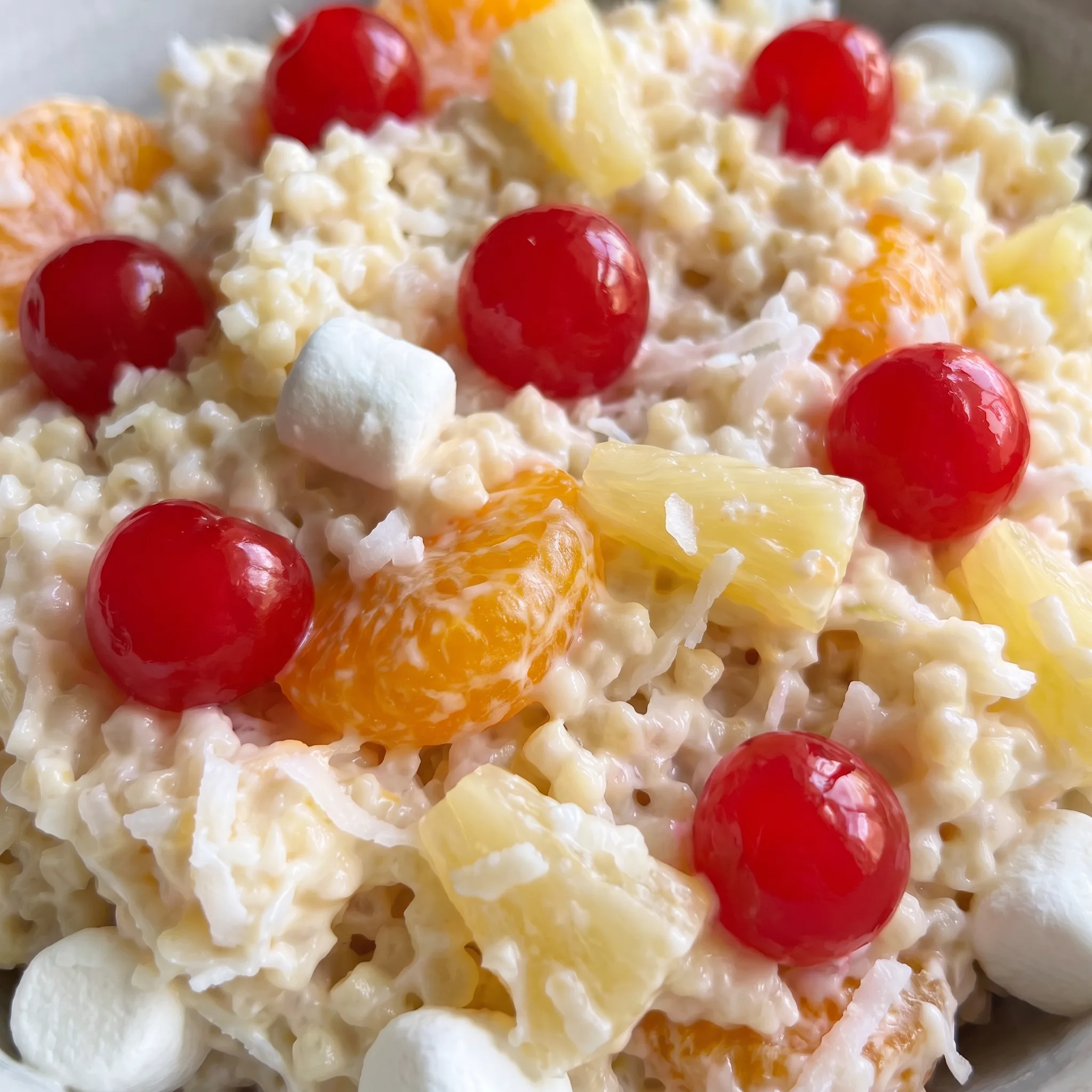
Around that, mini marshmallows add a springy chew and shredded coconut gives a little texture against the cream, so every bite has something to find. Fold everything in gently after the custard and topping are already combined, because rough stirring crushes the orange segments and knocks the air out of the topping. You’re looking for an even distribution, not a uniform paste.
The finished mixture should still show distinct pieces of fruit and white flecks of coconut throughout. If it looks like a smooth pudding with no texture, you’ve stirred too hard.
The Long Chill Sets the Structure
Chilling isn’t only about serving the salad cold. It’s a structural step. The custard needs to cool before you fold in the whipped topping; if you skip that, the residual heat melts the topping and you lose the light, stable base the salad depends on.
Once everything is combined, the long rest in the refrigerator lets the pasta drink up the custard and the juices from the fruit. That’s what turns a loose, wet mixture into something thick and scoopable.
The flavors also settle together during this time, so the pineapple and orange read more clearly against the creamy base instead of sitting on top of it. After a proper chill, a spoon should stand up in the bowl for a moment before falling. If it’s still runny, it needs more time.
Give it the full rest and the texture will be right.
The Garnish Makes It Recognizable
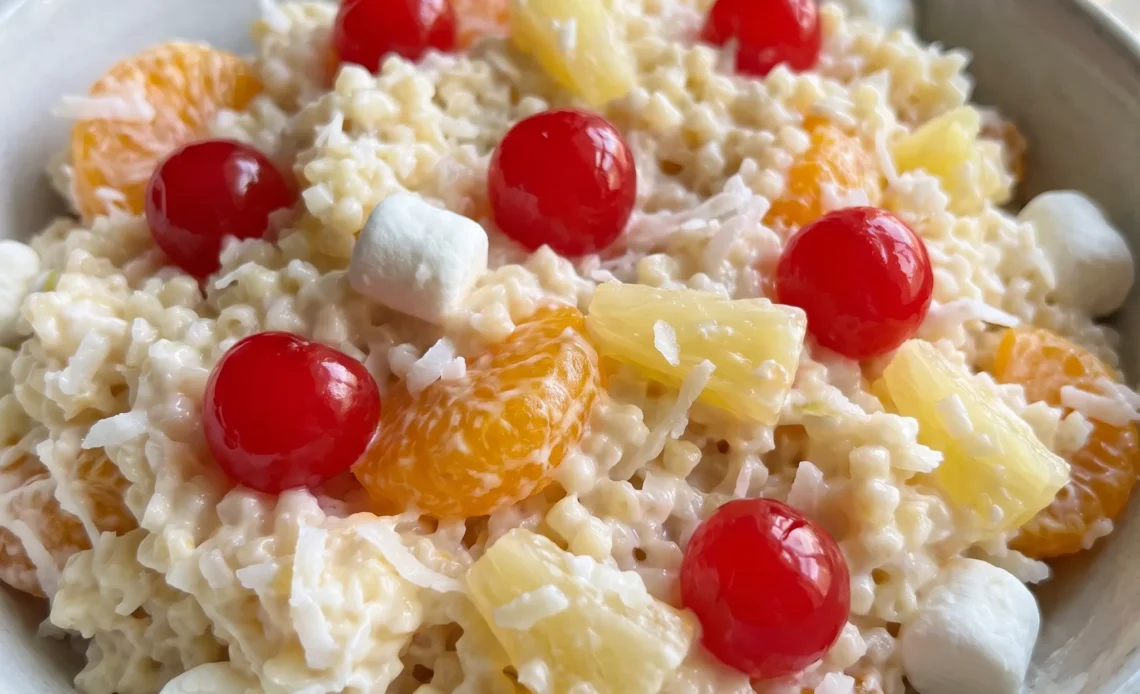
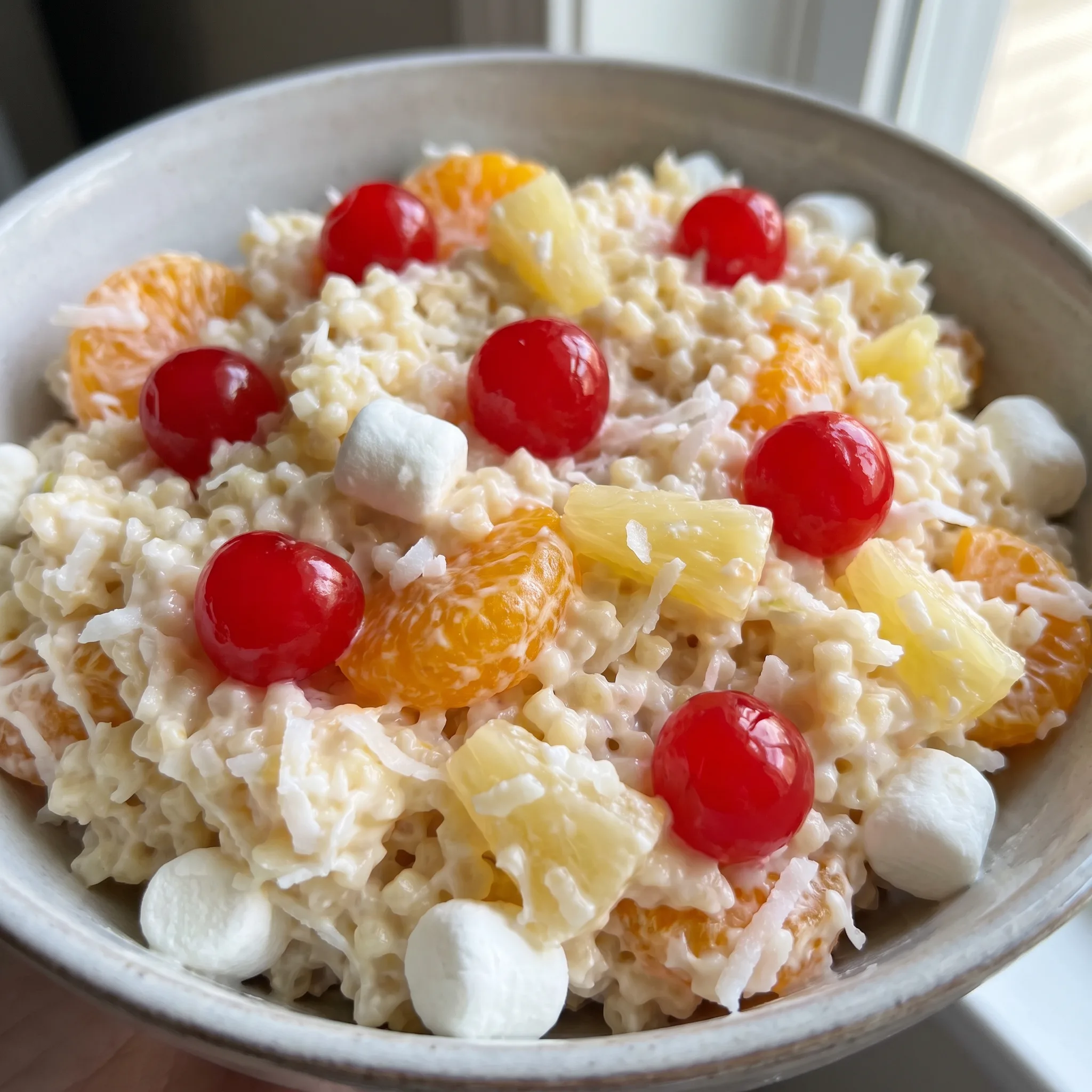
Maraschino cherries on top are the traditional signature, and they do more than look cheerful. Their bright red color and sweet-tart bite contrast with the pale, creamy base, and they tell anyone at the table that this is frog eye salad and not just another dessert salad. A few extra mini marshmallows and a scattering of coconut added just before serving refresh the texture; if they sat in the mixture for hours, the marshmallows would soften and the coconut would go limp.
The garnish is also a visual cue: the round pasta already looks like small eyes, and the cherries reinforce the whimsy. You don’t need to arrange them artfully, just dot them across the top.
When you set the bowl down, the contrast should be obvious at a glance. That’s the look people expect, and it signals what’s underneath.
The Ingredients That Actually Change the Bowl
Pineapple tidbits: Buy tidbits packed in juice, not heavy syrup, since the reserved liquid becomes the custard base.
Acini de pepe pasta: The tiny round shape is the whole visual gag, and larger pasta beads won’t sit right in a chilled scoop.
Large eggs: Two whole eggs plus one yolk give the custard its soft set, and that extra yolk is where the richness lives.
Whipped topping: Thaw it fully in the fridge first, because cold clumps won’t fold smoothly into the cooled custard.
This custard depends on two thickening systems working together: cornstarch gelatinizes when its granules absorb the pineapple juice and reach roughly 203°F, while the eggs coagulate around 180°F and add richness and set. The trade-off is heat application, cooking over medium heat with constant stirring lets the starch hydrate and thicken before the eggs can scramble, whereas higher heat or intermittent stirring pushes the eggs past their coagulation point first, producing lumps and a broken, watery base. The recipe uses the moderate, continuously stirred stovetop method because it keeps the two systems in sequence rather than in conflict.
Judging the Custard, the Pasta, and the Fold
When the custard is thick enough to stop
The mixture goes from frothy to suddenly heavy around the 10-minute mark. Stir constantly with a whisk, scraping the corners of the pan, because a lazy stir lets the egg catch and scramble on the bottom.
You’re there when the custard coats the back of a spoon and a finger drawn through leaves a clean line that doesn’t fill back in. If it does fill back, keep going, another minute. Pull it off the heat the moment it holds that line; past that, it can turn grainy and the cornstarch starts to break down.
The temperature gap between custard and whipped topping
The custard needs to be completely cool before the whipped topping touches it. Warm custard collapses the topping on contact, and you end up with a thin, soupy base that never recovers.
The card gives 1 hour in the fridge or 30 minutes in the freezer. Check by touching the bottom of the bowl: it should feel neutral, not cool, not warm. If it’s still warm after the shorter chill, give it more time.
There’s no fixing it once the topping is in.
Reading the pasta after the cold rinse
Acini de pepe goes from raw to done in a narrow window. After draining and rinsing under cold water, grab a piece to the touch.
It should feel plump and separate, not sticky or clumped. If it smashes into a paste, it’s overcooked and will drag the salad down.
If it’s still firm at the center, it needed another minute in the pot. The rinse stops the cooking, so any firmness left when you drain it stays firm in the salad.
Folding without crushing the fruit
Once the custard and whipped topping are combined, everything else goes in with a spatula, not a spoon. You’re looking for an even distribution where the mandarin segments stay whole and the marshmallows stay round.
Rough stirring crushes the oranges and deflates the topping, leaving a uniform paste. Stop as soon as the fruit and coconut are scattered through.
The mixture should still show distinct pieces and white flecks, not a smooth pink cream.
Judging the set after the long chill
After at least 4 hours in the refrigerator, the salad should be thick enough that a spoon stands up in the bowl for a moment before falling. If it’s still runny, the custard was undercooked or the fruit wasn’t drained well enough. You can’t fix it at this stage, but you can serve it in small bowls instead of trying to scoop it onto a plate.
The full rest is what turns a wet mixture into something that holds a shape.
Frog Eye Salad with Acini de Pepe and Pineapple
Ingredients
Method
- Drain both cans of pineapple tidbits, reserving the juice.
- In a small saucepan over medium heat, whisk the reserved pineapple juice, eggs, egg yolk, sugar, cornstarch, and vanilla until smooth. Cook, stirring constantly, about 10 minutes, until thickened into a smooth, glossy custard.
- Transfer the custard to an extra-large bowl, cover, and chill 1 hour in the refrigerator or 30 minutes in the freezer until cooled to room temperature.
- Cook the pasta according to package directions. Drain, rinse under cold water, and cool completely.
- Gently fold the whipped topping into the chilled custard until smooth and fully incorporated. Add the cooled pasta, pineapple tidbits, mandarin oranges, mini marshmallows, and shredded coconut; stir gently until evenly combined.
- Cover and refrigerate at least 4 hours, or overnight, to let the flavors meld.
- Just before serving, top with maraschino cherries and extra marshmallows and coconut, if desired.
Swaps That Work and Ones That Sink the Custard
Whipped topping (8 oz): Use an equal amount of another whipped topping, whether dairy-based or non-dairy. Both fold in the same way once fully thawed. The stabilizers differ, so a non-dairy version may hold its shape a touch longer or break down a little faster after the long chill.
Thaw it completely in the fridge first; cold clumps won’t blend smoothly and leave streaks. If you’re after a looser set, this is the place to change the texture without wrecking the custard.
Acini de pepe pasta (16 oz): Orzo or another tiny pasta shape can stand in, but keep the same weight. Cook, drain, and rinse the same way. Orzo is larger and flatter, so it won’t read as the tiny round ‘eyes’ the name promises, and it may feel more like a rice salad than a classic frog eye.
The custard still clings, but the texture turns denser and less playful. If you use a very small pasta like pastina, the pieces clump more easily after rinsing, so toss them with a little oil before folding in.
Reserved pineapple juice (from the 2 cans): If you’re short on juice because the cans were packed in syrup or you drained them over a strainer and lost some, top up with an equal amount of unsweetened pineapple juice from a bottle or a splash of orange juice. The custard needs that liquid to thicken, and the flavor rides on it. Bottled juice keeps the pineapple taste but may be less sweet, so taste the finished custard and add a spoonful more sugar if it seems flat.
Orange juice shifts the flavor toward the mandarin oranges, which some people prefer. Do not substitute water or milk; the custard will taste thin and the pineapple note disappears.
Large eggs (2 whole + 1 yolk): No reliable swap. The eggs set the custard along with the cornstarch, and replacing them with a commercial egg replacer or flax gel changes the texture entirely. Without the eggs, the custard won’t hold a clean line on the spoon and the finished salad will be loose and watery after chilling.
Cornstarch alone can thicken, but you lose the richness and the soft set that makes each scoop taste like more than sweetened juice. If you must avoid eggs, this isn’t the recipe to adapt.
Cornstarch (2 tbsp): Do not swap cornstarch for flour, arrowroot, or tapioca starch in the same amount. Flour needs longer cooking to lose its raw taste and gives a cloudy, pasty custard.
Arrowroot and tapioca thin out after chilling or when stirred too much, so the salad turns runny in the bowl. Cornstarch is what gives the custard its spoonable body and keeps a scoop from sliding apart; leave it as written.
Storage, Leftovers, and When to Eat It
This salad is at its best between the 4-hour minimum chill and about 24 hours later. Eat it that first day if you can. On day two the pasta has drunk more custard, so each scoop sits heavier and the marshmallows have softened at the edges.
By day three the marshmallows are gone spongy, the coconut has lost its bite, and the base turns slack as the pasta keeps pulling liquid. It still tastes fine, but the texture you built is gone. Keep leftovers in a sealed container in the refrigerator, and eat them within three days.
Stir before scooping and add a fresh spoonful of whipped topping if the surface looks dry. Don’t freeze the assembled salad; the custard and topping separate and the pasta goes grainy. If you want to work ahead, freeze the custard alone.
Add the cherries, extra marshmallows, and coconut just before the bowl goes out, never earlier. For a potluck, set it out cold and don’t leave it past two hours.
Tips
- Taste the custard while it is still warm off the stove, before it goes into the refrigerator. Warm custard reads sweeter than it will cold, and cold also mutes the pineapple tang from the reserved juice, so a base that seems balanced at room temperature can taste flat by the time it reaches the bowl. If it needs more sugar, whisk it in now while the custard is loose; once the whipped topping, oranges, marshmallows, and coconut go in, you cannot stir in sugar without deflating the topping and crushing the fruit.
- The 16 ounces of acini de pepe is a lot of pasta against that custard, so reserve about a cup of the cooked, rinsed pasta before folding everything together. If the finished mixture looks tight or the pasta is not fully coated after the first stir, leave the extra out rather than adding more custard you do not have. The reserved pasta keeps in the refrigerator for a day and can be stirred into leftovers if the salad thickens overnight.
Frequently Asked Questions
Can I make frog eye salad a day ahead?
Yes, and that’s the sweet spot. The salad sits at its best somewhere between the 4-hour minimum chill and about 24 hours later, so assembling it the night before lands you right there. On day two the pasta has drunk more custard, so each scoop sits heavier and the marshmallows have softened at the edges, which reads as richer rather than tired.
Hold the cherries, extra marshmallows, and coconut until the bowl goes out; those are the pieces that go limp if they sit.
Why is my frog eye salad runny?
Most likely the custard was pulled off the heat before it thickened, or the fruit went in wet. Pineapple and mandarin packing liquid will thin the custard and leave a puddle at the bottom of the bowl, so drain both cans well before they meet the base. Check the custard too: it needed to coat the back of a spoon with a clean line held through it.
If it’s already assembled and loose, more fridge time is the only lever left, and serving in small bowls beats trying to scoop it onto a plate.
How long does frog eye salad last in the fridge?
Eat it within three days, sealed in the refrigerator. Day one is the best version. By day two the pasta has pulled more custard and the marshmallows soften at the edges; by day three the marshmallows are gone spongy, the coconut has lost its bite, and the base turns slack as the pasta keeps drinking.
It still tastes fine at that point, but the texture you built is gone. Stir before scooping and add a fresh spoonful of whipped topping if the surface looks dry.
What’s the difference between frog eye salad and ambrosia?
The pasta. Ambrosia is fruit, coconut, marshmallows, and whipped cream, and that’s the whole bowl.
Here, 16 ounces of acini de pepe go in, and the tiny round shape is where the name comes from: each piece looks like a small eye suspended in the cream. The custard base is the other split.
Ambrosia is dressed, while this one is built on a cooked pineapple custard that sets the scoop, so it holds a shape on the plate where a straight fruit salad slumps.
Do I have to use acini de pepe pasta?
No, but the bowl changes character. Orzo or another tiny pasta can stand in at the same weight, cooked, drained, and rinsed the same way. Orzo is larger and flatter, so it won’t read as the tiny round eyes the name promises, and the texture turns denser and less playful, closer to a rice salad.
Very small pastas like pastina clump more easily after rinsing, so toss them with a little oil before folding them in.
