
Most home scones come out of the oven dry enough to need a dunk, and they taste like nothing by noon. The problem usually isn’t your technique.
It’s what carries the dough. Sour cream handles that job here, and its acidity means you can stir a little past the point you meant and the crumb still stays tender instead of turning tough.
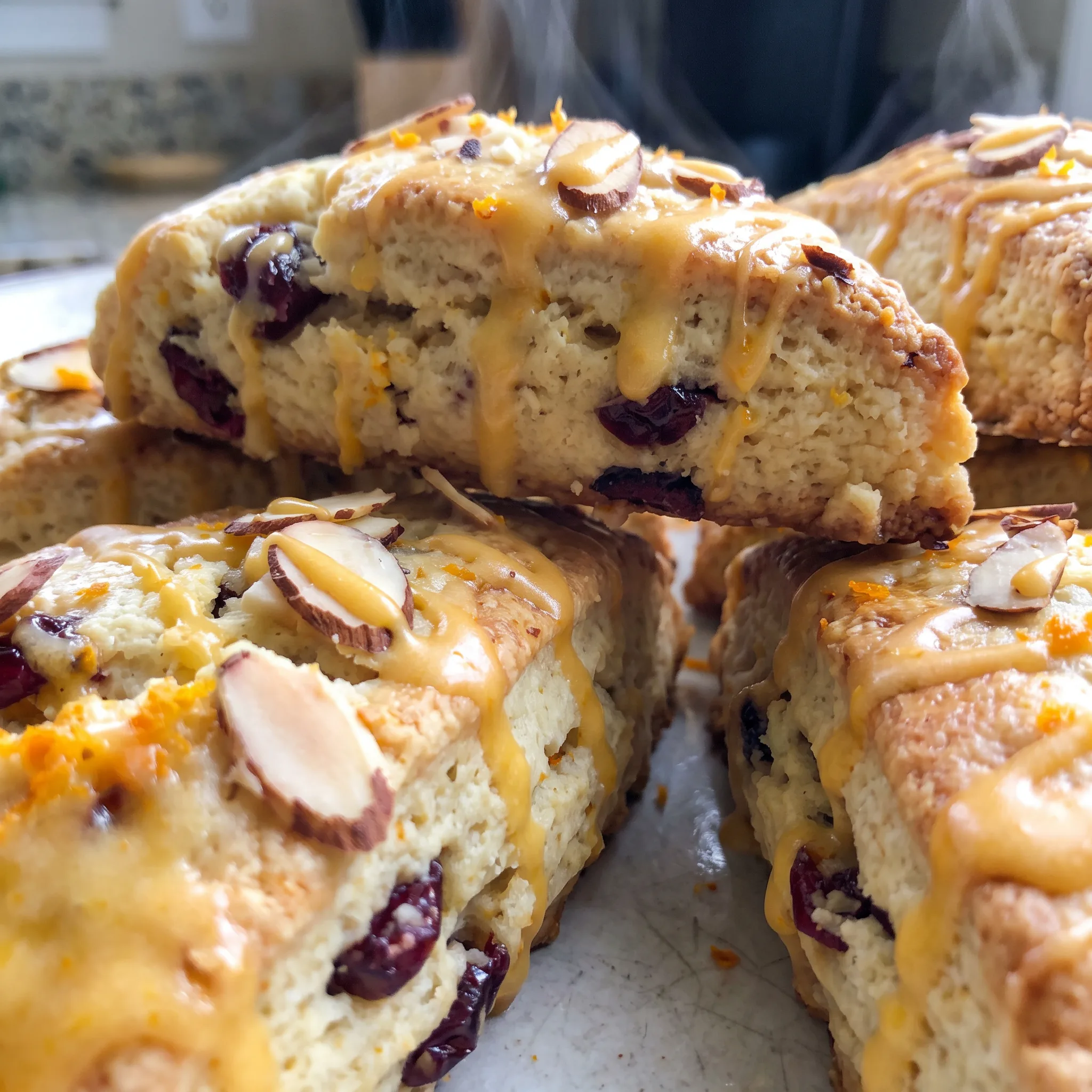
Dried cranberries need the orange to keep them from reading flat and sugary, which is why the zest goes in twice, dough and glaze. You can smell it in the first few minutes of the bake. With the almond and turbinado lid on top, these cranberry orange scones end up with a texture worth paying attention to, warm or hours later.
The one real risk is flour that gets packed into the cup, so spoon it in or weigh it.
The Tang That Keeps Them Tender
Sour cream does more than add a little tang. It changes how the dough comes together, and that difference shows up on the plate. The acidity in sour cream works against gluten, the protein that gives baked goods a chewy, tough structure.
With less gluten forming, the scones stay soft instead of turning brick-like. The fat in sour cream also plays a role.
It coats the flour particles, so they can’t easily link up into long gluten strands. That means even if you stir a bit more than you meant to, the dough won’t punish you. You’ll notice the result when you break open a baked scone: the crumb is fine and tender, not dense or dry.
Hours later, they’re still moist. A classic scone made without sour cream often dries out quickly and tastes best only straight from the oven. These keep their texture through the day.
That’s the quiet work sour cream does.
Orange, Twice Over
One hit of orange is never enough for a proper citrus scone. Zest in the dough releases oils that perfume every bite, not just the spots where you see a fleck.
You smell it as soon as the scones hit the oven, and you taste it throughout, even where there’s no cranberry. The optional glaze adds a second, brighter layer. It’s fresh and sharp, cutting through the buttery richness of the scone.
Without it, the orange is more of a background note. With it, the citrus becomes a clear top note that lingers.
Cranberry and orange work because the acidity of the orange balances the sweetness of the dried berries. The berries alone can taste flat and sugary; the orange wakes them up. You can skip the glaze and still have a good scone, but the double dose is what makes these taste deliberate rather than plain.
A squeeze of juice in the glaze, a scatter of zest in the dough, and the whole batch sings.
Crunch on Top, Every Time
A scone with a soft top is fine, but a scone with a crunchy, nutty lid is memorable. Sliced almonds toast in the oven, turning golden and crisp. They add a savory note that keeps the sweet dough from becoming one-dimensional.
Turbinado sugar, with its large, coarse crystals, stays crunchy after baking. It doesn’t dissolve into the dough like granulated sugar would. Instead, it gives a sweet, sandy bite that contrasts with the tender crumb underneath.
Both go on before baking, so they stick without any glaze or egg wash needed later. You get that textural contrast in every bite that includes a bit of topping. The almonds also hint at doneness: when they’re fragrant and lightly browned, the scones are close to ready.
This isn’t just decoration. It’s a deliberate layer that makes the scone feel finished.
The crunch lasts even after the scones cool, which is more than you can say for a plain sugar sprinkle.
Why Wedges Beat Rounds
Cutting the dough into wedges before baking isn’t just for looks. Each wedge has more exposed surface area than a round drop scone, so the edges crisp up in the heat.
That means you get a satisfying crunch on the outside and a tender interior, all in one bite. The shape also helps them bake evenly.
A thick round can end up with a doughy center while the outside overbrowns. Wedges are thinner in the middle and cook through at the same rate as the edges. And because you separate them before they go in, they don’t steam together.
If they touched in the oven, the sides would stay pale and soft. With space between them, hot air circulates around each one, setting the crust. The result is a batch of scones that look like they came from a bakery case, with defined edges and a golden top.
You don’t need a cutter or a special pan, just a sharp knife and a little room on the sheet.
What Actually Matters at the Store and the Counter
Sour cream: Buy full-fat sour cream, not reduced-fat or fat-free, since the fat is what keeps the crumb tender and the scones from drying out.
Dried cranberries: Use sweetened dried cranberries or Craisins, not unsweetened ones, because the sweetened berries stay plump and balance the orange.
Orange zest: Grate only the bright orange outer peel, stopping before the white pith, which turns bitter and ruins the citrus flavor.
Sliced almonds: Roughly break the sliced almonds by hand so some pieces stay larger and toast unevenly for a mix of crunchy and tender bits.
Turbinado sugar: Keep the turbinado sugar coarse; if yours looks fine like granulated, it’ll dissolve and you’ll lose the crunchy top.
Judging the Dough, the Topping, and the Bake
When the butter is small enough to stop cutting
Stop when the biggest butter pieces are the size of small peas and the rest looks like cornmeal. If you keep going, the butter warms and smears into the flour, and the scones bake up flat and tough instead of flaky.
Shake the bowl. The mixture should rattle, not clump.
Any larger flat flakes you see mean you can stop now. If the bowl feels warm, put it in the fridge for 10 minutes before adding the wet ingredients.
Reading the dough before you flour the counter
The dough should be shaggy and slightly damp, not a smooth ball. If it looks dry and crumbly, add heavy cream a teaspoon at a time.
If it looks wet and sticky, add flour a tablespoon at a time. You want it to hold together when you squeeze a handful but still feel tacky. Too dry and the scones bake up tough and crumbly.
Too wet and they spread in the oven.
The moment the egg wash goes on
Brush the egg wash just before baking. If you brush it too early, it soaks in and the almonds and turbinado sugar slide off. The wash should look glossy, not dripping.
A thin, even coat gives you a golden shine. If you miss a spot, the top stays pale there.
If you use too much, the egg pools around the base and burns. Dip the brush and wipe off the excess before you touch the scone.
When the almonds tell you they’re done
Start checking at 20 minutes. The almonds should be fragrant and lightly browned, and the scone tops should be golden.
If the almonds are dark brown, the scones are overbaked. If the tops are pale but the almonds are toasted, pull them out anyway; the bottoms are likely done. A toothpick in the center should come out clean.
If it’s wet, give them 2 more minutes.
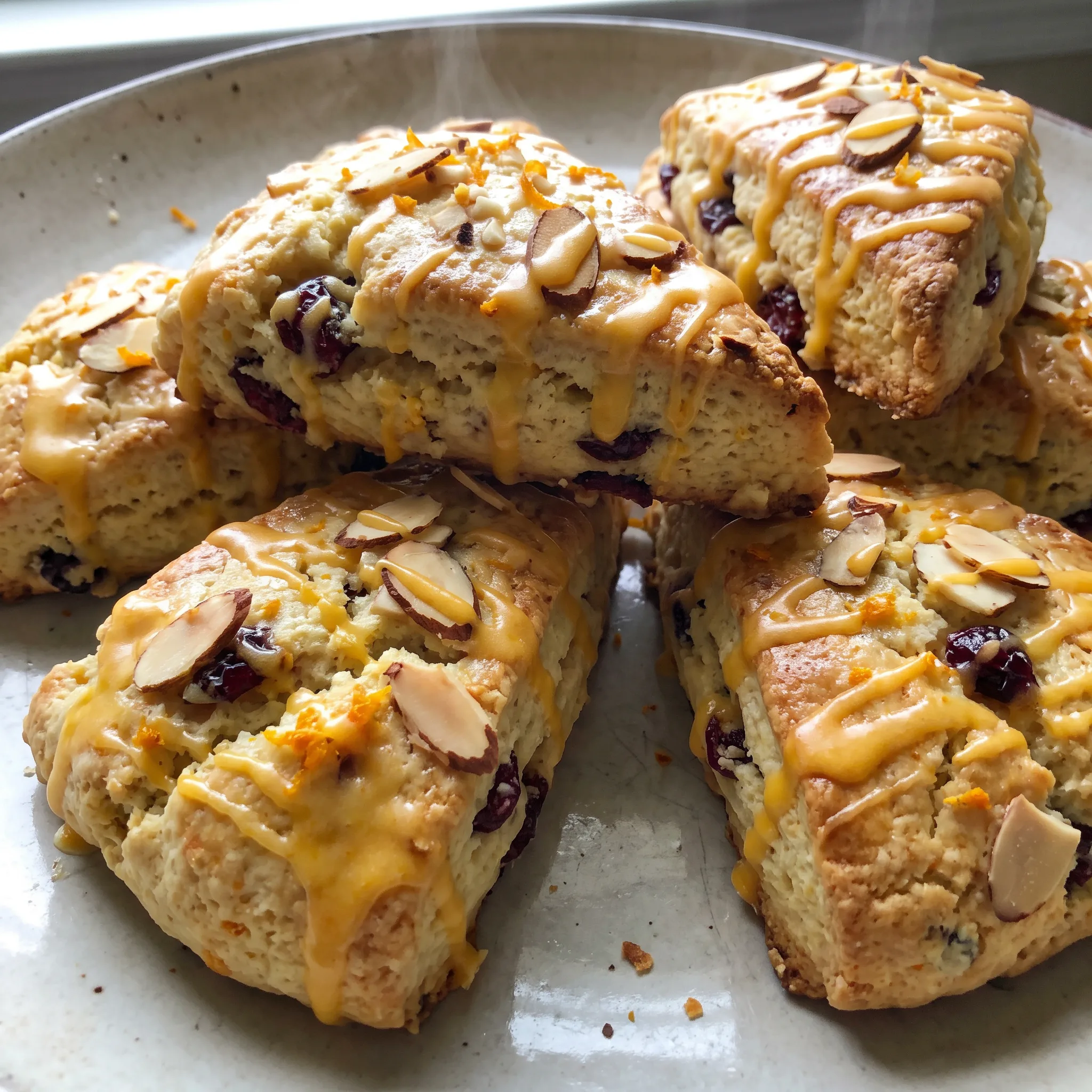
Cranberry Orange Sour Cream Scones
Ingredients
Method
- Set oven to 375°F (190°C). Prepare a large baking sheet or two standard baking sheets by lining with parchment paper; leave aside.
- In a medium mixing bowl, combine flour, granulated sugar, baking powder, baking soda, and salt by whisking.
- With a pastry cutter or two forks, incorporate the cold cubed butter into the dry mixture until it looks like cornmeal. Stir in dried cranberries until uniformly spread. Create a well in the center.
- In another bowl, whisk sour cream, heavy cream, 1 egg, orange zest, and vanilla extract. Add the wet mixture to the dry ingredients and stir gradually until completely hydrated.
- Transfer dough onto a lightly floured nonstick surface. Fold it a few times to coat with flour and lessen stickiness; avoid overworking.
- Shape dough into an 8-inch circle about 1 inch thick. With a sharp knife dipped in flour, cut into wedges. Arrange wedges on the prepared pan(s) with at least 3 inches between them.
- Egg wash: Whisk the remaining egg with 1 Tbsp water. Brush the top of each scone and scatter with sliced almonds and turbinado sugar.
- Bake for 20–22 minutes, or until golden. Serve warm with fresh whipped cream and orange marmalade.
- Optional glaze: In a small bowl, combine powdered sugar, orange zest, and fresh orange juice. Add juice 1 Tbsp at a time until desired consistency is reached. Drizzle over the warm scones just before serving, if desired.
Keeping the Crunch Past Day One
Eat these the day they’re baked if you can. That’s when the turbinado sugar and toasted almonds still crackle against the tender crumb, and the glaze, if you’re using it, sits bright on top. Once the scones cool completely, store them airtight at room temperature.
They hold for a day or two, but the topping softens first. The almonds pull moisture from the crumb overnight and lose their snap. The sugar crystals start to dissolve.
By day two the scones are still tender and worth eating, just quieter in texture. To bring the top back, warm them in a 300°F oven for 5 to 6 minutes.
That re-crisps the almonds and sugar without drying the interior. Skip the microwave; it steams the crust and leaves the topping limp. For longer keeping, freeze baked scones in a single layer, then bag them.
They thaw at room temperature and refresh the same way. Add the glaze only to scones you’re serving right then. Drizzled on stored ones, it weeps and turns them sticky.
What You Can Swap Without Losing the Scone
Sour cream: Full-fat Greek yogurt, same 1/2 cup (120 g). Greek yogurt brings the same tang and fat, so the crumb stays tender and the scones keep for hours. If you grab a low-fat or fat-free tub, the dough turns out drier and the baked scones feel cottony instead of rich.
Dried cranberries: Raisins or chopped dried apricots, same 2/3 cup (80 g). Both absorb the orange and stay plump in the bake.
Raisins read sweeter and softer; apricots bring a sharper, more jammy note. Either way, chop apricots to cranberry size so they don’t tear the dough as you fold.
Heavy cream: Whole milk, same 1/4 cup (60 mL). Whole milk thins the dough slightly and adds less fat, so the scones come out a touch less rich and brown a shade faster.
If the dough feels wet after mixing, dust in a tablespoon of flour. Don’t reach for skim or 2% here; the lack of fat leaves the crumb dry and tight.
Orange zest: 1/2 tsp orange extract, added with the wet ingredients. Extract gives you the orange hit without grating, but it tastes flatter and won’t release that fresh oils scent as the scones bake. Start with 1/2 tsp and taste the dough; add more only if the orange disappears behind the cranberries.
The glaze still wants real zest if you’re making it.
Tips
- Cube the butter and park it in the freezer for 10 minutes while you whisk the dry ingredients, then cut it in. At 2 1/4 cups of flour, butter that starts at fridge temperature softens the moment your hands or a warm bowl touch it, and soft butter smears into the flour instead of staying in distinct pea-sized bits. Those intact bits are what steam and push the dough apart into flaky layers as the scones bake.
- If you grate the orange over the bowl of dry ingredients rather than onto a cutting board, the zest oils fall directly into the flour and get distributed when you whisk, so no single wedge carries all the orange. The 1 1/2 Tbsp from about two oranges releases its oil on contact, and catching it in the flour keeps those oils from evaporating off a plate before the dough comes together.
Once the sour cream, cream, egg, and orange zest are stirred into the flour, the liquid immediately begins hydrating the flour proteins; every additional stroke of the spoon aligns those proteins into a continuous gluten network. That network sets firm in the oven, so the scone bakes up chewy and tight instead of tender and short. The dough will look shaggy and slightly sticky when it is correctly mixed, and that ragged texture is the signal to stop.

Frequently Asked Questions
Can I make the dough ahead of time and bake later?
You can mix the dough, shape it into wedges, and park them on the lined sheet in the fridge for a few hours, then bake straight from cold. Cold dough going into a 375°F oven holds its shape better, so the wedges don’t slump.
Hold off on the egg wash, almonds, and turbinado until right before they go in, or the wash soaks in and the toppings slide off. If you want to go longer than a few hours, freeze the unbaked wedges instead and bake them from frozen, adding a couple of minutes.
Why did my scones turn out dry and crumbly?
The usual culprit is flour that got packed into the measuring cup, so you ended up with more than the 270 g the recipe calls for. Fluff the flour, spoon it into the cup, and level it off, or just weigh it. A second check is the sour cream: if you grabbed a reduced-fat tub, the dough loses the fat that keeps the crumb tender.
The dough should feel shaggy and slightly damp when you squeeze a handful, not dry and dusty. If it crumbles before baking, work in a little extra heavy cream.
How do I know when the scones are fully baked?
Watch the almonds. When they’re fragrant and lightly browned, and the tops are golden, pull them.
If the almonds are still pale but the tops look set, give them another minute or two, but don’t let the nuts go dark brown or the scones are overbaked. A toothpick in the center should come out clean. The bottoms should be golden too, so lift one with a spatula to check if you’re unsure.
What’s the difference between these scones and traditional cream scones?
Traditional cream scones lean on heavy cream alone for the liquid and fat, which gives a rich but sometimes dense crumb. Here, sour cream does the heavy lifting, and its tang keeps the texture tender so they stay moist past the first hour.
The orange zest and dried cranberries add a bright, tart note you won’t find in a plain cream scone, and the almond-turbinado topping brings a crunch that a standard cream scone lacks. The glaze, if you use it, pushes the citrus even further. Think of these as a fruit-forward, textured version rather than a blank canvas for jam.
Can I freeze these scones, and how do I reheat them?
Freeze baked scones in a single layer, then bag them once solid. They thaw at room temperature, and a 300°F oven for 5 to 6 minutes brings the almonds and sugar back to a crackle without drying the inside. Skip the microwave, which steams the crust and leaves the topping limp.
If you glazed them, expect the glaze to weep after freezing, so add it fresh to scones you’re serving right away.
