Most bakers lose king cake to a dough that never doubles, and the culprit is usually the yeast before the flour ever enters the bowl. Warm water that feels merely warm can still be too hot, and dead yeast gives you sweet water with no foam and no rise, which no amount of extra kneading fixes. The dough itself is forgiving once it’s alive: enriched with milk, butter, and eggs, it stays tacky and soft on purpose, and cooks who keep adding flour until it feels like bread dough end up with a tight, heavy crumb.
Two fillings twisted through each braided oval is where the real margin for error sits, since a loose cream cheese layer can weep into the dough. Get the rise right and the rest follows, baby tucked in and all.
Why This Recipe Makes Two King Cakes
The dough you mix is enough for two full king cakes, not one oversized one. Once it has doubled during that first rise, you divide it in half, and each half becomes its own cake. That matters because a single cake from all this dough would be too thick to bake evenly and would dry out before the center sets.
Each cake is shaped from two dough logs twisted together, so you get two braided ovals, each one substantial enough to serve a crowd. The filling amounts are also for both cakes; if you only want one, you must halve the filling.
With two cakes, you need two baking sheets and enough oven space to bake them without crowding. They can go in side by side if your oven is wide enough, or on separate racks with a switch halfway through. The result is two generous, shareable cakes, each with its own hidden baby.
A Marbled Center from Two Fillings
Cinnamon sugar and cream cheese each bring something different to the crumb. The cinnamon filling combines brown sugar, granulated sugar, flour, cinnamon, and melted butter into a spiced, sweet paste that thickens as it bakes.
The cream cheese filling is a smooth mixture of cream cheese, powdered sugar, butter, and vanilla, tangy and rich. When you twist the two filled logs together, the fillings swirl into a marbled interior, so some bites are warmly spiced, others cool and creamy. Using both in each cake gives a richer, more complex result than a single filling would.
The contrast in texture is as noticeable as the contrast in flavor: the cinnamon filling stays slightly granular, while the cream cheese stays soft and almost custardy. That interplay is what makes a slice interesting from the first bite to the last.
If you prefer, you can choose just one filling, but the two together are what define this version.
Frosting That Drizzles, Not Drowns
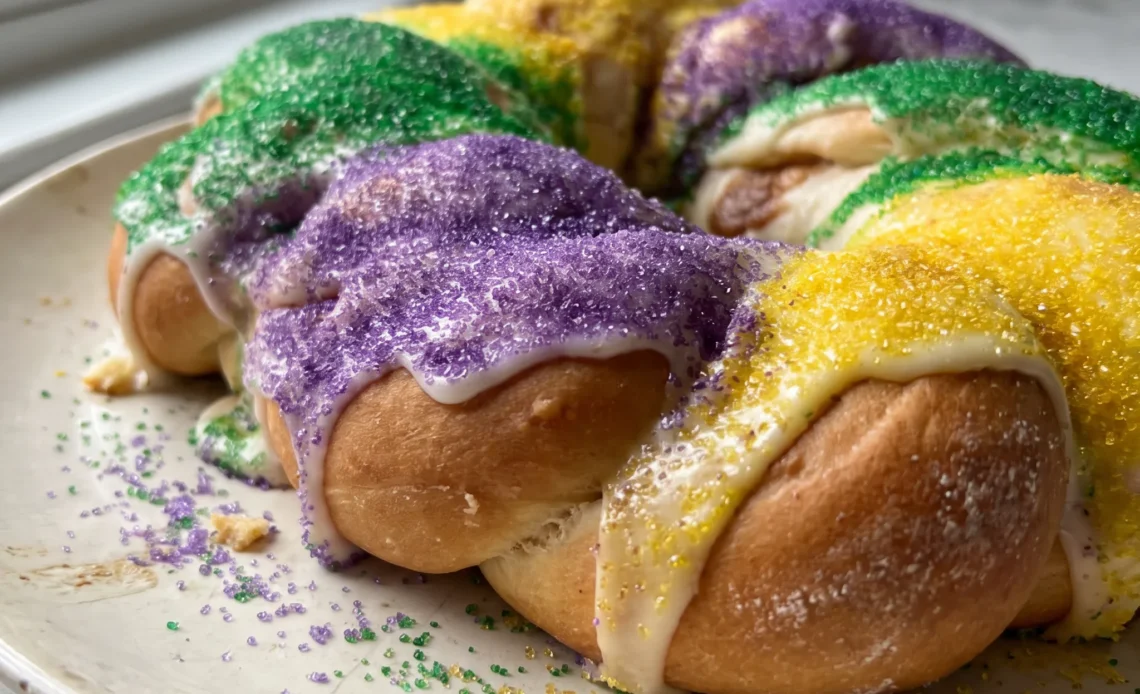
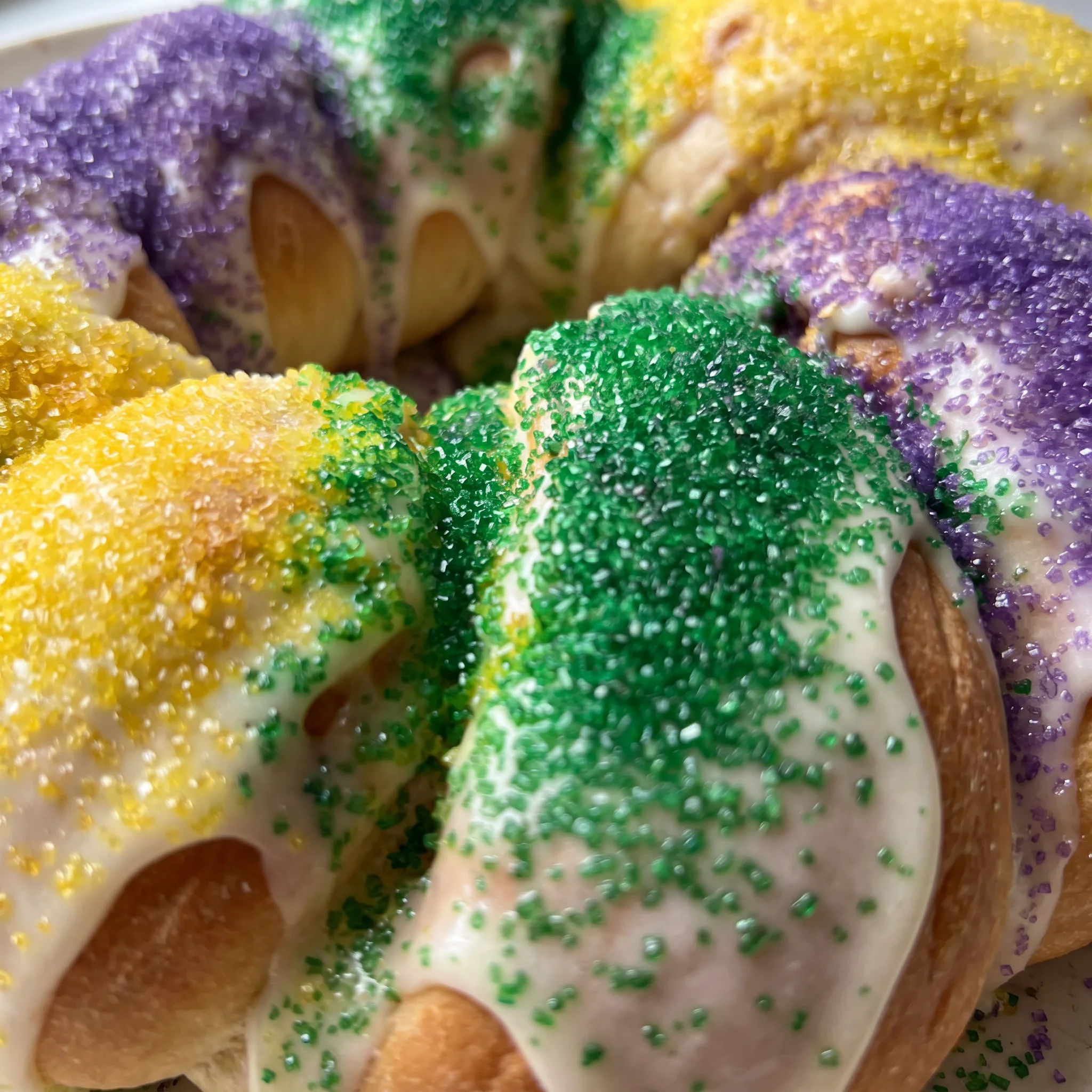
This frosting is intentionally thin, made with milk and lemon juice to reach a consistency that drizzles from a spoon but stays thick enough to cling to the cake. A pourable frosting coats the uneven surface of a twisted, risen loaf without tearing the delicate dough, and it settles into the crevices rather than sitting on top.
The lemon juice adds a subtle tang that balances the sweetness of the cake and frosting, so each bite stays lively. The purple, green, and gold sugars must be applied while the frosting is wet so they adhere; once it sets, they will simply roll off.
You will see the frosting start to firm up within minutes, so have your sugars ready. The finished look is glossy and colorful, with the sugars suspended in the frosting rather than dusted over it.
That’s the classic Mardi Gras finish, and it tastes as bright as it looks.
The Hidden Baby and Its Meaning
A small plastic baby is tucked into each cake after baking and before frosting. You push it down into the cake to hide it from view, so no one knows which slice holds it. The person who finds the baby in their slice is crowned king or queen for the day, a lighthearted honor that comes with a obligation: in many circles, they’re expected to bring the next king cake.
This tradition is central to Mardi Gras king cake celebrations, dating back to European customs where a bean or trinket was baked inside a cake to choose a mock king for the festivities. The baby itself represents the Christ child, but today it’s mostly about the fun of the find. Each cake gets its own baby, so you get two chances to crown a monarch.
Just warn your guests so no one bites down unexpectedly.
The Ingredients That Decide How This King Cake Turns Out
Active dry yeast: Buy a jar with a date still ahead of you, since old yeast foams weakly and the dough never doubles.
Cream cheese: Full-fat block cream cheese, not the spreadable tub kind, keeps the filling thick instead of runny.
Ground cinnamon: Fresh cinnamon smells sweet and warm when you open the jar, while stale powder tastes like dusty bark.
All-purpose flour: Spoon it into the cup and level it off, because scooped flour packs in extra and stiffens the dough.
Salted butter: Real butter, not margarine, gives the dough and fillings their flavor and the frosting its body.
Lemon juice: Bottled works, but fresh juice tastes brighter and cuts the powdered sugar in the frosting.
The recipe calls for 5 to 5½ cups of flour, but the full ½ cup is only for dough that is really sticky. If all 5½ cups go in at the start, the dough absorbs too much flour, gluten tightens, and the final baked cake turns out dry and tough instead of soft and tender. The dough should pull away from the bowl but still feel tacky, not stiff.
Judging the Dough, the Fillings, and the Bake
When the yeast is ready, not just wet
The yeast and warm water need 5 to 10 minutes to turn frothy. Look for a cap of beige foam across the surface, and smell for a yeasty, bread-like scent.
If the water was too hot, the yeast dies and you get a flat, sweet liquid with no foam; if too cool, it stays dormant and you wait longer. Without that froth, the dough will not rise properly.
Start over with fresh yeast and water that feels just warm on your wrist.
Reading the dough as it kneads
After 5 minutes on medium speed, the dough should pull away from the bowl and feel very soft, tacky but not sticky enough to cling to your fingers. If it still sticks, add the extra 1/2 cup flour a tablespoon at a time.
Too much flour makes a stiff dough that rises slowly and bakes up dense. Too little and it slumps.
Stop when it clears the bowl and holds a rough shape.
The first rise: doubled, not just puffy
The dough needs 1 to 2 hours to double in size. Judge by volume, not the clock: it should look twice as big and feel airy when you press a floured finger into it, leaving a dent that springs back slowly. If it has not doubled, let it go longer.
Under-risen dough bakes up tight and heavy; over-risen dough smells of alcohol and collapses when punched down. Use the time as a guide, but trust the dough.
The second rise: puffy, not proofed to the point of collapse
After shaping, the twisted loaves rest 30 to 45 minutes. They should look puffy and slightly larger, and a gentle poke with a floured finger should leave a mark that fills in slowly. If they over-rise, the braid blurs and the dough can collapse in the oven.
Under-risen, they bake up tight. Judge by feel, not the timer, because room temperature speeds or slows this stage.
When the bake is done, not just golden
The outside browns before the center sets. At 25 to 30 minutes, the crust can look done while the middle is still raw. The reliable test is 190° to 195°F on a digital thermometer inserted into the center of each loaf.
Below that, the crumb is gummy; above, it dries out. If the top browns too fast, tent with foil and keep baking until the temperature is reached.
Cinnamon Cream Cheese King Cake
Ingredients
Method
- In a microwave-safe bowl, warm the milk and butter for 60–90 seconds. Mix in the salt, then leave to cool until just warm, about 120°–130°F (49°–54°C).
- In another bowl, stir together the warm water, about 1 tbsp of the granulated sugar, and the yeast. Let stand 5–10 minutes until frothy.
- After the yeast is frothy, incorporate the milk-butter mixture, the remaining granulated sugar, eggs, vanilla, and 1 cup of the flour. Combine thoroughly, then keep adding flour while kneading with the dough hook, 1 cup at a time. Add the additional 1/2 cup flour only if the dough is really sticky. Knead 5 minutes on medium speed, or 8–10 minutes by hand, until a very soft dough forms and starts to pull away from the bowl.
- Transfer the dough to a floured surface and knead a few times by hand until a smooth, round ball forms. Clean and lightly oil the bowl, put the dough back, and turn to coat. Cover with plastic wrap and let rise in a warm place 1–2 hours until doubled in size.
- For the cinnamon filling, mix the brown sugar, granulated sugar, flour, cinnamon, and melted butter until combined. Set aside. Use only half of these amounts if filling just one king cake.
- For the cream cheese filling, combine the softened cream cheese, powdered sugar, softened butter, and vanilla in a bowl. Beat well until smooth. Set aside. Use only half of these amounts if filling just one king cake.
- Line two baking sheets with parchment paper and set aside.
- Once the dough has doubled, punch it down and divide in half (this recipe makes TWO king cakes). Roll one half into a large rectangle on a lightly floured surface, roughly 10×16 inches. Use a pizza cutter to divide the dough in half lengthwise, creating two long rectangles.
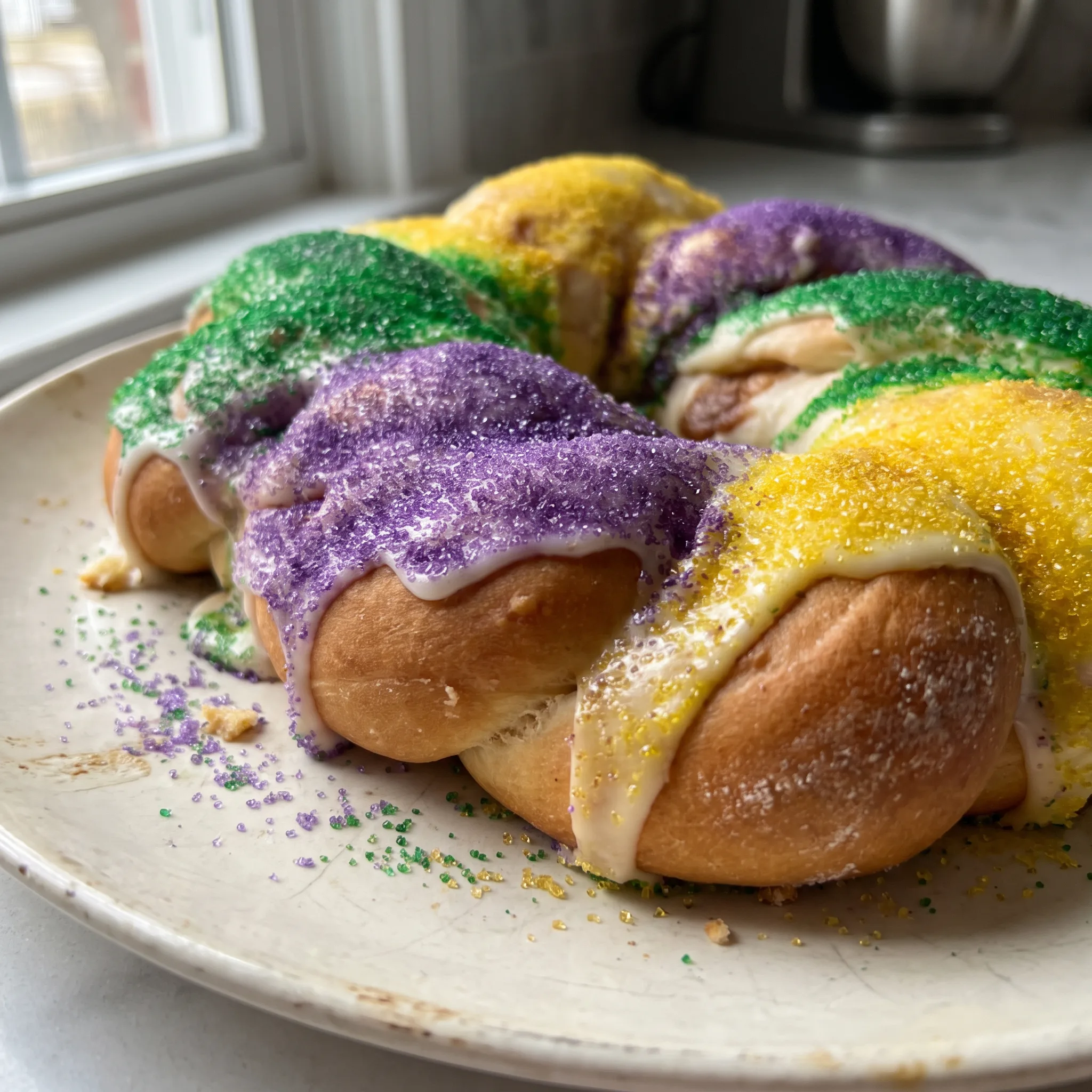
- Crumble the cinnamon filling or spread the cream cheese filling evenly over the dough, then roll up into two long cylinders, as for cinnamon rolls. Twist the two logs together into a rope braid, transfer to a prepared baking sheet, shape into an oval, and pinch the ends together. Repeat with the remaining dough and filling. Cover lightly with plastic wrap and let rise 30–45 minutes until puffy.
- Preheat oven to 350°F (175°C) while the king cake rises. Bake 25–30 minutes until golden brown and baked through; the cake is done when it reaches 190°–195°F (88°–91°C) on a digital thermometer inserted into the center of each loaf. Remove from oven and cool completely before frosting.
- Beat the powdered sugar, milk, butter, lemon juice, and vanilla in a medium bowl until smooth. The frosting should be pourable but thick.
- Stick a plastic baby figurine into each cake, pushing it down to hide it. Drizzle the frosting over both king cakes, spreading with a spatula if needed for good coverage. Sprinkle with purple, green, and gold sugar while the frosting is still wet, before it sets.
- Slice and serve. Whoever gets the slice with the baby gets to be king or queen for the day!
Storage and Serving
Eat a frosted king cake the day it’s baked. That’s when the crumb is at its softest and the sugar colors sit crisp on wet frosting.
After that, keep it covered at room temperature and finish it within a day or two; the dough firms and the sugars slowly weep into the glaze. Refrigerate only the cream-cheese-filled portions, since that dairy won’t hold at room temperature as long as the cinnamon filling will, and cold dulls the crumb. Let a chilled slice sit out 20 minutes before serving.
Press the plastic baby into each cake after baking and before the frosting goes on, then scatter the purple, green, and gold sugars immediately while that frosting is still wet; once it sets, nothing sticks. Unglazed, unfrosted cake freezes well wrapped tight, up to a month, and thaws at room temperature.
Frosted cake doesn’t freeze: the glaze and sugars won’t survive the thaw. Refresh a stored slice for 10 seconds in the microwave if you want it soft again.
Tips
- Stop adding flour the moment the dough clears the bowl and feels very soft and tacky, even if you have not used the full 5 1/2 cups. This dough is enriched with milk, butter, and eggs, so it stays looser than a plain bread dough by design; extra flour added to make it feel “right” is what bakes up into a tight, heavy crumb.
When a Swap Still Gives You a King Cake Worth Baking
Active dry yeast: Instant or rapid-rise yeast can replace the active dry. Skip the step where you stir the yeast into warm water with a spoonful of sugar and wait for foam.
Add the same amount of instant yeast straight to the dry ingredients, then pour in the warm water with the milk mixture. The first rise runs faster, often 45 minutes to an hour instead of one to two, and the dough may be slightly less tangy because instant yeast works quicker.
Start checking at 45 minutes and go by the doubled volume, not the clock.
Salted butter: Unsalted butter works if you add salt back. For the dough, use 1/4 cup unsalted butter and add 1/2 teaspoon salt along with the 1 1/2 teaspoons the recipe already calls for.
For the fillings and frosting, use the same amount of unsalted butter the recipe lists, then add a small pinch of salt to taste after mixing. Without the added salt, the dough tastes flat and the frosting loses its edge against the powdered sugar.
A little salt brings the butter flavor forward, and you won’t notice the swap in the baked cake.
Cream cheese: Full-fat block cream cheese is the only kind that works here. Low-fat or spreadable tub cream cheese will break down and turn grainy during baking. The filling should stay smooth and custardy in the twisted logs.
Low-fat cream cheese weeps liquid and leaves a curdled, watery streak through the crumb. If you can only find spreadable, use it in a no-bake filling or skip the cream cheese layer and double the cinnamon filling.
All-purpose flour: Bread flour can replace all-purpose, but start with the same 5 cups and hold back the final 1/2 cup. Add it only if the dough still sticks after 5 minutes of kneading. Bread flour drinks more water and builds a stronger gluten network, so the dough feels tighter and less soft than the recipe intends.
The baked cake comes out chewier rather than tender. If you use bread flour, expect to add a few extra tablespoons of water to keep the dough supple, and watch the first rise closely because it may take longer.
Frequently Asked Questions
Can I make king cake ahead of time?
You can bake the unfrosted, unglazed cakes up to a day ahead, wrap them tight, and frost the day you serve. Frosted cake is at its best the day it’s baked, and the sugars weep into the glaze after that, so hold off on the finish.
If you freeze, do it before frosting; the glaze and sugars won’t survive a thaw. Press the baby in and scatter the colored sugars only when you’re ready to serve, while the frosting is still wet.
Why did my king cake turn out dry?
The usual culprit is flour: if you scooped it straight from the bag, you packed in extra and the dough turned stiff. Spoon it into the cup and level it off, and add the final half cup only if the dough still clings to your fingers after kneading. A long bake is the other cause, so pull each loaf when a thermometer in the center reads 190° to 195°F.
The crust browns before the middle sets, so if the top is dark and the center is under, tent with foil and keep going.
How is this king cake different from a traditional French galette des rois?
A galette des rois is puff pastry around almond cream, crisp and flat, while this one is a yeast dough twisted into a braided oval with two fillings swirled inside. The crumb here is soft and tender, closer to a sweet bread than a pastry, and the frosting and colored sugars on top are pure Mardi Gras. Both hide a trinket, but the galette is typically cut and served the same day it’s baked, and this one holds up similarly.
If you’ve only had the French version, expect a thicker slice with a chew.
