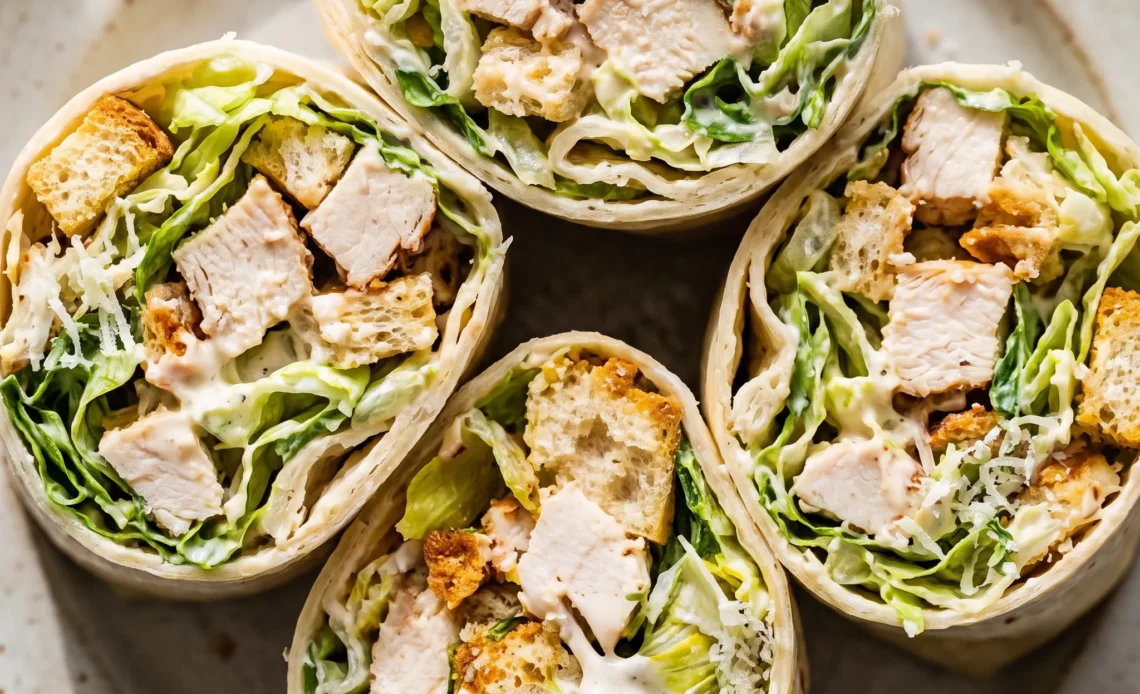
Somewhere along the way the Caesar salad became a sandwich filling, and the chicken caesar wraps version works better than most because the croutons ride inside instead of getting shoved to the rim of a bowl. What trips people up isn’t the rolling.
It’s the dressing sitting against crisp romaine for too long, or chicken dry enough to drink it all up, and either one turns the tortilla damp before the first bite. The window is short and the margin is real. Get the toss right and the wrap eats clean, one hand, no fork, with the anchovy sharpness cutting through the Parmesan and the crunch still audible.
Four wraps, sixteen minutes, most of that spent warming tortillas and chopping what’s already cooked.
Pick the Chicken with Care
Start with cooked chicken that’s already seasoned, whether from the grill, a fryer, or a store-bought rotisserie bird. Raw chicken has no place here because the wrap comes together in minutes and relies on ready-to-eat components; cooking raw meat would throw off the timing and leave the salad warm in a way that wilts the lettuce. The moisture in the chicken matters, too.
A dry breast will soak up dressing and leave the wrap tasting parched, while a juicy thigh or rotisserie piece adds richness that carries through each bite. Chopping the chicken into pieces about the size of a crouton keeps every forkful or bite consistent. If the chunks are too large, they resist folding and tear the tortilla; too small, and they disappear into the dressing.
Aim for a dice that’s roughly half an inch, and you’ll get even distribution without mashing the texture. The result is a filling that tastes deliberate, not like leftovers.
Dressing Ratio Makes or Breaks the Wrap
A third of a cup of Caesar dressing for three cups of romaine and a half cup of croutons might look stingy at first, but it’s calibrated to coat without drowning. Romaine holds a lot of water, and croutrons are little sponges.
Too much dressing and the lettuce wilts, the croutons go soft, and by the time you bite in, the tortilla has soaked through. Too little and the salad eats dry, with patches of bare leaves and a chalky Parmesan finish. Toss gently with tongs, lifting from the bottom, just until everything glistens.
You’re not trying to break down the lettuce; you want each leaf barely filmed. If you’re unsure, start with a quarter cup, taste a leaf, and add more by the tablespoon.
The croutons should still crunch when you assemble the wraps. That texture contrast is what makes the filling feel fresh rather than heavy.
A properly dressed salad holds its shape when you spoon it onto the tortilla, with no puddle forming underneath.
Warm Tortillas Prevent Tearing
A cold flour tortilla is stiff and prone to cracking when you fold it. Warming it up relaxes the gluten and brings the fat to the surface, making the sheet supple enough to bend without splitting. You’ll notice the difference immediately: a warmed tortilla drapes over your hand like a soft cloth, while a cold one snaps at the crease.
That pliability matters not just for rolling but for eating; a warm tortilla has a tender chew that complements the cool, crisp filling. After heating, stack them on a plate and cover with a clean kitchen towel. The towel traps steam and keeps them from drying out as you work.
If they cool down before you finish assembling, they’ll stiffen again and fight you. So keep them covered until the moment you fill them. The payoff is a wrap that folds neatly around the filling and stays intact through the first bite.
Assembly That Stays Sealed
Placing the filling in the center of the tortilla leaves a border on all sides, which is your insurance against leaking. Folding opposite sides inward first creates a pocket that cradles the salad, then rolling from the bottom up burrito-style traps everything inside. If you pile the filling off-center, one side will burst when you roll.
The folding order matters: sides first, then roll, so the ends are tucked in and the seam stays underneath. A toothpick inserted through the center can help hold the wrap closed, especially if you’re packing it for later. Without that security, a loosely rolled wrap can unfurl in transit and spill lettuce and croutons everywhere.
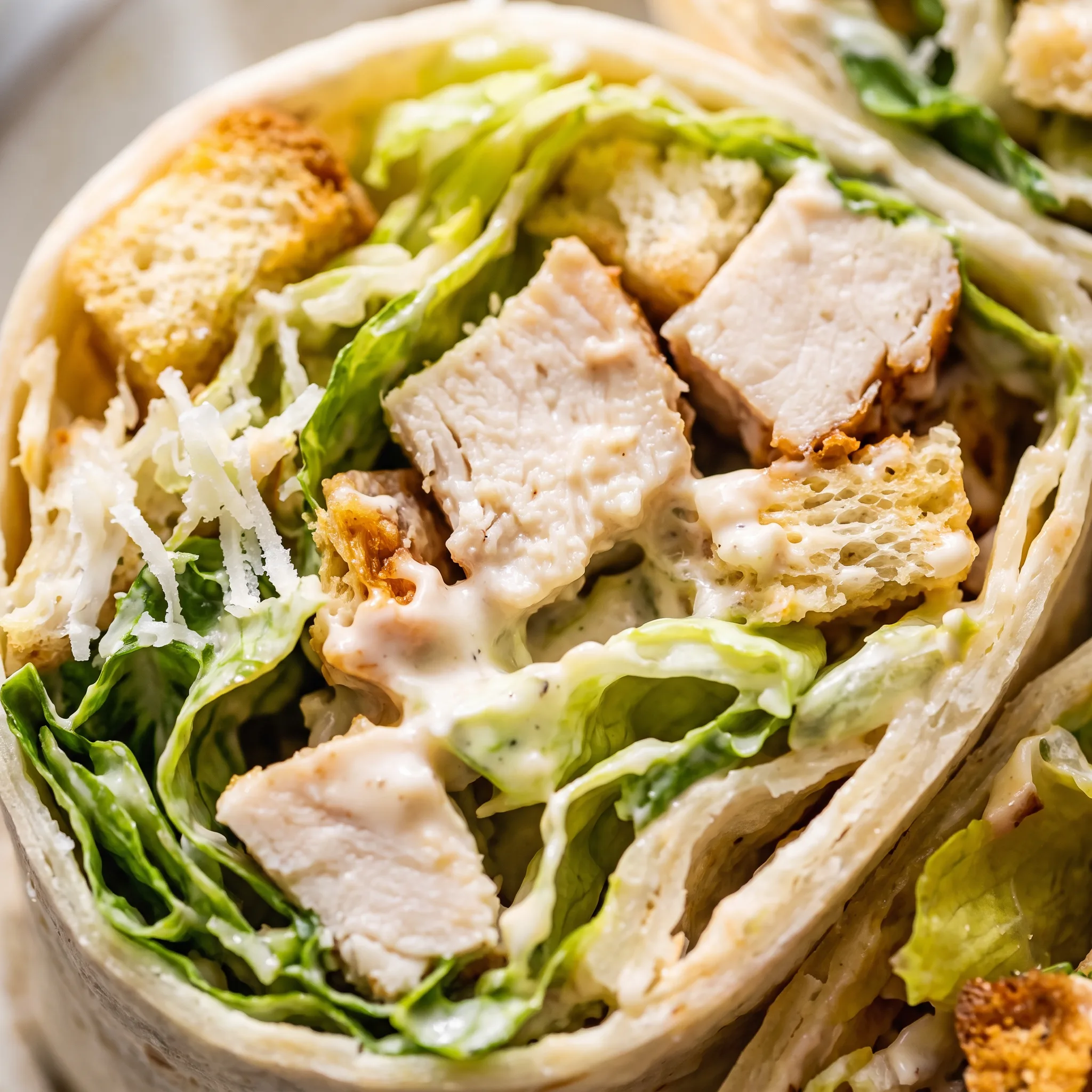
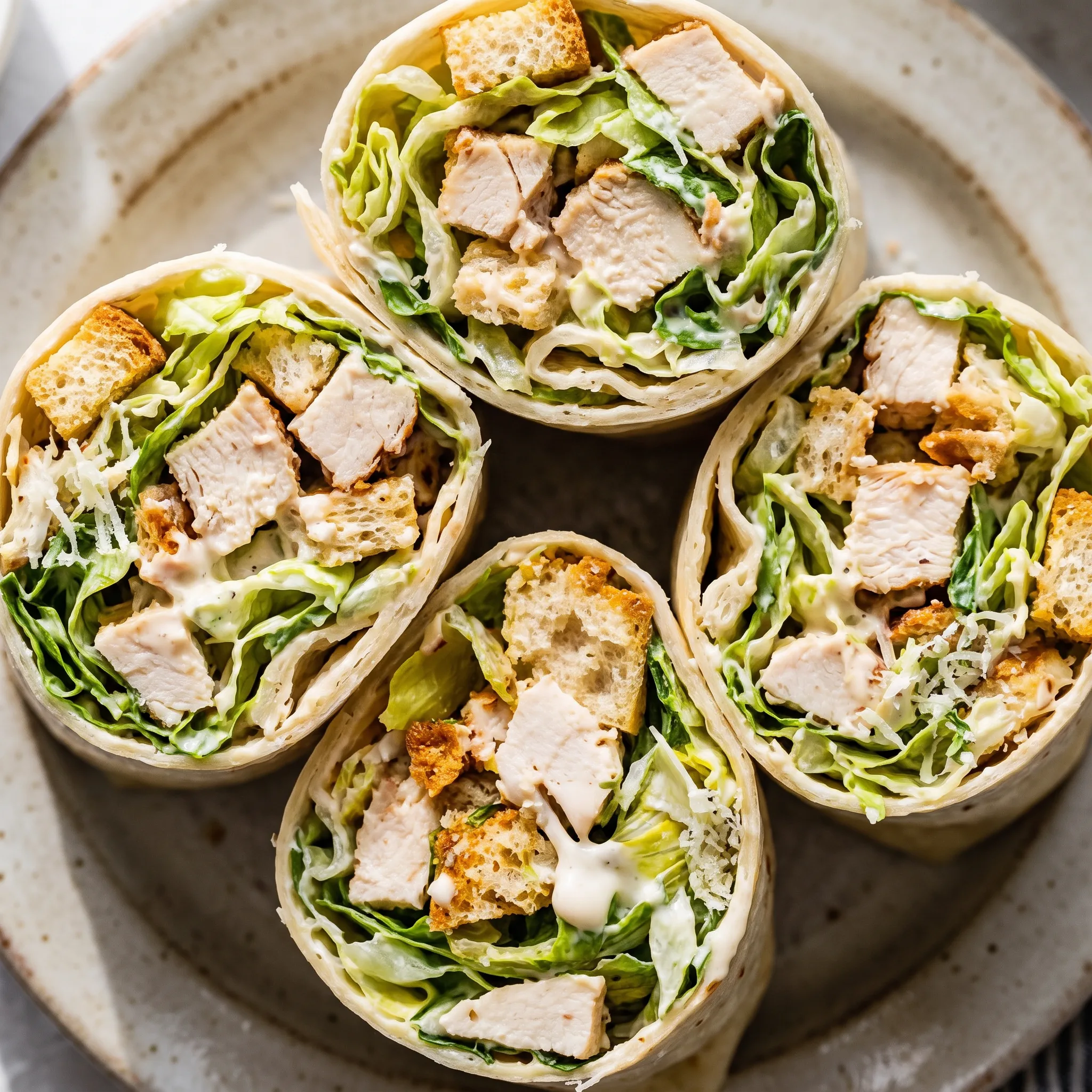
When you cut the wrap in half on a diagonal, you should see a neat cross-section with chicken, lettuce, and Parmesan evenly distributed. That’s the sign that your assembly held.
The wrap eats cleanly, with no need for a fork.
What to Look For Before You Toss
Romaine lettuce: Heads with crisp, deep-green outer leaves and no rust spots hold up to dressing; pale, limp cores turn slick the moment they’re tossed.
Cooked chicken: Rotisserie or grilled pieces should pull apart with a little resistance, not crumble, so they stay juicy against the dressing.
Caesar dressing: A refrigerated dressing with visible anchovy and Parmesan tastes sharper than shelf-stable versions, which lean sweet and thin.
Parmesan cheese: Grate it fresh from a wedge; pre-shredded cheese is dusted with cellulose that keeps it from melting into the dressing.
Croutons: Homemade croutons should be dry and rigid, not soft or oily, so they stay crisp after a quick toss with the salad.
Flour tortillas: Ten-inch wraps need to be fresh and pliable; older ones crack at the fold no matter how long you warm them.
The most common mistake is dressing the Caesar salad and letting it sit before wrapping, because the mixture looks and tastes best when freshly tossed. Salt and the watery components of the dressing pull moisture out of the cut romaine cells, and croutons act as sponges that soak it up, so the filling turns wet and the tortillas lose their structural integrity. The fix is to keep the dressed salad as a just-in-time filling: toss it immediately before distributing it among the warmed tortillas and serving, rather than letting it rest.
Reading the Salad Before It Hits the Tortilla
Judging whether the dressing is clinging or pooling
After tossing, the leaves should look barely filmed, with no dressing sitting at the bottom of the bowl. If you see a puddle, the lettuce will keep releasing water and the tortillas will soak through before you finish rolling.
Add more romaine or croutons to soak up the excess. The croutons should still feel firm when you press one; if they’ve gone soft, you’ve overmixed or overdressed. Stop tossing the moment everything glistens.
Knowing when the chicken is too dry to carry the dressing
Press a piece of chicken to the touch. If it feels springy and releases a little moisture, it’ll stay juicy in the wrap.
If it’s chalky and crumbles, it will drink up the dressing and leave the whole wrap tasting dry. You can rescue dry chicken by tossing it with a spoonful of extra dressing before it goes into the bowl, letting it sit for a minute to absorb. Taste a piece after that.
If it still tastes parched, chop it smaller so more surface area meets the dressing.
Telling when the tortilla is pliable, not stiff or brittle
A cold tortilla cracks at the fold; a properly warmed one drapes over your hand without snapping. In the pan, 15 to 30 seconds per side over medium heat is enough to make it supple, but the moment you see it puff slightly or smell toasted flour, pull it. Overheated, it turns leathery and tears when you roll.
If it stiffens while you work, stack the tortillas under a towel and reheat one at a time as needed.
The point where the filling should be light, not packed
When you spoon the salad onto the tortilla, it should sit in a loose mound that holds its shape, not a tight, compressed pile. If you press it down, the lettuce bruises and releases water, making the wrap soggy. You want enough filling to fill the center without spilling over the edges.
If the mixture looks wet, drain off any liquid before filling. A properly filled tortilla should feel full but not strained when you fold it.
Chicken Caesar Wraps with Romaine and Parmesan
Ingredients
Method
- In a large bowl, toss together the lettuce, chopped chicken, Caesar dressing, Parmesan cheese, and croutons using tongs until well combined. Add salt and pepper to taste. Sample and mix in additional dressing if you like. Set aside.
- Warm the tortillas in a large pan over medium heat for about 15 to 30 seconds on each side, just until they become pliable. Transfer to a plate and cover with a kitchen towel to keep them warm. As an alternative, microwave them between paper towels for 15 to 30 seconds.
- Lay the tortillas on a clean work surface. Evenly distribute the Caesar salad mixture among the flour tortillas, placing it in the center of each. Fold in opposite sides of each tortilla, then roll up, burrito-style. You can insert a toothpick in the center to help keep them closed. Cut in half or serve the wraps whole.
Storing and Serving Chicken Caesar Wraps
These wraps are at their best within 15 minutes of assembly. The romaine and croutons start losing their snap the moment the dressing goes on, and the tortilla begins soaking through almost immediately. If you can’t eat right away, keep the filling and tortillas separate, then assemble just before serving.
Leftovers hold in the fridge for up to 1 day, but the texture shifts: lettuce wilts, croutons soften, and the tortilla gets damp. To store, wrap each leftover tightly in plastic or foil and refrigerate. For a better next-day option, store the filling and tortillas separately, then drain any liquid from the filling before reassembling.
Don’t freeze assembled wraps; the lettuce and croutons won’t survive thawing. You can freeze the chicken filling without dressing for up to 2 months, then thaw, add fresh lettuce, dressing, and croutons.
To serve a chilled leftover, let it sit at room temperature for 10 minutes, or warm the tortilla briefly in a dry pan to refresh its texture. Add croutons only at the last second if you’re packing for later.
Swap with Care: What Holds and What Breaks in a Chicken Caesar Wrap
Cooked chicken: Shredded rotisserie chicken, leftover grilled breast, or chopped fried chicken. Shredded rotisserie will fold into the wrap more easily and stays juicy, but it can clump; break it up before tossing. Grilled breast is leaner and may need an extra spoonful of dressing to keep the wrap from eating dry.
Fried chicken adds crunch but also salt and oil, so taste before adding more Parmesan or salt. Start with the same 1 1/2 cups the recipe uses, then adjust after you toss.
Caesar dressing: For dairy-free: a dairy-free Caesar or a vinaigrette thickened with a little mustard. For a lighter option: half Greek yogurt, half Caesar dressing. Dairy-free Caesar often tastes sharper and thinner, so it may pool at the bottom of the bowl; use the same 1/3 cup, toss gently, and if you see liquid pooling, add a few more croutons or a handful of extra romaine.
The yogurt blend cuts richness but can make the salad taste tangy; start with the same 1/3 cup, taste a leaf, and add more if it’s too tart.
Croutons: For gluten-free: gluten-free croutons or toasted nuts like almonds or pecans. For a lower-carb crunch: chopped celery or cucumber. Gluten-free croutons vary in density; some stay crisp, others soften fast.
Add them just before serving. Nuts bring a different crunch and a nutty flavor that competes with the anchovy in the dressing, so use the same 1/2 cup and taste. Celery or cucumber adds water, which can make the wrap soggy; if you use them, pat dry and add just before rolling.
Flour tortillas: For gluten-free: gluten-free flour tortillas or large lettuce leaves. For lower-carb: whole-wheat or spinach wraps. Gluten-free tortillas often crack when cold, so warm them longer and handle gently; they may not stretch as much, so fill them less.
Lettuce leaves won’t hold a burrito fold; you’ll need to eat them as a lettuce cup or use two leaves per wrap, and the filling will be wetter. Whole-wheat or spinach wraps taste heartier and can overpower the Caesar, so stick with plain if you want the classic flavor.
Tips
- Divide the Caesar salad mixture by weight, not by eye. A digital scale makes this exact: the total filling weight divided by four gives you the precise amount per wrap. Spoon each portion onto a tortilla, then use the scale to confirm they match. This prevents one wrap from getting more than its share, which would make it bulge and split at the seam.
- Use a half-cup measuring cup to portion the filling. Scoop a level half-cup onto each tortilla, then redistribute any leftover filling one tablespoon at a time until it’s gone. This keeps the wraps close in size and stops you from overfilling the last one when the bowl is nearly empty.

Frequently Asked Questions
Can I make these chicken caesar wraps ahead of time?
Assemble them no more than 15 minutes before you plan to eat. Past that window the romaine and croutons lose their snap and the tortilla starts soaking through.
If you need them ready earlier, keep the filling and the tortillas in separate containers, then roll just before serving so the dressing doesn’t sit against the lettuce. A packed wrap will hold in the fridge for a day, but expect wilted greens and softened croutons when you unwrap it.
Why did my caesar wraps get soggy?
The dressing is the usual culprit. Once the leaves are tossed, any excess that pools at the bottom of the bowl keeps drawing water out of the romaine, and that liquid runs straight into the tortilla. Toss just until the leaves glisten, and if you see a puddle forming, add a handful more romaine or croutons to take it up.
A second check is the chicken: dry pieces drink the dressing and leave the filling wetter than it looks. If the salad sits in a loose mound rather than a tight, compressed pile, you’ve done it right.
How do I keep the tortillas from cracking when rolling?
A ten-inch flour tortilla needs to be supple before it meets the filling. Cold ones snap at the crease, so warm each one until it drapes over your hand without fighting back, and stack them under a clean kitchen towel so they stay that way while you work. If one stiffens before you get to it, reheat that single tortilla rather than forcing the fold.
Older wraps crack no matter how long you warm them, so check the date on the package if the problem keeps happening.
What’s the difference between a chicken caesar wrap and a chicken caesar salad?
The filling is the same salad, just carried in a flour tortilla instead of a bowl. That means the croutons and Parmesan ride along in every bite rather than getting pushed to the side, and the tortilla adds a soft, warm chew against the cold, crisp romaine.
The trade-off is structural: a salad can sit dressed for a while, while a wrap starts soaking through the moment it’s rolled. Four wraps use three cups of romaine and a third of a cup of dressing, which is a lighter coat than most restaurant salads get.
