
Cheesy scalloped potatoes fail at the sauce stage long before anyone blames the oven, and that’s the margin that decides whether this bakes into something creamy or watery underneath. A flour-thickened base has to go into the dish already thick, already glossy, because nothing later will fix a loose one.
The real difficulty is timing that sauce against a long bake without scorching the top or drying the potatoes under it. What surprises cooks is how forgiving the dish is once the base is right.
The recipe here feeds eight and comes out of a long covered bake with distinct layers, soft slices, and a sauce that clings instead of pooling. Broiling is where attention matters most, since the difference between golden and ruined is a matter of watching closely.
What Makes Scalloped Potatoes Different from Au Gratin?
A flour-thickened milk sauce is what sets scalloped potatoes apart. Au gratin leans on cream and cheese alone, no flour, and the result is richer but looser. Here, butter and flour cook together for a minute before the milk goes in.
That brief cookout takes the raw pasty edge off the flour and gives you a smooth base. You thicken the sauce first, then add the cheese. If the cheese went into thin milk, it would clump and pull into strings as it heated.
Instead it melts into a sauce that’s already stable, so the cheddar blends in smoothly. That thickened sauce is what coats every potato slice.
Without it, you’d get a watery casserole with cheese sitting on top. With it, the potatoes bake in a silky sauce that clings.
The sauce should look like heavy cream before the cheese goes in, then turn glossy and smooth once it does.
Why Does Slice Thickness Matter So Much?
Cut potatoes to a quarter inch, and they’ll all hit tenderness at the same time. Go thinner and they collapse during the long bake, leaving you with a pasty fill.
Go thicker and the centers stay firm while the sauce around them overcooks and breaks. A quarter inch gives each slice enough body to hold its shape but still absorb the cheese sauce. Russets are the right potato here because their high starch helps thicken the sauce as they bake, adding body without flour.
You want slices that bend slightly when done, not ones that snap or dissolve. When you pull the dish from the oven, a knife should slide through with just a little resistance.
That’s the texture to aim for. If the slices are uneven, some will be done while others are still hard, and no amount of extra baking fixes that without turning the finished ones to paste. So take the time to cut them uniformly.
How Does Layering Potatoes and Onions Affect the Bake?
Alternating potato slices and onion rings does more than look neat. Onions release a lot of water as they cook, and if they’re clumped in one spot, that moisture pools and thins the cheese sauce right there. Spread them out and the water they give off becomes part of the sauce, not a puddle at the bottom.
Even distribution also means every serving gets its share of onion, so you don’t end up with one bland corner and one onion-heavy one. Stirring everything together in a bowl seems easier, but it leads to uneven cooking.
Some slices end up stacked while others have no sauce at all. Staggering them keeps the layers loose enough for the sauce to flow down and fill the gaps.
When you cut into the finished dish, you should see distinct layers, each slice coated, with no watery separation. That’s what even layering gives you.
The Broiler Trade-Off: Crisp Top vs. Dry Potatoes
Broiling after baking gives you a browned, crisp top that contrasts with the creamy potatoes underneath. But that high heat is a trade-off.
Leave it too long and the cheese toughens and the surface dries out, pulling away from the sauce. The broiler doesn’t cook the potatoes any further; it only browns what’s already there.
So keep an eye on it. You want the top to turn golden and bubbly, not dark brown or black.
A minute or two is often enough. If you’re unsure, pull it early.
You can always put it back, but you can’t undo burnt cheese. The reward is a crisp lid that gives way to soft, saucy potatoes.
Without it, you still have a good dish, just without that textural contrast. With it, you get a finish that makes the whole thing feel more complete. Just don’t walk away.
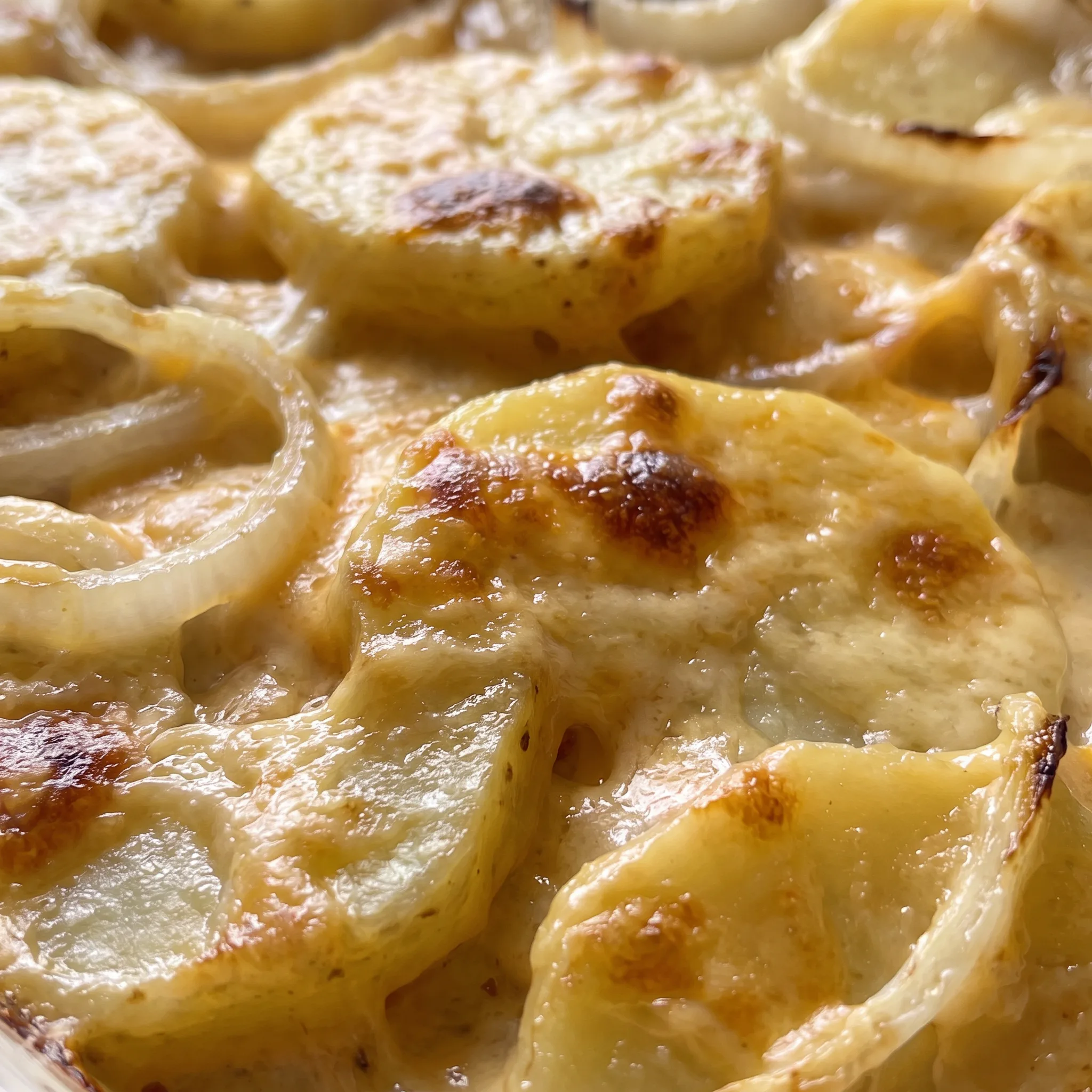
The Ingredients That Decide How This Dish Sets Up
Russet potatoes: High-starch russets break down enough to thicken the sauce from within, so waxy reds or yellows leave you with a thinner, looser bake.
Whole milk: Room temperature keeps the sauce from seizing when it hits the hot roux, and anything less than whole leaves the finished dish tasting lean.
Mild cheddar cheese: Shred it yourself off a block; bagged shreds carry a starch coating that keeps them from melting into a smooth sauce.
Yellow onion: Sliced into rings, not diced, so they cook at the same rate as the potato slices and release their water evenly through the layers.
Unsalted butter: Unsalted lets you taste the sauce as it thickens and adjust the salt at the end, since the cheddar brings its own.
How to Tell When Scalloped Potatoes Are Done Right at Each Stage
Judging the sauce before the cheese goes in
After the milk goes into the roux, the sauce needs to thicken to the point where it coats the back of a spoon and a line drawn through it holds. If it’s still thin and watery, the flour hasn’t cooked out; keep stirring over medium heat. Once it’s thick, pull it off the heat before adding cheese.
If it’s too thick, the cheese will seize and turn stringy. The sauce should be smooth and glossy, not grainy.
Knowing when the cheese is fully melted and smooth
Add the cheese all at once and stir constantly. It should melt in 30 to 60 seconds. If it clumps or looks oily, the heat is too high or the sauce was too hot.
Take it off the heat immediately and whisk vigorously. If it stays grainy, the cheese may have been too cold or low-fat.
The finished sauce should be uniform, with no visible shreds.
Checking potato tenderness after the covered bake
After 85 to 90 minutes, a knife should slide through the potatoes with slight resistance, like a baked potato that’s just done. If it meets a firm center, bake 5 more minutes and check again. But if the slices are falling apart, they’re overdone.
The sauce around them should be bubbling and thickened, not watery. If there’s a pool of liquid, the potatoes released too much water; uncover and bake 5 to 10 minutes to reduce it.
The broiler moment: when to pull it
Under the broiler, the top will go from golden to burnt in under a minute. Stay at the oven. You want bubbly, golden-brown spots, not dark brown or black.
If you smell toasted cheese turning acrid, pull it. The broiler doesn’t cook the potatoes further, so if they’re tender, you’re just adding color. If you’re unsure, pull early; you can always broil again, but you can’t undo burnt cheese.
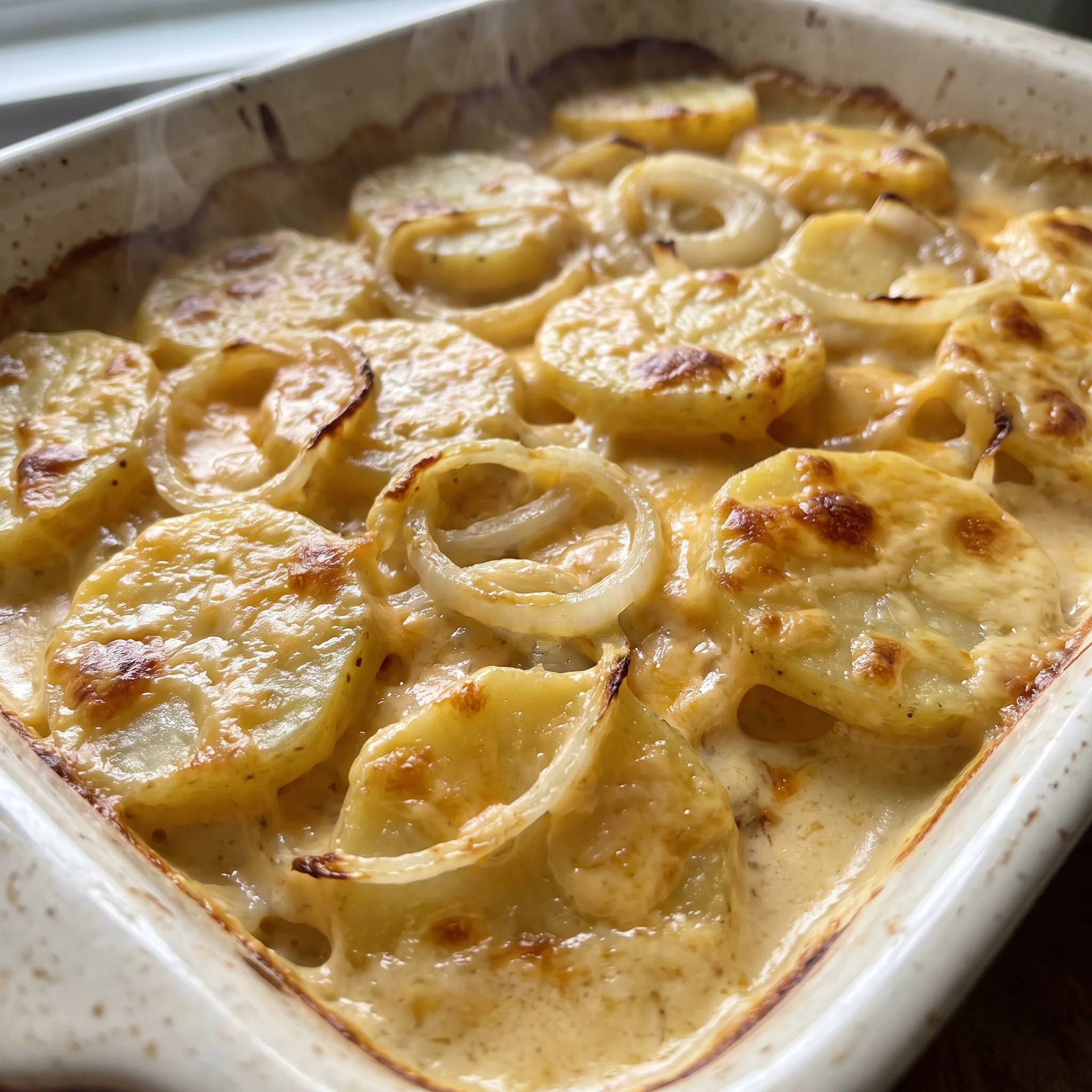
Cheesy Scalloped Potatoes with Cheddar and Onion
Ingredients
Method
- Preheat oven to 400°F (205°C). Lightly spray an 8×8-inch casserole dish with nonstick cooking spray.
- Arrange the potatoes and onions in the prepared baking dish, staggering potato and then onion.
- In a medium-size saucepan, melt butter over medium heat. Mix in the flour and salt, and stir constantly with a whisk for one minute. Stir in milk. Cook until mixture has thickened.
- Stir in cheese all at once, and continue stirring until melted and smooth, about 30-60 seconds.
- Pour the cheese sauce over the potatoes, and cover the dish with aluminum foil.
- Bake for 85-90 minutes, or until the potatoes are tender.
- For a crisp topping, change the oven setting to broil after the potatoes are baked. Broil until golden brown.
- Season with salt and pepper to taste and serve.
What Swaps Hold This Bake Together and Which Ones Let It Slip
Whole milk: Half-and-half, or a 50/50 mix of whole milk and heavy cream, measured cup for cup against the 2 cups the recipe calls for. Either one gives you a richer sauce that sets a little firmer, which reads as more rich but also heavier against the potatoes.
Skim or 1% is where it goes wrong: the sauce starts thin and stays thin, and without enough fat the cheese can turn grainy instead of glossy. The bake still sets, but it’s watery at the bottom and lean-tasting.
If all you have is low-fat milk, keep the whole 2 cups and accept a looser result rather than cutting the liquid down.
Mild cheddar: Gruyère for a nutty, sharper sauce, or Colby Jack for something softer and milder. Use the same 1 1/2 cups shredded off a block either way. Gruyère melts just as smoothly and pushes the flavor toward savory and slightly funky, which some people love and others find too strong against the onions.
Colby Jack melts easily but brings less salt and less tang, so taste the sauce before it goes over the potatoes and season up. Skip anything pre-shredded in a bag no matter the variety: the coating that keeps the shreds from clumping also keeps them from blending, and you end up with a sauce dotted with rubbery threads.
Russet potatoes: Yukon Golds, sliced to the same quarter inch. You lose the starch that thickens the sauce from inside the dish, so expect a looser filling and slices that hold their shape more firmly rather than bending. The flavor is buttery and pleasant, but the texture is different: less creamy, more distinct.
If you make this switch, the sauce needs to go in already thick, because nothing in the potatoes will help it along. Waxy reds are the one to avoid. They stay firm and slick, and the sauce never quite clings.
Unsalted butter: A dairy-free spread or vegan butter stick, used in the same 3 tablespoons. This only works if the spread actually melts and binds with the flour. Some tub spreads carry too much water and the roux turns slack, never thickening, and the finished sauce separates in the oven.
Pick a stick-style product meant for baking, melt it the same way, and watch the flour mixture: if it looks slick and loose instead of pasty after a minute, add another tablespoon of flour and cook it a bit longer before the milk goes in. Taste the sauce before the cheese; dairy-free spreads vary a lot in salt.
Storage and Serving: Reheating Scalloped Potatoes Without Breaking the Sauce
Eat this within 30 minutes of the broiler for the best contrast: crisp top, creamy sauce, potatoes still holding their edge. Cool leftovers to room temperature within two hours, then cover the dish or transfer portions to an airtight container. Refrigerate up to 4 days.
The sauce sets firm and the broiled top softens by day two, which is normal, not a flaw. Reheat covered at 350°F with a splash of milk stirred into each portion; the milk loosens the set sauce without thinning it, and the covered foil traps steam so the potatoes warm through instead of drying at the edges.
A single serving takes about 15 minutes, a full 8×8 dish closer to 30. Skip the microwave if you can, since it heats unevenly and can split the sauce.
Freezing doesn’t work here: the milk and flour sauce separates on thaw and the potatoes turn grainy. If you must, freeze a portion and reheat it gently, but expect a looser, less creamy result.
Tips
- Pull the milk out when you start slicing potatoes and onions, not when you reach the saucepan. Slicing 2 lb of potatoes and arranging them takes 15 minutes, which is enough time for 2 cups of cold milk to lose its chill, and cold milk hitting the hot roux is what makes flour seize into lumps you can’t whisk out.
- If you forgot to set the milk out, pour it into a glass measuring cup and microwave in 15-second bursts, stirring between each, until the cup feels barely warm to the touch. Scalding milk will cook the flour unevenly and can break the sauce, so stop before it steams.
The most common mistake is pouring a thin, unthickened milk-and-cheese mixture over the potatoes, which is tempting because it looks creamy and saves a step. During the long bake, the potatoes release their own moisture and the cheese proteins tighten and squeeze out fat, so the sauce separates into a watery pool instead of clinging to the slices. A properly cooked roux hydrates the flour and forms a stable starch network that traps the milk and cheese into a coating that survives the oven.
Frequently Asked Questions
Can I make cheesy scalloped potatoes ahead of time?
Assemble the whole dish up to the point of baking, cover it, and refrigerate it overnight. The potatoes will sit in the sauce and might darken a bit, but that’s normal.
The next day, bake it covered straight from the fridge, adding a few extra minutes to the bake time to get it hot through. For the best texture, broil just before serving so the top stays crisp.
Why did my scalloped potatoes turn out watery?
The most likely cause is that the sauce was too thin before it went over the potatoes. It should coat a spoon and hold a line drawn through it; if it’s still watery, the flour hasn’t cooked out and it won’t thicken in the oven. A second check: if you used waxy potatoes or low-fat milk, they release more water and set up looser.
If the finished dish has a pool of liquid, uncover and bake a few more minutes to reduce it.
What’s the difference between scalloped potatoes and au gratin potatoes?
Scalloped potatoes are built on a flour-thickened milk sauce, while au gratin skips the flour and relies on cream and cheese alone. That flour is why the sauce here clings to every slice instead of pooling at the bottom. Au gratin ends up richer but looser; scalloped sets up creamier and more cohesive.
The trade-off is texture: one is saucy and spoonable, the other is sliceable and rich.
