
Milk going into a pot of boiling stock is where this soup usually goes wrong, and it happens fast. The fix takes one extra pot and a roux, and it’s the difference between silky broth and something that looks like it split. Timing matters more here than in most soups, because the dairy waits for nothing.
Get the base thick in its own pot, then marry the two off the boil. Sausage potato soup rewards that bit of extra attention with a bowl that eats like a loaded baked potato, though the sour cream on top is doing more work than you’d think: cold, tart, and meant to stay where you put it.
Skip it and the bowl turns one-note rich. Bread on the side, no ceremony.
Why does the dairy base get its own pot?
You’ve got hot, salty chicken stock on one side, and milk that’s about to meet it. Heat the milk directly in that stock and you’re asking for trouble: the proteins in milk tighten up when they hit acid and high heat, and the soup turns grainy.
Building the milk mixture in a separate pot sidesteps all that. The flour you whisk into the butter coats the milk proteins before they ever see the stock, so they stay suspended and smooth.
The heavy cream goes into that same pot, not the main one, because its fat adds body and helps keep the mixture stable. Once the base is thick and creamy, you can stir it into the soup without worrying about it breaking.
The result is a pot of soup that looks and tastes like one thing, not a curdled mess. A cook can see it: the base coats a spoon evenly, and when it hits the stock, it disappears into silky broth.
What do unpeeled gold potatoes do for the broth?
Leave the skins on those baby golds. They’re thin, so you won’t notice them, but they hold starch that ends up in the broth. As the potatoes simmer, their edges soften and some of that starch sloughs off, giving the soup a natural body.
That’s why the recipe calls for only 6 tablespoons of flour. A cream soup without potatoes might need a half cup or more to get the same thickness. Here, the potatoes do half the work, and the flour just tightens things up.
Chopping them instead of leaving them whole means more surface area, so more starch releases and the pieces cook through evenly. The soup ends up hearty but not gluey, with a texture that feels like it came from the vegetables themselves. When you stir the pot, the broth should feel slightly silky, and the potato pieces should hold their shape but give way under a spoon.
Why extra-sharp Cheddar, and why add it last?
Extra-sharp Cheddar brings a tang and a salty bite that mild or medium can’t match. That sharpness is what keeps this soup from tasting flat. You’ve got heavy cream, sausage fat, and butter all adding richness, and without something acidic and salty to cut through it, the whole bowl would taste heavy.
The cheese goes in after the milk mixture is merged, once the pot is off the boil. Boiling can make cheese seize up and turn stringy, so you stir it in at a lower heat, just until it melts into the broth. The result is a smooth, cheesy base that still tastes like soup, not a pot of melted cheese.
The sharpness lingers in the background, balancing the cream and the sausage. When you taste it, the first thing you notice is the savory broth, then the cheese comes through with a little tang.
What happens to the sausage after browning?
Brown the sausage first, then get it out of the pot. Moving it to a paper-towel-lined plate does two things: it stops the cooking so the meat stays tender, and it drains off excess fat. But you’re not wiping out the pot.
Those browned bits and the thin film of fat left behind are exactly what you want for the mirepoix. As the carrots, celery, and onion cook, they pick up that pork flavor and the fat helps them soften without sticking.
The potatoes go in later and soak up the same seasoned broth. If you left the sausage in the whole time, it would keep rendering fat and turn rubbery, and the soup would end up greasy. Adding it back at the end, after the dairy and cheese, keeps the pieces distinct.
You get a spoonful with a chunk of sausage that still tastes like sausage, not a homogeneous meat sauce. The texture stays varied: soft vegetables, creamy broth, and bits of meat that hold their shape.
Sour cream on top, not stirred in
That dollop of sour cream is meant to sit on the surface, not disappear into the pot. Stir it in and you dull its cold tang and thin its body, and the soup just tastes a little richer overall. Leave it as a topping and every spoonful you take from the edge gets a cool, tart contrast against the hot, creamy broth.
It’s a small thing, but it changes the whole bowl: the first bite is bright and sharp, then the next is pure comfort. The soup is rich enough on its own, so the sour cream acts as a reset for your palate.
Serve the soup hot, with buttered bread alongside. The bread isn’t just filler; it’s there to mop up the last of the broth and to give you something to chew between spoonfuls. A bowl of this and a slice of buttered bread is a meal that feels complete, even without anything else on the table.

The Ingredients That Decide How This Soup Turns Out
Italian sausage: Mild or hot both work, but the hot version’s spice cuts the cream and cheese in a way sweet sausage can’t.
Baby gold potatoes: Chop them unpeeled into bite-size pieces, since those thin skins carry the starch that thickens the broth.
Extra-sharp Cheddar: Buy the sharpest you can find and shred it yourself, because pre-shredded cheese is dusted with starch that keeps it from melting smoothly.
Mirepoix: Dice the carrots, celery, and onion to the same small size so they soften at the same rate in the pot.
Milk and heavy cream: Use whatever milk you keep, but don’t skip the cream, since its fat is what keeps the dairy base from turning grainy.
When the milk mixture is added directly to the hot, acidic chicken stock, the milk proteins can curdle and the soup turns grainy. The two-pot method prevents this by first cooking the flour into the butter to form a roux, which coats the milk proteins and protects them from the acidic environment. If the milk mixture is added too quickly or the soup is boiled after combining, the proteins will still curdle, so watch for a slight grainy texture or separation at the edges, once that happens, it cannot be reversed.
How to Judge Sausage Potato Soup While You Cook
Reading the sausage for doneness and fat left behind
Push the sausage around until the pieces are browned on all sides and no pink shows, about 5 to 7 minutes. If the meat releases a lot of fat, that’s fine; you want a thin film left in the pot for the mirepoix. Too much fat and the vegetables will fry instead of sweat.
If there’s a puddle, spoon off all but a slick. browning means the bits are crisp at the edges but still tender inside.
When the mirepoix is ready for the garlic
The carrots, celery, and onion should look glossy and slightly softened after 5 to 7 minutes. You’re not trying to brown them. If they start to stick, add a splash of water or lower the heat.
Garlic goes in only when the vegetables are ready, because it burns in 30 seconds. If you smell acrid garlic, you’ve gone too far; start over with fresh garlic in a clean spot.
Knowing when the potatoes are tender enough
After the broth comes to a boil, cover and simmer. Check at 15 minutes by piercing a potato piece with a knife.
It should slide in with no resistance but the piece shouldn’t collapse. If it falls apart, you’ve overcooked them and the soup will be thick with potato shreds.
If still firm, give it 5 more minutes and check again. The goal is creamy broth with distinct chunks.
Thickening the milk mixture without lumps
Melt the butter, whisk in the flour, and cook for a minute until it smells toasty. Pour in the milk in a slow stream, whisking constantly.
The mixture will thicken as it heats; you’ll know it’s ready when it coats the back of a spoon and a line drawn through it holds. If lumps form, whisk hard or strain.
Don’t let it boil hard or it may scorch. Stir in the cream off the heat.
Adding the cheese and sausage back without breaking the soup
Once the milk mixture is in the soup, keep the heat low. Add the Cheddar in handfuls, stirring until each melts before adding more.
If the soup looks oily or grainy, it’s too hot; pull it off the burner and whisk. Fold in the sour cream and sausage last, just to warm through.
The soup should be smooth and silky, with the sausage pieces intact.
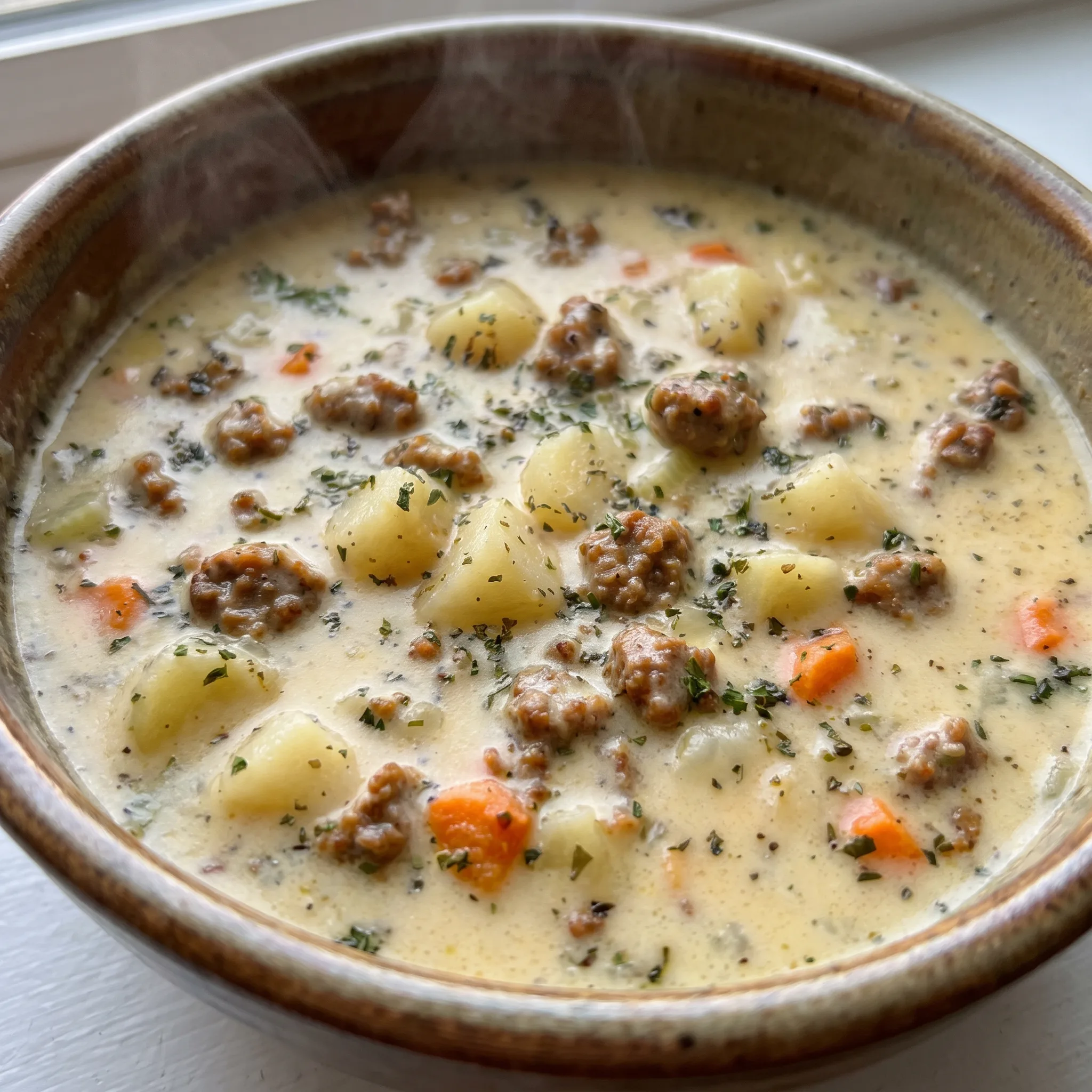
Creamy Sausage Potato Soup with Cheddar
Ingredients
Method
- Brown the sausage in a large pot, breaking it apart as it cooks, until it reaches a browned color; move it to a plate lined with paper towels.
- In the same pot, melt 1 tablespoon of the butter, cook the mirepoix for 5–7 minutes, then incorporate the garlic and cook for 30 seconds more.
- Introduce the potatoes, parsley, basil, salt, and pepper; add the chicken stock, bring to a boil, then cover and simmer until the potatoes become tender.
- In another pot, melt the remaining 4 tablespoons butter, whisk in the flour, then slowly pour in the milk, whisking until it thickens; blend in the heavy cream.
- Merge the milk mixture into the soup, add the Cheddar and stir until it melts, fold in the sour cream, and put the sausage back into the pot.
- Serve hot accompanied by hearty buttered bread, if desired.
How to Store and Reheat Sausage Potato Soup
Eat this soup the day you make it. The texture peaks within the first few hours, while the potato pieces still hold their shape and the dairy base is silky.
Cool leftovers fast, then refrigerate in a sealed container. The flour-and-butter roux and the Cheddar mean it will thicken considerably in the fridge, sometimes to the point of spoonable solid, and the fat can separate and rise. That’s normal.
Reheat gently on the stovetop, not in a hard boil, and stir in a splash of milk or stock until it loosens back to a pourable broth. A low, patient reheat keeps the dairy from breaking.
Use leftovers within three days. Freezing doesn’t work here: the milk and cream separate on thaw and the potatoes go grainy. The sour cream goes on cold, straight from the fridge, only at the moment you serve.
Same with the bread, sliced and buttered to order.
Swaps That Work Here, and the Ones That Won’t
Italian sausage: Use hot Italian sausage for mild, or mild for hot. If you have neither, 1 pound ground pork plus 1 teaspoon fennel seed, crushed, and a pinch of red pepper flakes approximates the flavor.
Hot sausage brings a chili heat that cuts the cream and cheese, keeping the soup from tasting heavy. Mild lets the dairy and Cheddar lead.
Ground pork with fennel gets you the anise note, but the texture is finer and less craggy than link sausage you break up yourself; the pieces won’t hold their shape as well after simmering.
Milk and heavy cream: Keep the 3 cups milk and 1/2 cup heavy cream as written. For a lighter soup, replace the cream with whole milk, but don’t go below 2% for the milk. If you’re out of cream, melt 4 tablespoons butter into 1/2 cup whole milk as a stand-in.
The cream’s fat is what keeps the dairy base from turning grainy when it hits the hot stock. Swap it for milk alone and the soup still thickens from the flour and potatoes, but it tastes leaner and the texture is thinner, closer to a chowder than a cream soup.
The butter-and-milk substitute adds fat back, but it won’t have the same body; expect a slightly less silky bowl.
Extra-sharp Cheddar cheese: Use sharp or extra-sharp white Cheddar, or a sharp melting cheese like Gruyère. Avoid pre-shredded bags if you can; if you must, use them as is. The sharpness is what balances the sausage fat and butter.
A milder cheese like Monterey Jack will melt smoothly but the soup will taste flat and rich without that tang. Pre-shredded cheese is dusted with starch that keeps it from melting into a smooth base; you may see tiny flecks or a slightly grainy texture, though the flavor is unaffected.
All-purpose flour: For gluten-free, use 4 tablespoons cornstarch or 6 tablespoons gluten-free all-purpose flour blend. Add cornstarch as a slurry with a little cold milk, then whisk into the hot butter.
Cornstarch thickens at a lower temperature and can break down if boiled hard, so keep the heat moderate after adding. The soup will be glossy rather than creamy.
Gluten-free flour blends vary; some taste bean-y, so start with the same 6 tablespoons and adjust after the soup simmers.
Tips
- Salt at the end, not before. The pound of sausage and 2 cups of sharp Cheddar carry enough sodium that a teaspoon added early can push the pot past where you want it. Wait until the cheese has melted and the sausage is back in, then taste a spoonful with a piece of each in it. If it needs more, add it in 1/4 teaspoon increments, because the soup will keep tasting saltier as it sits.

Frequently Asked Questions
Can I make this sausage potato soup ahead of time?
Cook it and eat it the same day. The texture peaks in the first few hours, while the potato chunks still hold their shape and the dairy base is silky.
If you do want a head start, brown the sausage and cook the mirepoix, then stop and refrigerate those; the potatoes and the milk base are the parts that don’t sit well. The sausage pieces will taste tired after a night in the fridge, and the flour and Cheddar will pull the broth tight enough that you’ll be thinning it back with stock anyway.
Why did my soup turn out grainy or curdled?
Nine times out of ten it’s heat on the dairy. The milk mixture went in while the pot was still at a rolling boil, or the cheese went in over direct high heat and seized. Pull the pot off the burner, let it settle a minute, then whisk in a splash of warm milk or stock to bring it back toward smooth.
The other check is the cheese itself: pre-shredded bags are dusted with starch, and those little flecks show up as a sandy texture even when the temperature was fine. Shred a block of extra-sharp Cheddar yourself next time and you’ll see the difference in how it melts into the broth.
How is this different from a classic potato soup?
Classic potato soup leans on bacon, and the fat in the pot is where the whole thing starts. Here the sausage does that job, and it brings fennel and chili heat along with it, so the base tastes seasoned from the meat rather than from a smoke note.
You also get the mirepoix sweetening the broth underneath the pork, which a plain potato soup usually skips. The dairy is the same idea, milk and cream thickened with a roux, but the sharp Cheddar goes in at the end, so the bowl reads more like a sausage-and-cheese chowder than a mild potato puree.
Do I have to use Italian sausage, or can I use another kind?
Italian sausage is the right call because of the fennel and the fat, and either mild or hot works. Ground pork with crushed fennel seed and a pinch of red pepper flakes gets you close if that’s what’s in the case, though the texture comes out finer and the pieces won’t hold their shape as well after simmering.
Breakfast sausage is a different flavor entirely, sage and maple where you want anise, and it fights the Cheddar. Hot Italian is worth trying once: the chili heat cuts the cream and cheese and keeps the bowl from tasting heavy.
