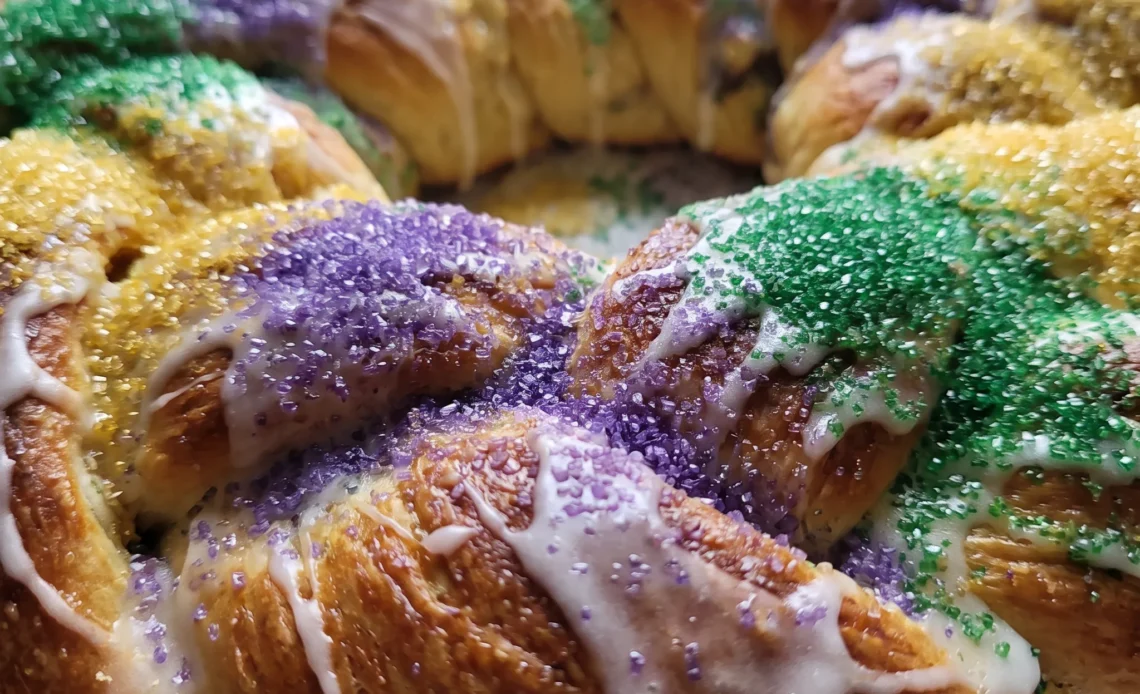
The most common way a mardi gras king cake goes wrong happens before the oven: the dough gets overfloured. It feels tacky, so you keep adding, and the crumb bakes up tight and dry.
A soft, slightly sticky dough is what you want, and knowing when to stop is the whole game. From there it’s two filled strips twisted into a braid and shaped into an oval, because a single log bakes with gaps and empty pockets. The colors and the baby come later, and the baby goes in after baking, never before.
Get the dough right and the rest is decoration.
The filling contains melted butter and sugars that liquefy at oven temperature, so any unsealed edge or gap in the twisted braid becomes a path for the filling to run out. Sealing the ends and pinching the seam creates a continuous dough barrier that contains the filling as it expands and cooks. Without that seal, the filling leaks onto the baking sheet, leaving dry, hollow sections in the cake and burnt sugar on the parchment.
Why twist filled dough into a braid?
Rolling two strips with cinnamon filling and twisting them into a braid isn’t just for looks. A single filled log often bakes with gaps and uneven filling.
The twist spreads the filling through the dough, so every slice gets some. Sealing the ends and pinching the seam keeps the filling from leaking out during baking. Forming the braid into an oval mimics the traditional king cake shape and helps the cake bake evenly.
When you cut into it, you see spirals of cinnamon sugar, not pockets of emptiness. The braid also gives the cake a more interesting texture, with crisp edges and soft interior. If you skip the twist, you might end up with a dense log that bakes unevenly.
But with the braid, the cake bakes into a, even ring that’s ready to frost and decorate.
What do the purple, green, and gold sugars mean?
The colors of Mardi Gras aren’t random. Purple stands for justice, green for faith, and gold for power.
These meanings go back to the 1890s, when they were chosen to represent the values of the celebration. Sanding sugar is used because it’s coarse and sparkly, giving the cake a festive look without melting into the frosting. Unlike granulated sugar, which would dissolve, sanding sugar stays put and adds a pleasant crunch.
You sprinkle the sugars while the frosting is still wet so they stick. The result is a cake that’s as much a visual treat as a tasty one. The contrast of the white frosting and the bright sugars makes the king cake instantly recognizable.
Each slice gets a bit of the sugary topping, so every bite has that slight crunch and sweetness.
The plastic baby tradition and safety
Hiding a small plastic baby in a king cake is a long-standing tradition. Whoever finds it is said to have good luck and is responsible for bringing the next year’s cake.
The baby is inserted after baking, through the underside, so it doesn’t melt or become a hazard during baking. But that baby can be a choking hazard, especially for young children. Always warn your guests, and if kids are around, consider using a larger token or skipping it altogether.
To serve fairly, cut from the bottom so the baby is distributed randomly. Some hosts announce that the baby is in the cake and to eat carefully.
The fun is in the surprise, but safety comes first. When you slice the cake, you might be the one who finds it, and then it’s your turn to host next year.
Why is the frosting more like a glaze?
The frosting for a king cake is thinner than buttercream, more like a glaze. Powdered sugar, milk, melted butter, lemon juice, and vanilla make a smooth, pourable mixture.
The lemon juice adds a subtle tang that cuts through the sweetness of the cake and the sanding sugars. This frosting needs to be thick enough to stay on top but thin enough to drizzle and spread gently.
It also acts as a glue for the sanding sugars, so you have to apply them while the frosting is still wet. If the frosting is too thick, it won’t spread easily; too thin, and it runs off the cake. The goal is a consistency that coats the back of a spoon but still flows.
Once you drizzle it over the cooled cake, you have a glossy base for the colorful sugars. The frosting sets slightly as it sits, holding everything in place.
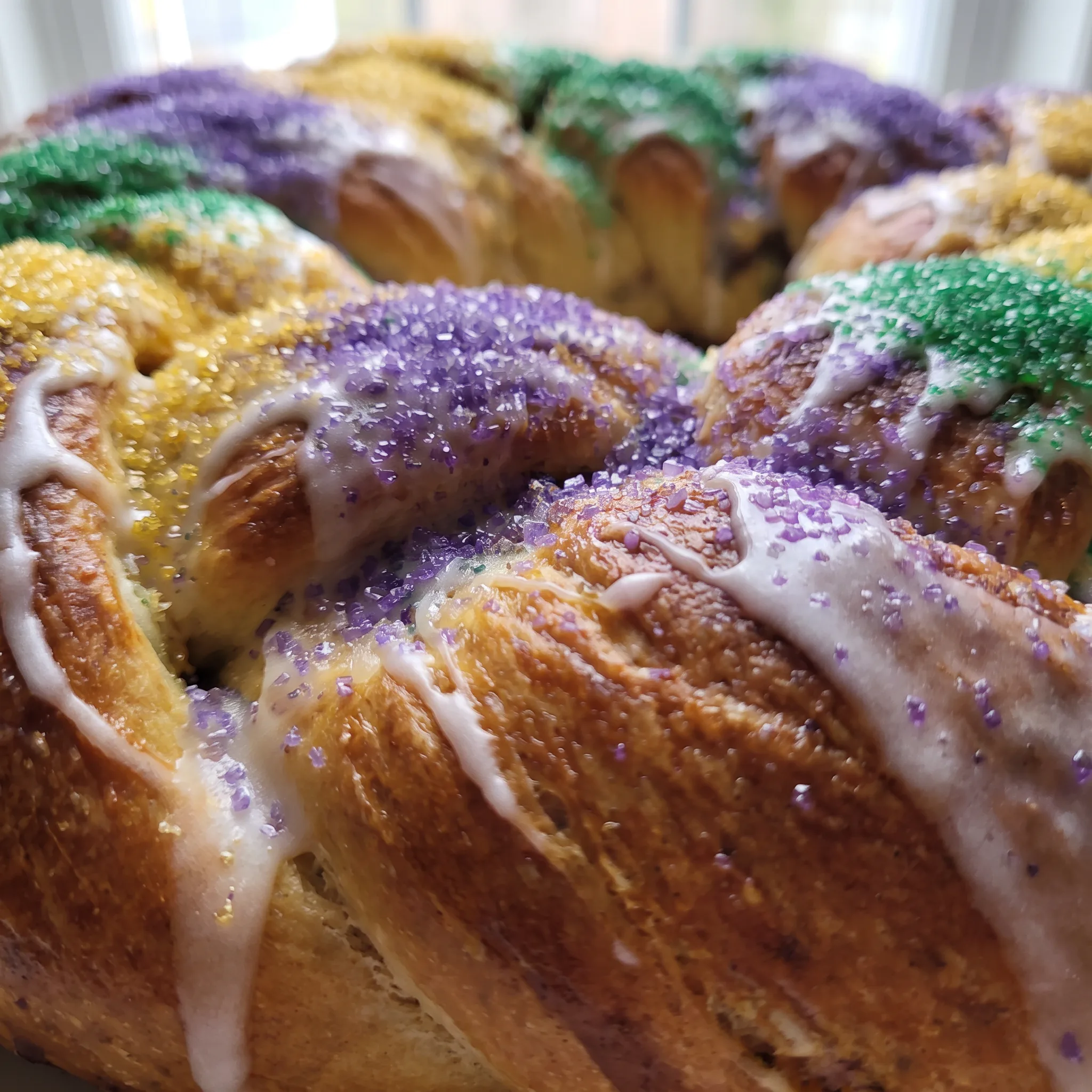
Four ingredients where the wrong pick shows up in the bake
Active dry yeast: Check the expiration date and proof it in the warm water with a spoonful of the sugar before it goes anywhere near the flour.
Vanilla bean paste: The paste carries visible seed flecks that extract lacks, and it goes into both the dough and the frosting.
Sanding sugar: Coarse sanding sugar in purple, green, and gold sits on the frosting; finer granulated sugar dissolves into it instead.
Salted butter: The recipe uses salted butter in the dough, filling, and frosting, so skip any extra salt beyond the measured kosher salt.
Read the dough, the rise, and the bake, not the clock
Judging when the dough has absorbed enough flour
Stop adding flour the moment the dough clears the bowl sides and feels tacky, not sticky. Overflouring makes a stiff, dry cake that bakes up dense. If you’ve already added too much, a teaspoon of water kneaded in can loosen it, but the texture won’t fully recover.
The dough should be soft enough to slump slightly when you lift it.
Knowing when the dough has doubled properly
Doubled means the dough domes above the bowl rim and a gentle press leaves an indent that springs back slowly. Under-risen dough bakes tight and heavy; over-risen dough smells yeasty and collapses when you punch it down. If your kitchen is cool, the 1 to 2 hours can stretch longer.
Judge by the look and feel, not the timer.
Reading the final rise before baking
After shaping, the cakes should look puffy and the dough should barely spring back when poked. If they’re still tight, give them more time; if they’ve over-proofed, they’ll deflate in the oven. The 30 to 45 minutes is a guide, but the poke test tells you more.
Underproofed cakes bake up dense; overproofed ones collapse.
Telling when the cake is baked through
Golden brown on top isn’t enough. The real test is an internal temperature of 190°F to 195°F.
Below that, the center is doughy; above, it dries out. If you don’t have a thermometer, tap the bottom: a hollow sound means it’s done. Cool completely before frosting or the glaze will slide off.
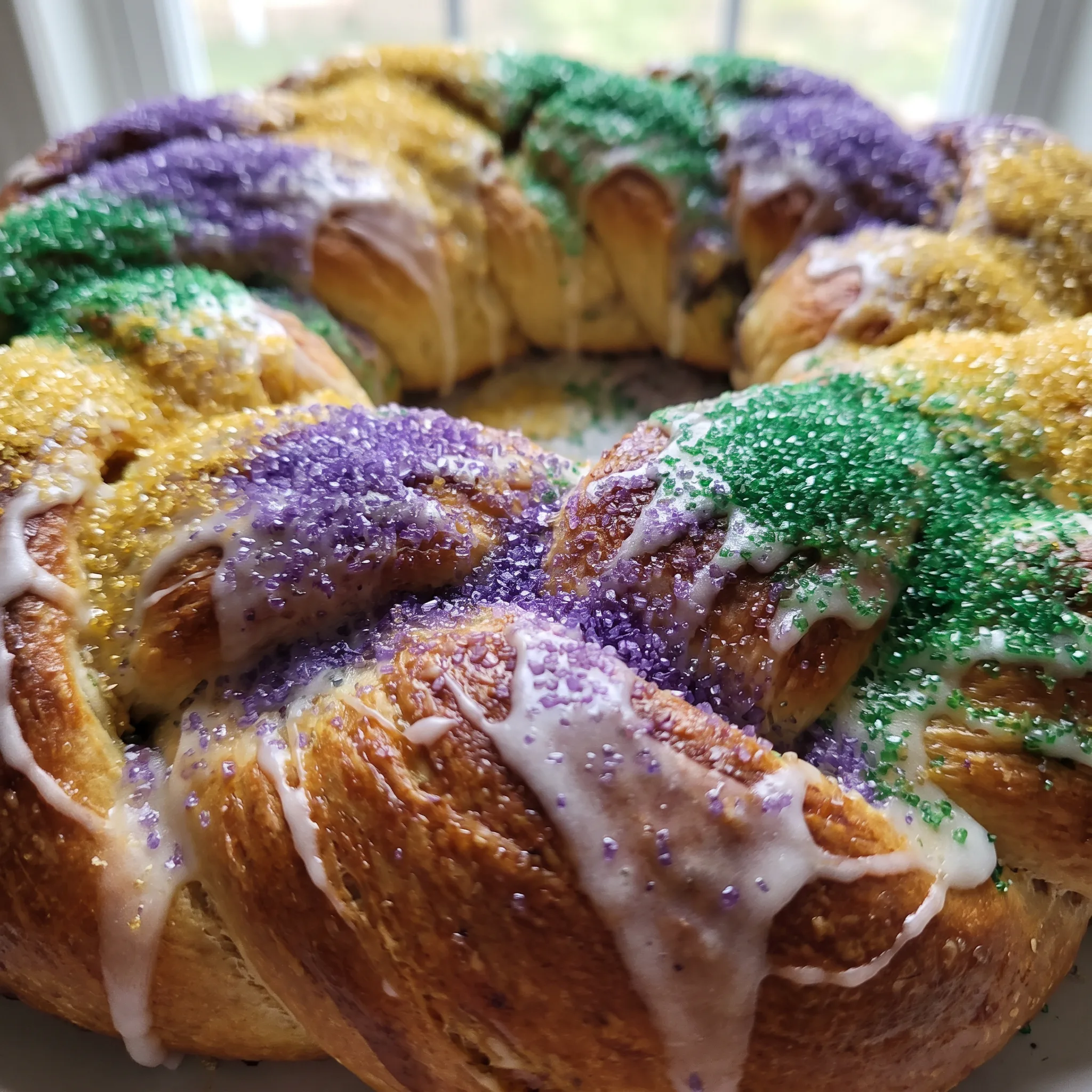
Mardi Gras King Cake with Cinnamon Filling
Ingredients
Method
- In a microwave-safe bowl, heat the milk and butter until the butter is melted and the mixture is warm, about 60–90 seconds.
- Add the salt and stir, then let cool until just warm to the touch (about 120°F (50°C)–130°F (55°C) / 49°C–54°C).
- In another bowl, mix the warm water, about 1 tablespoon of the granulated sugar, and the yeast; stir and let stand 5–10 minutes until foamy.
- To the yeast mixture, add the milk mixture, the remaining granulated sugar, eggs, and vanilla.
- Stir in 1 cup of the flour until combined.
- Keep adding flour about 1 cup at a time, mixing and kneading until a very soft dough forms and begins pulling away from the sides of the bowl; add the remaining ½ cup flour only if the dough is excessively sticky.
- Knead with a dough hook on medium speed for about 5 minutes, or by hand for 8–10 minutes, until smooth and elastic.
- Form the dough into a ball, place in a lightly oiled bowl, turn to coat, and cover.
- Let rise in a warm place until doubled in size, 1–2 hours.
- In a bowl, combine the brown sugar, granulated sugar, flour, cinnamon, and melted butter.
- Mix until evenly blended and crumbly.
- Set aside.
- Line two baking sheets with parchment paper.
- Punch down the risen dough and divide it in half.
- On a lightly floured surface, roll one half into a rectangle approximately 10 × 16 inches.
- Cut the rectangle lengthwise into two long strips.
- Sprinkle the cinnamon filling evenly over both strips.
- Roll each strip tightly into a log, seam side down.
- Twist the two logs together to form a braid, then shape into an oval and pinch the ends to seal.
- Transfer to a prepared baking sheet.
- Repeat with the remaining dough and filling.
- Cover loosely and let rise until puffy, 30–45 minutes.
- Preheat the oven to 350°F (175°C).
- Bake the king cakes for 25–30 minutes, until golden brown and baked through.
- An internal temperature of 190°F (90°C)–195°F (88°C–91°C) indicates doneness.
- Cool completely before frosting.
- Whisk together the powdered sugar, milk, melted butter, lemon juice, and vanilla until smooth.
- Adjust with additional milk if needed to achieve a thick but pourable consistency.
- Insert a small plastic baby into the underside of each cake, if using.
- Drizzle the frosting over the cooled cakes and spread gently if needed.
- Decorate with purple, green, and gold sanding sugar while the frosting is still wet.
- Slice and serve.
What You Can Swap in a King Cake Dough and Glaze Without Ruining the Batch
Active dry yeast: Instant yeast works, but it doesn’t need proofing. Use the same amount: 1 tablespoon.
Skip the step where you dissolve it in warm water with a spoonful of sugar and let it foam. Instead, whisk the instant yeast into the flour, then add the warm water and other liquids.
The dough will rise a bit faster, so start checking at 45 minutes. The crumb comes out the same if you catch the rise in time. Wait too long and the dough smells boozy and collapses when you punch it down.
If you use instant yeast and still proof it, you’ll lose some of its power before it ever hits the flour.
Salted butter: Unsalted butter is fine. Use the same amount: ¼ cup (57 g) in the dough, 4 tablespoons (57 g) in the filling, and 1 tablespoon (14 g) in the frosting. Add an extra ¼ teaspoon kosher salt to the dough, and a pinch (about ⅛ teaspoon) to the filling and frosting.
If you keep the measured kosher salt as written and just swap in unsalted butter without adding any, the cake tastes flat. Without that extra salt, the sweetness reads one-dimensional.
The filling tastes like plain sugar and cinnamon. The frosting lacks the little savory edge that keeps it from being cloying.
Vanilla bean paste: Vanilla extract works in both the dough and the frosting. Use the same amount: 2 teaspoons in the dough, 1 teaspoon in the frosting.
The paste has visible seed flecks and a slightly thicker body; extract is thinner and clear. Bourbon or rum extract can stand in, but start with half the amount and taste the dough before adding more. You lose the little dark specks and the deeper, almost caramel note the paste brings.
The cake still tastes like vanilla, just cleaner and simpler. If you use a strong extract and don’t cut it back, the dough can taste like perfume.
Lemon juice: Bottled lemon juice works in the frosting. Use the same amount: 1 teaspoon.
Fresh juice has a brighter, sharper bite; bottled is flatter and sometimes slightly bitter. If you’re out of both, leave it out entirely and add an extra ½ teaspoon of milk to keep the glaze pourable.
The frosting loses its tang. It still sets and holds the sanding sugars, but the sweetness hits harder. Without any lemon, the glaze tastes like powdered sugar and milk, which is fine but less interesting against the cinnamon filling.
Tips
- Flour absorbs humidity, so the same 5 cups behaves differently in July and January. Before you decide the dough needs that last half cup, wet your hands and knead for a full minute. If it stops grabbing your palms and pulls clean, it has enough flour. Adding the extra half cup too early makes a dough that kneads stiff and bakes tight, and no amount of resting fixes it.
- Set the covered bowl somewhere you walk past, not in a closed oven or a proofing box. The dough is ready when it domes above the rim and a floured finger pressed an inch in leaves a dent that fills back slowly. Checking it every 20 minutes from the one-hour mark tells you more than the timer, because the same dough rises in 70 minutes in a warm kitchen and 2 hours in a cool one.
Storing, Freezing, and the Serving Window
Frosting and sanding sugar are the clock on this cake. Eat it the day it’s decorated for the best texture: the sugars stay crisp and the crumb is at its softest. The frosting does glue the sugars on while it’s wet, so decorate right after you drizzle, and plan to serve within a few hours.
Leftovers keep at room temperature, loosely covered, for a day or two. The cut faces stale first, and the sanding sugars pull moisture from the frosting and soften into something dull. Press plastic wrap against those cut edges to slow it.
For a next-day serving, slice and warm individual portions for 10 to 15 seconds; the crumb loosens without melting the sugar. The frosting is the part that suffers in the fridge, so skip it unless the kitchen is hot.
The unfrosted baked rings freeze well for up to a month, wrapped tight. Thaw them at room temperature, then frost, sugar, and serve the same day.
Frequently Asked Questions
Can I make king cake ahead of time?
Bake the rings ahead, not the finished cake. The unfrosted rings freeze well for up to a month, wrapped tight, and thaw at room temperature before you frost, sugar, and serve them the same day.
Hold off on the glaze and the sanding sugars until serving day: the frosting is what glues the sugars on while it’s wet, and once decorated the sugars start pulling moisture and softening. If you frost early, you lose the crunch that makes the topping worth having.
Why did my king cake turn out dry?
Overflouring is the usual culprit. The dough should clear the bowl sides and feel tacky, not sticky; if you kept adding flour past that point, or used the full 5½ cups when the dough had already come together, the crumb bakes tight and dry.
Measure by spooning flour into the cup and leveling it, since a packed cup can add a lot. The other check is the bake itself: the center needs to reach 190°F to 195°F, and past that the cake dries out even if the dough was right.
If the dough was already overfloured, a teaspoon of water kneaded in can loosen it, but the texture won’t fully recover.
What’s the difference between a king cake and a cinnamon roll?
Shape and assembly set them apart more than the dough does. A cinnamon roll is a single spiral, cut into individual rounds and baked close together so the sides stay soft.
This cake rolls two filling-covered strips, twists them into a braid, then forms one large oval ring per half batch, so you get a sliceable cake rather than separate buns. The finish is different too: a pourable glaze and coarse purple, green, and gold sanding sugar instead of a thick spread frosting. That’s why a king cake reads as a celebration cake you cut into wedges, not a breakfast pastry you pull apart.
